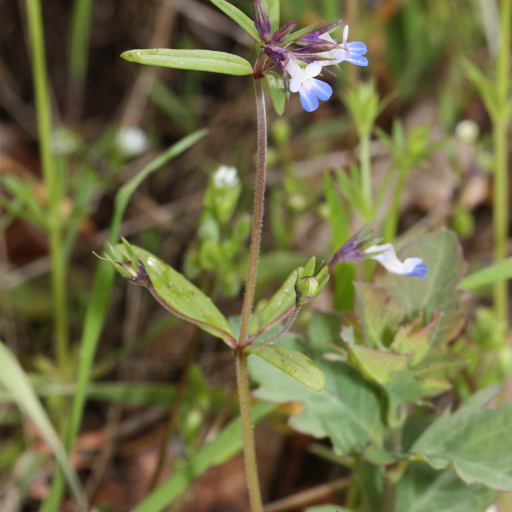
Plant Overview
Often called the "Maiden Blue-eyed Mary," this tiny wildflower is a delightful herald of spring across North America. Despite its miniature size, its striking two-toned flowers can carpet forest floors and rocky slopes in a delicate mist of blue and white. It belongs to the same family as snapdragons, which explains its curious, "pouty" hooded floral shape.
🔍 How to Identify
- 🌸 The Bi-Colored Bloom: The flowers are small (only about 5-8mm) with a white upper lip and a deep blue or violet lower lip.
- 🍃 The Leaves: Small, narrow, and lance-shaped. They usually grow in opposite pairs along the stem and can sometimes take on a reddish or purplish tint in bright sun.
- 🌱 Growth Habit: A low-growing annual that typically stands only a few inches tall. Its stems are slender and can be slightly hairy, often sprawling across the ground before turning upward.
🏡 In Your Garden
- 🪨 The Rocky Specialist: This plant loves "thin" soil. You’ll often find it in mossy rocky outcrops or open woodlands where other plants struggle to take root.
- 💧 The Ephemeral Life: As a spring ephemeral, it completes its life cycle quickly. It relies heavily on winter and spring moisture; once the heat of mid-summer hits, the plant will go to seed and disappear until next year.
- 🐝 Early Pollinators: Because it blooms so early, it provides a vital "first meal" for small native bees and beeflies that emerge while other flowers are still dormant.
⚠️ Safety & Toxicity
- ✅ Status: Generally considered non-toxic.
- 🐾 Details: There are no known reports of toxicity toward dogs, cats, or horses. However, it is a delicate wildflower and not intended for human consumption. It is best enjoyed visually to allow it to drop seeds for the following season.
✨ Fun Fact
The genus name Collinsia was chosen to honor Zaccheus Collins, a 19th-century botanist from Philadelphia. While the flowers look like they require complex pollination, they are actually highly efficient at self-pollinating if an insect doesn't visit them!

Detailed Care Instructions
To grow Collinsia parviflora, commonly known as blue-eyed Mary, follow these steps:
- Location: Choose a spot that receives partial shade to full sunlight. This plant can tolerate different soil types but prefers well-drained, fertile soil.
- Planting: Plant the seeds in early spring after the danger of frost has passed. Scatter the seeds on the soil surface or sow them at a depth of 1/8 inch. Keep in mind that Collinsia self-seeds, so be mindful of its spreading habit.
- Watering: Water the seeds and seedlings regularly to keep the soil moist but not soggy. Once the plant is established, it can tolerate dry spells but will benefit from occasional watering during prolonged periods of drought.
- Mulching: Mulch around the plants to help retain moisture and suppress weeds. Use a layer of organic mulch like wood chips or straw, keeping it a few inches away from the plant stems.
- Maintenance: Remove any weeds that compete with Collinsia for nutrients and water. Deadhead the faded flowers regularly to encourage new blooms. This will also prevent self-seeding if you want to control the plant's spread.
- Fertilization: Collinsia plants do not require heavy fertilization. However, you can apply a balanced, slow-release fertilizer in spring to provide some additional nutrients for optimal growth.
- Pests and diseases: Collinsia is generally resistant to most pests and diseases. However, watch out for slugs, snails, and aphids. If necessary, treat the plant with organic pest control methods.
- Propagation: If you want to propagate more Collinsia plants, collect seeds from mature seedpods and sow them in new areas or containers.
By providing adequate sunlight, regular watering, and proper maintenance, you can successfully grow Collinsia parviflora in your garden, enjoying its beautiful blue flowers.

Place in a window with dappled sun or a spot in the middle of a room. Or directly in a window facing west or east.

1. Check the soil moisture level of the plant by gently inserting a finger into the soil up to your first knuckle. If the soil feels dry, it's time to water the plant.
2. Use a watering can or a hose with a gentle spray nozzle to avoid damaging the plant. Aim the water flow at the base of the plant, not directly on the leaves or flowers.
3. Water the plant deeply, until the water saturates the soil. Avoid overwatering, as it can lead to root rot and other diseases.
4. Let the soil dry out slightly between watering sessions, but don't allow it to completely dry out. Collinsia Parviflora prefers moist soil.
5. Consider using a mulch around the base of the plant to help retain moisture in the soil. This will also prevent weeds from sprouting.
6. Water with care during the summer months, when the plant may go dormant due to hot weather. Reduce watering frequency during this time.
7. Finally, observe the plant regularly for signs of overwatering or underwatering. Wilting or yellowing leaves may indicate that the plant needs more or less water.
To fertilize this plant, apply a balanced fertilizer every two weeks during the growing season. Use a low-nitrogen fertilizer, as too much nitrogen can lead to excessive foliage growth and fewer flowers. Water the plant before and after fertilizing to prevent fertilizer burn. Avoid fertilizing during winter, as the plant enters a period of dormancy.
Collinsia Parviflora grows best in well-draining, slightly acidic soil with a pH between 5.5 and 6.5. The soil should be fertile and rich in organic matter. It's important that the soil is consistently moist, but not waterlogged or overly wet, as this can lead to root rot. A good mix for this plant would consist of loamy soil mixed with compost, peat moss, or aged manure. It's also recommended to top dress with organic fertilizer during the growing season to promote healthy growth and blooms.
To propagate this plant, take cuttings of approximately 4-6 inches in length from the stem of a healthy, mature plant. Make sure to use a sterilized sharp blade to do this.
Remove the lower leaves from the cutting, leaving only a few leaves at the top intact. Dip the cut end of the stem into rooting hormone powder and then plant it into a potting mix that is well-draining and nutrient-rich.
Keep the cutting in a humid environment by placing a plastic bag over the pot or misting it with water frequently. Place the pot in indirect sunlight or in a location where it receives bright, filtered light.
In about 2-3 weeks, roots should start to develop from the stem. Once the cutting has rooted and started to grow new leaves, it can be transplanted into a larger pot or to its desired location in the garden.








