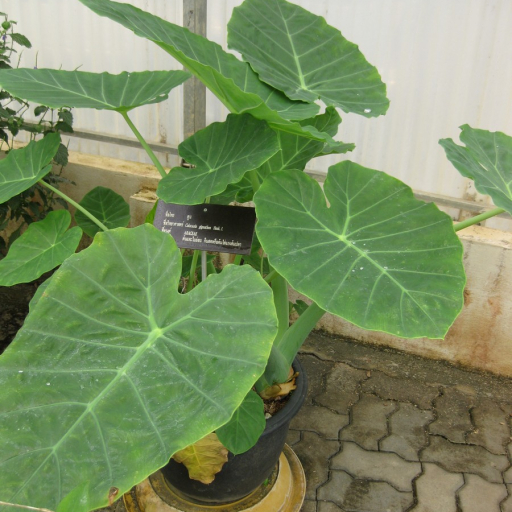
Plant Overview
Known as the "Thailand Giant," Colocasia gigantea transforms any ordinary backyard into a lush, prehistoric jungle. Originating from the warm rainforests of Southeast Asia, these titans are famous for their colossal leaves that look like they belong in a dinosaur movie. Unlike its smaller cousins, this species is a fast-growing architectural marvel that commands attention with its sheer scale and vibrant green presence.
🔍 How to Identify
- 🍃 Gargantuan Foliage: The leaves are heart-shaped (sagittate) and can reach lengths of 5 to 6 feet. They are a soft, matte light green with a slightly "dusty" or glaucous texture.
- 📏 Sturdy Petioles: The leaf stalks (petioles) are thick, succulent, and pale green, growing directly from a massive underground tuber to support the weight of the heavy leaves.
- 🌼 Fragrant Blooms: Unlike many other elephant ears, this variety produces clusters of white, lily-like flowers (spathes) that carry a surprisingly sweet, pleasant perfume.
🏡 In Your Garden
- 💧 Thirst for Life: These plants are heavy drinkers. To maintain those massive leaves, they require consistently moist soil; they are even happy growing at the edges of ponds or in boggy areas where other plants might rot.
- 🍽️ Gluttonous Feeders: Because they grow so much biomass in a single season, they are "heavy feeders." They require rich, organic compost and regular fertilizing to reach their record-breaking potential.
- 🌡️ Tropical Temperament: They lack a "dormancy" switch compared to other Colocasia. They hate the cold and will stop growing or die back if temperatures drop below 50°F (10°C), making them best suited for large pots in cooler climates.
⚠️ Safety & Toxicity
- 🐾 Toxic to Pets and Humans: Like most members of the Araceae family, the entire plant contains raphides—needle-like crystals of calcium oxalate.
- ✋ Irritation Risk: If bitten or chewed, it causes immediate intense pain, swelling of the mouth/throat, and digestive distress. The sap can also cause mild skin irritation or "itchiness" for some gardeners, so wearing gloves during pruning is recommended.
✨ Fun Fact
In Southeast Asian cuisine, particularly in Vietnam, the fibrous stalks of certain varieties of Colocasia gigantea (known as bạc hà) are used in soups and stir-frys after the outer skin is peeled to remove the stinging crystals!

Detailed Care Instructions
| Humidity | Normal |
| Difficulty | Medium |
| Temperature | 18°C - 23°C |
| Hardiness Zones | 8 - 10 |
Here are some steps to help you grow Colocasia Gigantea (also known as Elephant Ear) plants:
- Choose the right location: Colocasia Gigantea plants prefer a warm, humid climate and thrive in full or partial sun. They can be grown outdoors in USDA hardiness zones 8-10. Ensure the planting area has well-draining soil and protection from strong winds.
- Planting: When planting Colocasia Gigantea, ensure the soil is consistently moist but not waterlogged. Dig a hole that is about twice the size of the plant's root ball and place the plant in the hole. Backfill the hole with soil, gently patting it down around the plant's roots.
- Watering: These plants require regular watering to keep the soil consistently moist. However, they are susceptible to root rot if the soil becomes waterlogged. Water deeply and allow the top layer of soil to dry out slightly between waterings. During warmer months, you may need to water more frequently.
- Fertilizing: Colocasia Gigantea plants are heavy feeders and benefit from regular fertilization. Use a balanced, soluble fertilizer or a slow-release granular fertilizer according to the manufacturer's instructions. Apply fertilizer every 4-6 weeks during the growing season.
- Mulching: Apply a layer of organic mulch around the base of the plant to help retain moisture and suppress weed growth. This will also help protect the plant during colder months.
- Provide adequate space: Colocasia Gigantea plants can grow quite large, with leaves reaching up to 5 feet in length. Ensure you provide enough space for the plant to grow without becoming crowded.
- Pest and disease control: Watch out for pests such as aphids, spider mites, and caterpillars, which can occasionally infest Colocasia Gigantea. Regularly inspect the leaves and stems and use organic pest control methods, if necessary. Colocasia plants are also susceptible to fungal diseases, so ensure good air circulation and avoid overhead watering to prevent issues.
- Winter care: In colder climates, Colocasia Gigantea plants are often grown as tropical ornamentals and may need protection during winter. If you live in a region with freezing temperatures, plan to dig up the tubers in the fall before the first frost. Store them in a cool, dry place (such as a basement or garage) over the winter and replant them in the spring after the danger of frost has passed.
By following these steps, you can successfully grow and enjoy your Colocasia Gigantea plant.

Place in a window with dappled sun or a spot in the middle of a room. Or directly in a window facing west or east.

To water this plant, one should thoroughly saturate the soil around the base of the plant, taking care not to splash water onto the leaves or stem. Additionally, this plant requires consistent moisture, so it is important to monitor the soil moisture level and water as needed to prevent the soil from drying out. Overwatering should also be avoided, as this can lead to root rot and other problems. In general, a good rule of thumb is to allow the top inch of soil to dry out slightly before watering again.
- Choose a balanced, water-soluble fertilizer with a ratio of 10-10-10 or 20-20-20.
- Dilute the fertilizer according to package instructions.
- Water the plant thoroughly before fertilizing to prevent burning the roots.
- Apply the diluted fertilizer to the soil around the base of the plant.
- Avoid getting any fertilizer on the leaves or stem of the plant.
- Repeat the fertilizing process every 2-3 weeks during the growing season.
- Decrease fertilization during the winter months when the plant is dormant.
- Monitor the plant for any signs of fertilizer burn, such as brown or yellow leaves, and adjust the amount of fertilizer as needed.
When planting the Colocasia Gigantea plant, it is important to use a well-draining soil that is rich in organic matter. The soil should be slightly acidic with a pH between 5.5 and 6.5.
A good soil mix for this plant would be a blend of peat moss, perlite, and compost or well-rotted manure. The peat moss will help retain moisture while the perlite will provide good drainage. The compost or manure will add nutrients to the soil and improve its texture.
It is also important to ensure the soil is free of any pests or diseases before planting the Colocasia Gigantea plant. This can be done by sterilizing the soil in an oven or microwave before use, or by purchasing sterilized soil from a garden center.
Overall, the soil used for Colocasia Gigantea should be a nutrient-rich, well-draining, slightly acidic mix that is free of pests and diseases.
One way to propagate this plant is through root division. To do this, first carefully dig up the plant and separate the roots into smaller sections, ensuring that each section has several healthy shoots and roots. Plant each section in a pot or directly into the ground, keeping the soil moist until new growth emerges. Another method is through stem cuttings. Cut a mature stem with a sharp, clean knife and place it in a jar of water, ensuring that at least one node is submerged. After a few weeks, roots should start to grow from the node. Once the roots are established, the cutting can be planted in soil. Both of these methods are best done in the spring or early summer, when the plant is actively growing.
Common pests of the elephant's-ear include Mealybugs, spider mites, fungus gnats, thrips. Make a habit of checking your elephant's-ear frequently for pests so that any infestations can be caught and managed early.








