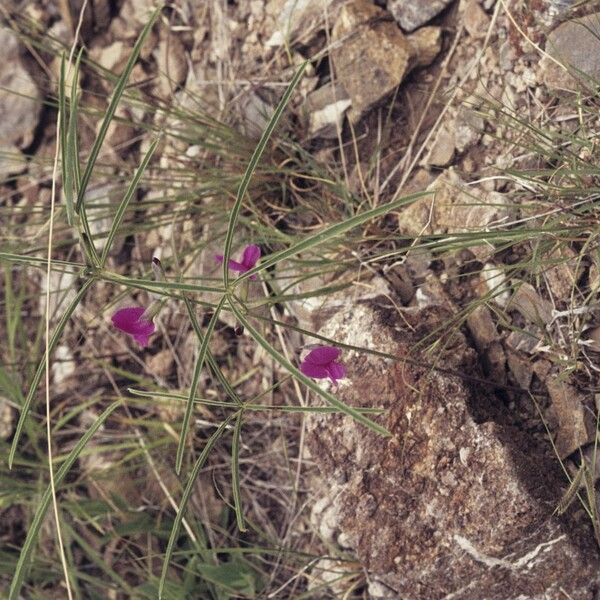
Plant Overview
Known as the Longleaf Cologania, this slender beauty is a master of disguise in the wild. Often found weaving through the high-altitude grasses of the American Southwest and Mexico, it remains almost invisible until its vibrant, orchid-like flowers pop against the landscape. It is a resilient survivor, perfectly adapted to the rocky slopes and pine-oak woodlands of its native range.
🔍 How to Identify
- 🌿 Narrow Foliage: True to its name (angustifolia means narrow-leafed), its leaves are exceptionally thin and linear, appearing in the classic "clover" set of three leaflets.
- 🌸 Pea-Shaped Blooms: The flowers are a striking shade of violet or reddish-purple. They have a prominent "banner" petal that stands upright to signal pollinators.
- 🧵 Wiry Stems: It grows on delicate, twisting stems that either trail along the dusty ground or use nearby stalks of grass for support.
🏡 In Your Garden
- ⛰️ Natural Setting: In the wild, it thrives in well-drained, rocky soils. If you find it appearing in your landscape, it is a sign of a healthy, sunny ecosystem with excellent drainage.
- 🤝 Soil Enricher: As a member of the legume family, it works with specialized soil bacteria to "fix" nitrogen. This means it actually improves the soil quality for neighboring plants by pulling nutrients from the air into the earth.
- 🧱 Taproot Sensitivity: This plant develops a deep, sturdy root system to survive droughts. Because of this, it hates being moved. If you are lucky enough to have it growing, avoid transplanting it, as the taproot is easily damaged.
⚠️ Safety & Toxicity
- 🐾 Mildly Concerning: While not listed as a high-threat toxin, many wild legumes contain compounds that can cause digestive distress if ingested by pets or livestock.
- 🚫 Not for Foraging: There is no recorded history of this plant being edible for humans. The seed pods may look like tiny garden peas, but they should never be consumed.
✨ Fun Fact
The Longleaf Cologania is an expert at "self-insurance." It produces two types of flowers: the showy purple ones that require bees, and tiny, hidden flowers near the soil surface that never open. These hidden flowers self-pollinate in secret, ensuring the plant produces seeds even if the weather is too cold for bees to fly!

Detailed Care Instructions

Place in a bright room that is sun drenched almost all day. Or directly in a south-facing window.

Some plants require more regular watering than others, which should be done every few days. It's critical to maintain the soil moist all of the time. The water requirements of the same plant placed in pots with varying sizes will differ. Because the water in the smaller pot evaporates faster than the water in the larger pot, it will require more watering. Regardless of pot size, the surface should constantly be maintained moist.








