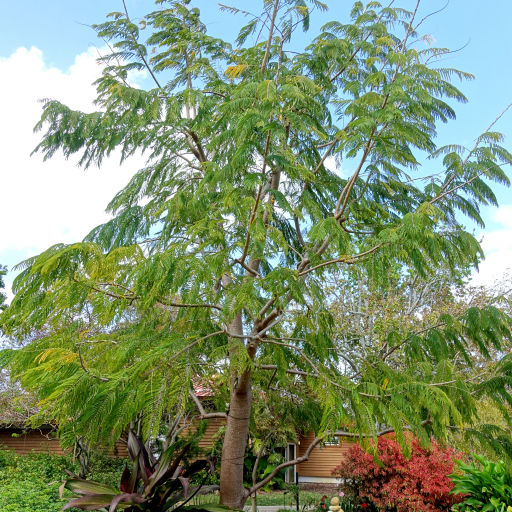
Plant Overview
Named the "Colville's Glory," this majestic Madagascan native is often considered the "holy grail" for tropical gardeners. While its feathery foliage mimics the popular Royal Poinciana, it waits until the heat of late autumn to reveal its true splendor. It is a tree of patience and drama, turning landscapes into a fiery spectacle when most other flowering trees have already faded.
🔍 How to Identify
- 🏮 Velvety Buds: Before the flowers open, they appear as dense, drooping clusters of bright orange spheres that look like clusters of exotic grapes or velvet beads.
- 🌿 Lacy Foliage: The leaves are large, bipinnate, and fern-like, creating a soft, airy canopy that filters sunlight into a dappled pattern on the ground.
- 🗼 Conical Blooms: Unlike the flat-topped flowers of its cousins, Colville’s Glory produces long, cylindrical flower spikes (racemes) that can reach over a foot in length, hanging heavily from the branch tips.
🏡 In Your Garden
- ☀️ Patience for Blooms: This isn't a tree for the impatient gardener; it can take several years to reach maturity before it produces its first flower. It requires a permanent home in full sun to gather enough energy for its massive late-season display.
- 🪴 Space Requirements: Because it develops a thick trunk and a wide-spreading crown, it needs plenty of room to breathe. Avoid planting it too close to power lines or structures, as it aims for the sky and needs "elbow room" to show off its drooping blossoms.
⚠️ Safety & Toxicity
- 🟢 Generally Safe: Colville’s Glory is not known to be toxic to humans or common household pets like cats and dogs upon contact.
- 🥜 Seed Caution: As a member of the legume family, it produces long woody pods. While not specifically listed as highly poisonous, the seeds should never be ingested by children or pets, as many seeds in this family contain compounds that can cause digestive distress.
✨ Fun Fact
The tree was named in honor of Sir Charles Colville, a British General and Governor of Mauritius in the 1830s. Despite its beauty, it is actually quite rare in its original wild habitat in Madagascar, making garden specimens important for the species' continued visibility!

Detailed Care Instructions
To grow Colvillea racemosa plants, also known as the Colville's glory tree or the Colvillea plant, you can follow these steps:
- Climate: Colvillea racemosa plants thrive in a warm climate and require temperatures above 50°F (10°C) year-round. They are native to tropical regions, so they need a lot of sunlight and warmth to grow.
- Planting: Choose a sunny spot in your garden where the plant can receive full sun for most of the day. Make sure the soil is well-draining and of good quality. Dig a hole twice as wide and deep as the current root ball of the plant.
- Soil Preparation: Mix organic compost or well-rotted manure into the soil to improve its fertility and drainage. This will help the plant establish strong roots.
- Planting Process: Gently remove the Colvillea racemosa plant from its container. Place the root ball into the prepared hole and ensure it is at the same level it was in the container. Backfill the hole with soil, firming it gently around the roots.
- Watering: After planting, give the plant a thorough watering. Water it regularly, especially during dry periods. Colvillea racemosa plants prefer moist soil but should not be overwatered, as that can cause root rot.
- Pruning: Once the plant is established, you may need to prune it occasionally to maintain its shape and size. Remove any dead or damaged branches and trim back any overgrown areas. Pruning in early spring or late winter is usually recommended.
- Fertilizing: Apply a balanced, slow-release fertilizer in early spring to promote healthy growth. Follow the instructions on the fertilizer packaging for proper dosage and application.
- Pests and Diseases: Colvillea racemosa plants are generally resistant to pests and diseases. However, it's always a good idea to keep an eye out for common garden pests like aphids or spider mites. Treat any infestations promptly using appropriate organic or chemical controls.
Remember to regularly monitor the plant's growth and provide any necessary care throughout the growing season. With proper care, your Colvillea racemosa plant should thrive and provide beautiful flowering displays.

Place in a bright room that is sun drenched almost all day. Or directly in a south-facing window.

1. Determine the watering needs of the Colvillea Racemosa plant by considering its growth stage, environmental conditions, and soil moisture levels.
2. Before watering, check the moisture content of the soil. Insert your finger about two inches into the soil near the root zone to assess if it feels dry or moist.
3. Use a watering can or hose with a gentle spray nozzle attachment to water the plant. Avoid using high pressure, as it can damage the plant's delicate foliage and root system.
4. Water the plant thoroughly, ensuring that the water reaches the entire root system. To achieve this, water the soil around the base of the plant, aiming to moisten the entire root ball.
5. Be cautious not to overwater the plant, as excessive moisture can lead to root rot and other water-related issues. Allow the soil to partially dry out between waterings, avoiding consistently wet conditions.
6. Water the plant more frequently during the summer months or during periods of increased heat. This might involve watering every 2-3 days, but always monitor the soil's moisture level to avoid excessive watering.
7. During the cooler months or winter season, the plant's water requirements may decrease. Reduce the frequency of watering and adjust to the plant's needs accordingly.
8. Pay attention to any specific watering instructions given by the plant's nursery or care guidelines, as certain Colvillea Racemosa cultivars may have slightly different watering preferences.
9. Consider the plant's location and the surrounding environment when watering. If it is planted in a container, ensure proper drainage by providing a drainage hole at the bottom. If the plant is outdoors, evaluate if rainfall is sufficient or if it requires supplemental watering.
10. Monitor the plant closely after watering to check for signs of stress or excessive moisture build-up. Look for symptoms such as wilting, yellowing leaves, or mushy root systems, which may indicate overwatering. Adjust the watering routine accordingly if necessary.
Remember that while water is essential for plant health, every plant has unique watering needs. It is vital to observe and understand the specific requirements of the Colvillea Racemosa plant to provide appropriate and effective watering care.
To fertilize Colvillea Racemosa, follow these instructions:
- Choose a balanced fertilizer with equal amounts of nitrogen (N), phosphorus (P), and potassium (K), ideally in a ratio of 10-10-10 or similar.
- Dilute the fertilizer according to the manufacturer's instructions. Typically, this involves mixing a specific amount of fertilizer with water.
- Apply the diluted fertilizer to the soil around the base of the Colvillea Racemosa plant. Avoid pouring it directly onto the foliage or flowers.
- Ensure that the soil is moist before applying the fertilizer to prevent root burn. If the soil is dry, water the plant thoroughly a day or two prior to fertilizing.
- Use the recommended dosage of fertilizer based on the size and age of the Colvillea Racemosa plant. This information is usually provided on the fertilizer packaging.
- Repeat the fertilization process every 4-6 weeks during the growing season, which typically spans from early spring to late summer. Avoid fertilizing during the dormant season.
- Monitor the plant's response to the fertilizer. If you notice signs of excessive foliage growth without proper flowering, reduce the frequency or dosage of fertilization.
- Additionally, consider testing the soil periodically to assess its nutrient levels and pH. Adjust the fertilizer application accordingly, based on the test results and any specific nutrient deficiencies.
Remember to always read and follow the instructions provided by the manufacturer of the fertilizer for the best results.
When cultivating Colvillea Racemosa plants, it is essential to choose the appropriate soil type to ensure their optimal growth and development. The preferred soil for this plant is a well-draining, loamy soil that is rich in organic matter. This type of soil provides a balanced combination of moisture retention and good aeration.
The soil should have a slightly acidic to neutral pH level, ranging from 6.0 to 7.0, as this is most suitable for the plant's nutrient uptake. This pH range allows for efficient absorption of essential minerals and promotes healthy root development.
To ensure proper drainage and prevent waterlogging, it is recommended to amend the soil with materials such as perlite, vermiculite, or sand. These amendments enhance the soil's structure and help prevent waterlogged conditions, which can be detrimental to the plant.
In terms of texture, the soil should have a loose and crumbly consistency that allows for easy root penetration. This promotes good aeration and enables the roots to access oxygen, which is vital for the plant's metabolic processes.
Additionally, incorporating organic matter into the soil composition improves its fertility and nutrient content. Organic matter, such as well-rotted compost or aged manure, enhances the soil's ability to retain moisture, promotes beneficial microbial activity, and provides slow-release nutrients to the plant.
It is important to note that Colvillea Racemosa plants are not tolerant of heavy clay soils, as these tend to retain excessive moisture and can lead to root rot. Therefore, it is best to avoid clay-based soils or improve them with organic matter and amendments to enhance their drainage capabilities.
Overall, selecting a well-draining, loamy soil with slightly acidic to neutral pH and enriching it with organic matter will provide an ideal growing medium for your Colvillea Racemosa plant, helping it thrive and flourish.
To propagate the plant scientifically known as Colvillea Racemosa, follow these steps:
- Gather the necessary materials: You will need a sharp, clean pair of pruning shears, a sterile knife or razor blade, a rooting hormone (optional), clean pots or containers, well-draining soil or a rooting medium such as perlite or vermiculite, and a plastic bag or propagation dome.
- Choose a healthy, mature Colvillea Racemosa plant for propagation. Look for a plant that has strong stems and is free from diseases or pests.
- Take semi-hardwood or hardwood cuttings from the parent plant during late spring or early summer. Select stems that are around 6-8 inches long and have several nodes or leaf joints.
- Using the pruning shears or sterile knife, make a clean diagonal cut just below a leaf node. Remove any leaves from the lower half of the cutting.
- Dip the bottom end of the cutting into a rooting hormone powder to encourage root development (optional).
- Prepare the planting medium by filling clean pots or containers with well-draining soil or a rooting medium like perlite or vermiculite.
- Create a planting hole in the soil with your finger or a clean tool. Insert the bottom end of the cutting into the hole, making sure that at least two nodes are buried beneath the soil.
- Gently firm the soil around the cutting to provide stability.
- Water the cutting thoroughly, ensuring that the soil is evenly moist but not waterlogged.
- Place a clear plastic bag or propagation dome over the cutting to create a mini greenhouse environment that will retain humidity. This will help prevent excessive moisture loss.
- Position the cuttings in a warm and brightly lit area, but avoid direct sunlight, as it may cause excessive heat buildup inside the propagation enclosure.
- Monitor the soil moisture regularly, ensuring it remains moist but not soggy. Mist the cutting occasionally to maintain humidity if necessary.
- After a few weeks, check for root development by gently tugging on the cutting. If you feel resistance, it indicates that roots have formed.
- Once roots have established, gradually acclimate the propagated plants to lower humidity and increase exposure to indirect sunlight over a week or two.
- Transplant the rooted cuttings into individual pots filled with well-draining soil or a suitable growing medium.
- Continue to care for the propagated plants by providing routine watering, suitable lighting, and regular fertilization according to their specific needs.
By following these steps, you can successfully propagate Colvillea Racemosa and expand your collection of these beautiful plants.








