Plant Overview
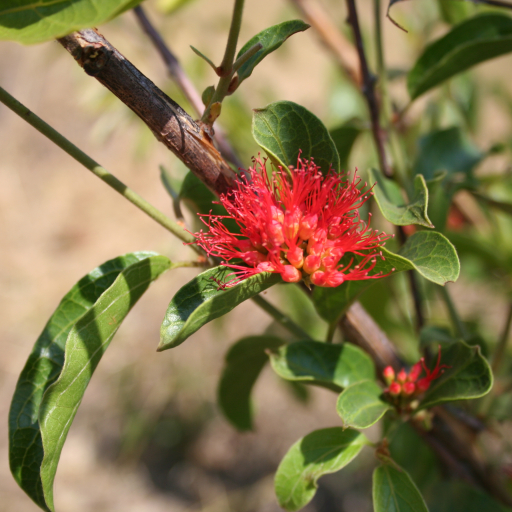
Imagine a forest canopy suddenly erupting in "flames." The Combretum paniculatum, often called the Flame Creeper or Forest Burning Bush, is a vigorous woody climber native to the tropical and southern regions of Africa. It is legendary among birdwatchers and gardeners for its spectacular ability to transform a green treeline into a sea of fiery scarlet during its peak blooming season.
🔍 How to Identify
- 🔥 The Flowers: Its most striking feature is the dense, horizontal spikes (panicles) of tiny, bright red flowers. The long, protruding stamens give the flower clusters a soft, brush-like or "fuzzy" appearance.
- 🍃 Leaf Structure: The leaves are large, simple, and opposite. They have a deep green, glossy finish and are often broadly elliptical, providing a lush backdrop for the red blooms.
- 🪜 Growth Habit: This is a powerful "scrambler." It uses its long, flexible branches to hook onto nearby trees and structures, quickly climbing high into the air to reach the sunlight.
🏡 In Your Garden
- 🏗️ Space and Support: Because of its vigorous nature, this plant needs a very sturdy trellis, a large fence, or a strong established tree to climb. It is not suited for small pots or cramped balconies.
- 🐦 Pollinator Magnet: If you want a garden filled with life, this is the plant for you. The nectar-rich flowers are an absolute favorite for sunbirds, butterflies, and bees, who will visit the "flames" daily.
- ✂️ Pruning Nuance: It can become quite wild if left to its own devices. Pruning after the flowering season helps maintain its shape and encourages more blooms to form closer to eye level rather than high up in the canopy.
⚠️ Safety & Toxicity
- 🟢 General Safety: Combretum paniculatum is generally considered non-toxic to humans and is even used in various traditional African medicines.
- 🐾 Pets & Kids: While not classified as a "poisonous" plant, the seeds and sap of many Combretum species can cause mild stomach upset if ingested or skin irritation in sensitive individuals. It is best to admire the "fire" without tasting it.
✨ Fun Fact
The name Combretum was originally used by the Roman naturalist Pliny the Elder. In the wild, these plants are so bright that they are often used by rangers and hikers as natural landmarks that can be seen from miles away against the green landscape!

Detailed Care Instructions
To grow Combretum Paniculatum (also known as the Forest Flame), you can follow these steps:
- Climate: Determine if your climate is suitable for growing the plant. Combretum Paniculatum is native to tropical and subtropical regions. It thrives in warm climates with temperatures ranging from 60-85°F (15-30°C).
- Location: Find a suitable location to plant the Forest Flame. It prefers full sun but can tolerate partial shade.
- Soil: Ensure the soil is well-draining, fertile, and rich in organic matter. The pH level should be slightly acidic to neutral, around 6.0-7.0.
- Planting: You can either grow the Forest Flame from seeds or propagate it from stem cuttings. If using seeds, make a small hole in the ground, plant the seeds, and cover them with soil. If using stem cuttings, remove a 6-8 inch (15-20 cm) cutting from a healthy plant, dip the cut end in hormone rooting powder, and plant it in a pot or directly in the ground.
- Watering: Keep the soil consistently moist but not waterlogged. Water the plant whenever the top inch (2.5 cm) of soil feels dry. Avoid overwatering as it can lead to root rot.
- Fertilization: Apply a balanced fertilizer once every two to three months during the growing season (spring and summer). Follow the instructions on the fertilizer package for dosage and application method.
- Pruning: Regularly prune the Forest Flame to maintain its shape and promote bushier growth. Pruning after flowering can help encourage new growth and flower production.
- Mulching: Apply a layer of organic mulch around the base of the plant to conserve moisture, suppress weed growth, and provide essential nutrients as it breaks down.
- Pest and disease control: Monitor the plant for any signs of pests or diseases and take appropriate measures if needed. Common pests that can affect Combretum Paniculatum include aphids, mealybugs, and spider mites. Treatments can include organic insecticides or insecticidal soap.
- Support: Depending on the growth habit, some Combretum Paniculatum varieties may require support, such as trellises or stakes, to keep them upright and prevent damage from winds.
Remember to research specific care requirements for the particular variety of Combretum Paniculatum you have as they may slightly vary. Regular care, proper watering, and providing ideal growing conditions should help your plant thrive and grow to its full potential.

To properly water this plant, you should first determine the soil type and drainage of the area in which it is planted. Then, water the plant deeply and infrequently, providing enough water to saturate the soil to a depth of at least 6 inches. It is important to avoid over-watering or allowing the soil to become waterlogged, which can lead to root rot and other health issues. Additionally, it is recommended to water the plant in the morning or early afternoon to allow the foliage to dry before nightfall, which can help prevent fungal diseases. Finally, be sure to monitor the plant's water needs, adjusting frequency and amount of watering as necessary based on weather conditions and other environmental factors.
To fertilize this plant, use a balanced fertilizer with equal amounts of nitrogen, phosphorus, and potassium. Apply the fertilizer in the spring and summer, every two weeks, following the instructions on the label. Water the plant deeply after fertilizing to help the nutrients reach the roots. Avoid over-fertilizing, as this can damage the plant.
Combretum paniculatum is a plant that requires well-draining soil with good aeration. The ideal soil for this plant is one that is loamy or sandy, with a pH level ranging from neutral to slightly acidic. It is important to avoid soil that is heavy or clay-like, as this can lead to poor drainage and root rot. The soil should also be rich in organic matter, which will help to provide necessary nutrients to the plant. Additionally, it is recommended to add a slow-release fertilizer to the soil before planting, as this will help to ensure that the plant has access to the nutrients it needs to thrive. Overall, the key to successful growth of Combretum paniculatum is to provide it with a well-draining soil that is rich in nutrients and organic matter.
To propagate this plant, you can take a cutting from the parent plant. Choose a healthy stem from the top or middle of the plant and make a clean cut just below a node. Remove any leaves from the bottom of the cutting, leaving only a few at the top. Dip the cut end in rooting hormone and plant it in a well-draining potting mix. Keep the soil moist but not waterlogged, and place the pot in a bright, indirect light location. The cutting should root in a few weeks to a few months. Once roots have formed, you can transplant the new plant into a larger pot or outdoors in a suitable location.








