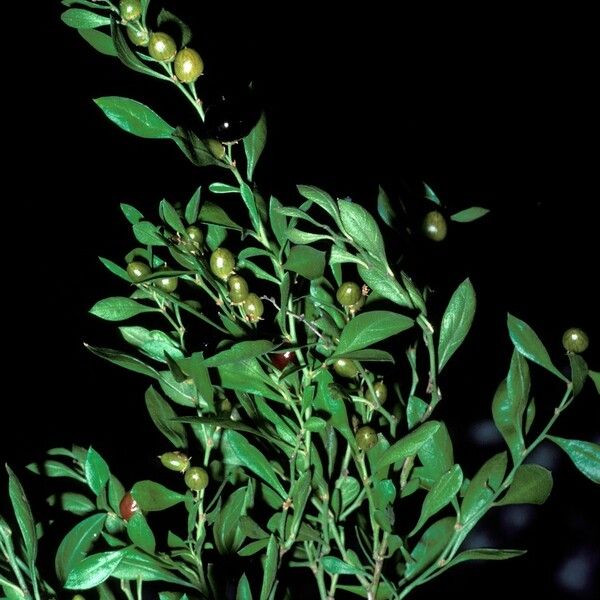
Plant Overview
Known as Brasil, Bluewood, or Logwood, Condalia hookeri is a resilient superstar of the South Texas brush country and Northern Mexico. It is often affectionately called the "refrigerator of the desert" because its dense, evergreen canopy provides such deep shade that it significantly cools the ground beneath it, offering a sanctuary for heat-stressed wildlife.
🔍 How to Identify
- 🍃 Leaf Shape: Small, bright lime-green leaves that are shaped like tiny spatulas or spoons, typically appearing in clusters along the stems.
- ⚔️ The Spines: The branches grow in a distinctive "zig-zag" pattern and end in sharp, rigid thorns that act as a natural barbed-wire fence.
- 🍇 The Fruit: It produces small, round berries that transition from green to a deep, shiny purple-black when they reach maturity in the summer.
🏡 In Your Garden
- 🐦 Wildlife Sanctuary: This plant is a "five-star hotel" for birds. The wicked thorns protect nests from climbing predators, while the juicy berries provide a vital sugary snack for mockingbirds and thrashers.
- 🏜️ Drought Warrior: Because it possesses a deep taproot, it is nearly indestructible once established. It thrives in poor, rocky, or sandy soil where other plants would wither, making it a perfect structural choice for low-maintenance xeriscaping.
⚠️ Safety & Toxicity
- ✅ Edible Berries: The fruit is non-toxic and surprisingly tasty, with a flavor reminiscent of a sweet prune or watermelon, though they are quite small and contain a large pit.
- 🚫 Physical Hazard: The primary danger is mechanical. The thorns are incredibly sharp and stiff; avoid planting this near walkways, as the "bite" of the spines can easily pierce clothing and skin.
- 🐾 Pet Safety: While not chemically toxic to dogs or cats, the spines can cause painful punctures or eye injuries to curious pets who try to run through the brush.
✨ Fun Fact
Its nickname "Bluewood" comes from the plant's dense heartwood. While the wood itself is a rich red-brown, it produces a deep blue or purple dye when processed, which was historically used by craftsmen to color textiles and leather.

Detailed Care Instructions
Condalia Hookeri, also known as bluewood condalia, is a shrub native to the southwestern United States and northern Mexico. Here are some tips on how to grow this plant:
- Sunlight: Condalia Hookeri prefers full sun to partial shade. Make sure to place the plant in a location where it receives at least 6 hours of sunlight per day.
- Soil: The plant thrives in well-draining soil with a pH level of 6.0 to 7.5. Amend the soil with organic matter such as compost before planting to improve drainage and fertility.
- Watering: Water the plant regularly, especially during the hot summer months. Avoid overwatering, as this can lead to root rot. Allow the soil to dry out slightly between waterings.
- Fertilization: Feed the plant with a balanced fertilizer once a year in early spring to promote healthy growth and blooming.
- Pruning: Prune the plant in late winter or early spring to remove dead or damaged branches and promote new growth. You can also shape the plant to maintain its desired size and form.
- Propagation: Condalia Hookeri can be propagated from seeds or stem cuttings. Sow seeds in a well-draining seed-starting mix or take stem cuttings from the plant and root them in a rooting hormone.
- Pests and diseases: Keep an eye out for common pests such as aphids, spider mites, and scale insects. Treat any infestations promptly with insecticidal soap or neem oil. Watch out for fungal diseases such as powdery mildew and rust, and provide good air circulation to prevent them.
By following these tips, you can successfully grow Condalia Hookeri in your garden or landscape.

Place in a bright room that is sun drenched almost all day. Or directly in a south-facing window.

Condalia Hookeri is a plant that requires watering on a regular basis to thrive. The best way to water this plant is to gently pour water directly onto the soil at the base of the plant, making sure not to over-water or create waterlogged conditions. It is important to let the soil dry out slightly between waterings to prevent root rot. Additionally, it is recommended to water in the morning or evening to avoid the heat of the day and minimize water evaporation. Monitoring the plant's moisture levels and adjusting watering frequency as needed will help ensure the health and growth of Condalia Hookeri.
For optimal growth and health of the plant, fertilize Condalia Hookeri in the early spring using a balanced, slow-release fertilizer. Follow the instructions on the fertilizer packaging for proper application and dosage. Additionally, avoid over-fertilizing as this can cause damage to the plant. Water the plant thoroughly after fertilizing to help the nutrients penetrate the soil and reach the roots. Repeat this fertilizing process every 4-6 weeks during the growing season to promote strong, healthy growth.
Condalia Hookeri plant thrives in well-draining, sandy soil with a slightly acidic to neutral pH level. It is important to ensure that the soil is not continuously waterlogged as this can lead to root rot. A mixture of sand, perlite, and peat moss can be used to provide a suitable growing medium for this plant. Adding organic matter such as compost can also help provide essential nutrients and improve soil structure. Ensure that the soil is kept consistently moist but not waterlogged, and allow the top inch of soil to dry out between waterings. Regularly fertilizing the plant with a balanced fertilizer during the growing season can also help promote healthy growth.
Condalia Hookeri can be propagated through various methods such as seed propagation or stem cuttings.
To propagate through seeds, collect mature seeds from the plant and sow them in well-draining soil. It is important to keep the soil consistently moist and provide enough sunlight for the seeds to germinate.
Another method of propagation is through stem cuttings. Take a healthy stem cutting from the plant, making sure it has at least a few nodes. Place the cutting in a moist, well-draining potting mix and keep it in a warm, sunny location. With proper care and attention, the cutting should develop roots and grow into a new plant.
Propagation can be a rewarding way to expand your garden or share plants with others. It is important to be patient and provide the proper care and conditions to ensure the success of the propagation process.








