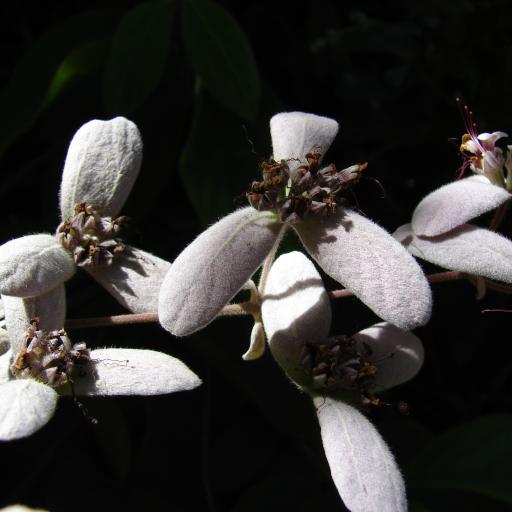
Plant Overview
Known affectionately as the "Shower of Orchids" or the "Lavender Wreath," Congea tomentosa is a show-stopping woody climber native to the tropical forests of Southeast Asia. Despite its common name, it isn't an orchid at all, but a member of the mint family (Lamiaceae). It creates a romantic, ethereal look in the landscape, often appearing as a massive, velvety cloud of soft pink and purple floating among the trees.
🔍 How to Identify
- 🌸 The "False" Flowers: The most striking feature isn't the flower itself, but the three large, velvety, leaf-like bracts that surround the tiny, inconspicuous white blossoms.
- ☁️ Woolly Texture: True to its species name tomentosa (meaning "clothed with woolly hairs"), the stems, underside of the leaves, and the colorful bracts are covered in a soft, silver-gray fuzz.
- 🍃 Ever-Changing Colors: The bracts undergo a beautiful transformation, starting as a pale lime green, blushing into deep lavender or pink, and finally fading to a sophisticated silvery-gray as they age.
🏡 In Your Garden
- 🧗 The Need for Support: This is a vigorous, heavy climber. It lacks tendrils, so it needs a sturdy pergola, a tall fence, or a large tree to scramble over. Without support, it will simply mound into a massive, fuzzy heap.
- ✂️ Pruning Strategy: Because it blooms on new growth, it’s best to prune it back hard after the flowering season ends. This keeps the "vining monster" in check and ensures a more dramatic "shower" of color the following year.
⚠️ Safety & Toxicity
- ✅ Status: Generally considered non-toxic to humans and pets.
- 🧤 Skin Sensitivity: While not poisonous, the dense, tiny hairs (the "wool") on the leaves and stems can cause mild skin irritation or itchiness for gardeners with sensitive skin. Wearing gloves during heavy pruning is recommended.
✨ Fun Fact
Unlike most flowers that wither and fall quickly, the colorful bracts of the Woolly Congea are "persistent." They remain on the vine for many weeks, even after they have dried out, making the plant look like it is in full bloom for months at a time!

Detailed Care Instructions
To grow Congea tomentosa (commonly known as a Chinese violet), follow these steps:
- Choose the right location: Congea tomentosa thrives in warm, humid climates, so select a location that receives bright, indirect sunlight, preferably with a consistent temperature between 60-80°F (15-27°C).
- Prepare the soil: Use well-draining soil enriched with organic matter. The soil pH should be slightly acidic to neutral (around 6.0-7.0).
- Propagation method: Congea tomentosa can be propagated through stem cuttings or by seed. Stem cuttings are the most common and reliable method. Take a 2-4 inch (5-10 cm) long cutting from a healthy, mature plant, ensuring it has a few leaves and a node at the base.
- Rooting the cuttings: Dip the cut end of the stem in a rooting hormone powder to encourage root development. Plant the cutting in a pot filled with moist, well-draining soil. Keep the soil consistently damp but not soggy. Optimal rooting conditions can be provided by using a plastic bag or propagator, which helps maintain humidity around the cutting. Roots should start to develop in 2-4 weeks.
- Transplantation: Once the cutting has rooted and shows signs of new growth, it can be transplanted into a larger pot or into the ground. Choose a container or planting site with good drainage. Make sure to gently tease the roots when transplanting to promote healthy growth.
- Watering and fertilizing: Keep the soil evenly moist but not waterlogged. Congea tomentosa appreciates regular watering, especially during dry spells, but avoid overwatering as it can lead to root rot. Fertilize every two weeks during the growing season with a balanced, water-soluble fertilizer, following the instructions on the label.
- Pruning and training: Congea tomentosa can be trained to climb or kept as a bushy shrub. Regular pruning can help control the size and shape of the plant. Prune after flowering to encourage bushier growth and remove any dead or damaged branches.
- Pests and diseases: Keep an eye out for common indoor plant pests, such as aphids, mealybugs, or spider mites. Treat any infestations promptly with insecticidal soap or other suitable pesticides. Ensure good air circulation around the plant to prevent fungal diseases.
- Flowering: Congea tomentosa produces stunning clusters of purple flowers when it reaches maturity, usually around 3-4 years of age. However, flowering can vary depending on growing conditions and care.
Remember to provide regular care, including the appropriate water, sunlight, and fertilizer, and soon your Congea tomentosa plant should flourish and reward you with its beautiful blooms.

Place in a bright room that is sun drenched almost all day. Or directly in a south-facing window.

Watering Congea Tomentosa needs to be done regularly but without overwatering the plant, as excess moisture can cause root rot. It is best to water the plant when the top inch of soil is dry to the touch. The amount of water the plant needs depends on the temperature and humidity of the environment, so it is important to monitor these factors. When watering, it is better to use room temperature water and avoid using cold water, as it can shock the plant. Additionally, it is recommended to water the plant at the base, avoiding getting water on the leaves, as this can lead to fungal infections. Finally, it is essential to let the excess water drain from the pot to prevent the soil from becoming waterlogged.
To fertilize the Congea Tomentosa plant, use a balanced fertilizer with equal parts nitrogen, phosphorus, and potassium. Fertilize every 2-3 weeks during the growing season, reducing to once a month during the dormant period. Dilute the fertilizer to half strength and apply it to the soil around the base of the plant. Avoid getting fertilizer on the leaves or stems as it may cause burning. Water the plant thoroughly after fertilizing.
The ideal soil for Congea Tomentosa plant is well-draining and fertile soil that retains moisture but doesn't become waterlogged. It should have a pH range between 5.5 to 7.5. A combination of loamy soil with compost or organic matter such as peat moss is suitable for growing the plant. It should be porous to allow air circulation and easy rooting. High-quality potting mix that is formulated for the specific needs of the plant will ensure optimal growth and healthy development of the roots. The soil should be kept moist but not excessively wet. Adequate drainage is essential to avoid root rot and waterlogging. Adding perlite or vermiculite can enhance the soil's drainage while retaining moisture levels. Overall, the soil should support the plant's nutrient requirements, promote healthy root growth, and provide the right structure for anchoring the plant while allowing adequate nutrient uptake, water retention and air circulation.
To propagate this plant, you will need to take stem cuttings. Choose a healthy stem with at least two leaves and cut it at an angle just below a node. Remove the lower leaves and any flowers or buds. Dip the cut end in a rooting hormone powder and plant it in a well-draining potting mix. Cover the pot with a plastic bag to create a humid environment and place it in bright, indirect light. Keep the soil moist but not saturated and check for new roots after a few weeks. Once the new plant has rooted, gradually expose it to more sunlight and water it regularly.








