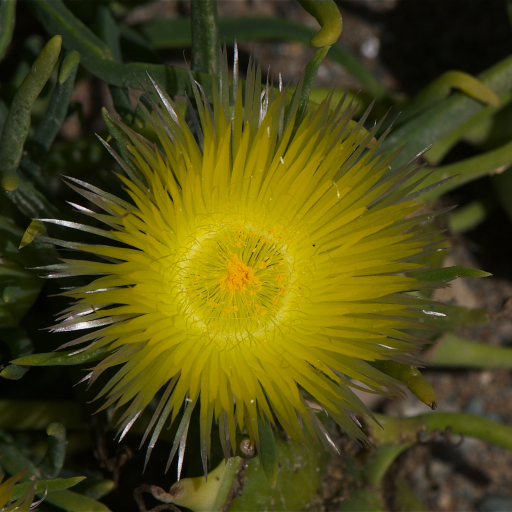
Plant Overview
Often called the Narrow-leaved Ice Plant or Slender-leaved Ice Plant, this South African native is a master of coastal survival. With its striking, neon-yellow blooms and succulent foliage, it looks like a cluster of green fingers reaching out of the sand. While it is a beloved ornamental in dry climates, it has a rebellious side—in coastal California, it’s known as a wanderer that can quickly overtake native dunes.
🔍 How to Identify
- 🌿 The Foliage: Long, fleshy, and narrow leaves that are roughly triangular in cross-section. They are a bright, waxy green and grow in dense, upward-reaching tufts.
- 🌼 The Flowers: Large, brilliant yellow daisy-like blossoms that sit atop short stalks. These flowers are "diurnal," meaning they open wide to soak up the midday sun and tuck themselves away at night.
- 🧊 The Texture: Like many members of the ice plant family, the stems and leaves may appear to have a slight "frosted" or glistening texture when viewed up close in the light.
🏡 In Your Garden
- 🏜️ The Deep Taproot: Unlike many succulents that have shallow, spreading roots, this plant develops a significant taproot. This makes it incredibly drought-tolerant but means it absolutely hates being moved once established.
- 🌊 Coastal Warrior: It is highly salt-tolerant and thrives in sandy, well-draining soil where other plants might wither. It’s a perfect choice for seaside rockeries or "hellstrip" gardening between sidewalks.
- 🌱 Self-Sowing Nature: Be mindful that this plant is an enthusiastic self-seeder. After the flowers fade, they produce dry capsules that release seeds easily, which is how it often escapes garden borders.
⚠️ Safety & Toxicity
- 🐾 Pet Safety: Conicosia pugioniformis is generally considered non-toxic to dogs, cats, and horses. It lacks the sharp spines or caustic saps found in many other succulents.
- 👶 Human Interaction: While not poisonous, the plant is not meant for consumption. The leaves are tough and unpalatable, and the seeds can be a choking hazard for curious toddlers.
✨ Fun Fact
When the seed pods of the Narrow-leaved Ice Plant dry out, they sometimes detach and roll along the ground like tiny, geometric tumbleweeds, using the wind to scatter their seeds across the landscape!

Detailed Care Instructions
To grow Conicosia Pugioniformis (also known as sword leaf crowfoot), you can follow these steps:
- Obtain seeds or young plants from a reputable nursery or online supplier. Conicosia Pugioniformis is a native plant of Western Asia and is not widely available, so you may have to search for specialized suppliers.
- Choose a suitable location for planting. Conicosia Pugioniformis prefers well-drained soil and full sun to partial shade. It can tolerate relatively dry conditions, but it is important to provide occasional watering during dry spells.
- Prepare the soil by removing any weeds, rocks, or debris. Loosen the soil to a depth of about 6 inches (15 cm) using a garden fork or tiller. If the soil is heavy or clay-like, mix in some compost or sand to improve drainage.
- Sow the seeds or transplant young plants into the prepared soil. If planting seeds, follow the recommended depth and spacing indicated on the seed packet. If transplanting, dig a hole slightly larger than the root ball and place the plant, ensuring it is at the same level as it was in its previous container.
- Water the newly planted seeds or transplants thoroughly. Keep the soil slightly moist but not waterlogged during the establishment period, which usually lasts a few weeks.
- Mulch around the plants to help retain moisture and suppress weed growth. Use organic mulch, such as wood chips or straw, and spread it about 2-3 inches (5-7 cm) deep around the base of the plants, leaving a small space around the stem.
- Monitor the plants regularly to ensure they receive adequate water and sunlight. Water deeply but infrequently, allowing the top few inches of soil to dry out between watering sessions. Adjust the watering schedule based on the weather and rainfall.
- Fertilize sparingly if needed. Conicosia Pugioniformis generally doesn't require much fertilizer, especially if the soil is already enriched with organic matter. If desired, use a balanced, slow-release fertilizer according to the package instructions.
- Control weeds around the plants by manually pulling them or using an appropriate weed control method. Avoid using herbicides near the plants, as they can damage or kill them.
- Prune the plants occasionally to maintain their shape and remove any dead or damaged foliage. Pruning can be done in late winter or early spring before new growth emerges.
With proper care and maintenance, Conicosia Pugioniformis should grow well and provide attractive foliage in your garden or landscape.

Place in a bright room that is sun drenched almost all day. Or directly in a south-facing window.

The watering requirements for this plant depend on several factors such as the environment, temperature, humidity, and the container size. It is important to water this plant thoroughly, but make sure that the soil is not waterlogged. Before watering, check the moisture level of the soil by sticking your finger about an inch into the soil to ensure it is dry.
When watering, pour water slowly onto the surface of the soil until it begins to drain through the drainage holes at the bottom of the pot. Make sure to discard any water that remains in the saucer after a few minutes.
During the winter and dormant season, reduce the frequency of watering as the plant does not require as much moisture. In contrast, during the growing season, this plant requires more frequent watering to ensure that the soil does not dry out completely.
Overall, it is important to pay close attention to the moisture levels of the soil and adjust the frequency of watering accordingly to keep the plant healthy and thriving.
To fertilize this plant, you should mix a balanced fertilizer into the soil in the spring, before the start of the growing season. It is important to use a slow-release fertilizer to avoid burning the roots. Alternatively, you can use liquid or water-soluble fertilizer every two to three weeks during the growing season. Be sure to follow the instructions on the fertilizer package, as over-fertilization can harm the plant. It is also important to water the plant thoroughly after fertilizing to ensure the nutrients are absorbed properly.
The ideal soil for this plant should be well-draining, loose, and fertile with a pH range of 6.0 to 7.0. It is recommended to use a mix of sand, loam, and organic matter in equal proportions. The soil should have good water retention capacity but should not hold excess water, as this can lead to root rot. It is best to avoid heavy or clay soils as they do not drain well, and the plant may suffer from waterlogging. Adding perlite or vermiculite to the soil mix can help improve drainage. Regularly amending the soil with organic matter such as compost or aged manure can also help improve soil fertility and structure.
To propagate this plant, you will need to take stem cuttings in the spring or summer. Choose a healthy stem that has a few sets of leaves and cut it with a clean, sharp pair of scissors. Remove any lower leaves on the cutting, leaving only a few sets of leaves at the top. Dip the cut end of the stem into rooting hormone powder and plant it in a well-draining potting mix. Water the cutting thoroughly and place it in a bright, warm location with indirect sunlight. Keep the soil moist but not waterlogged and avoid letting it dry out completely. Over the next few weeks, new roots should begin to form, and new growth should appear on the stem. Once the cutting has established a strong root system, it can be transplanted into a larger pot or planted in the ground.








