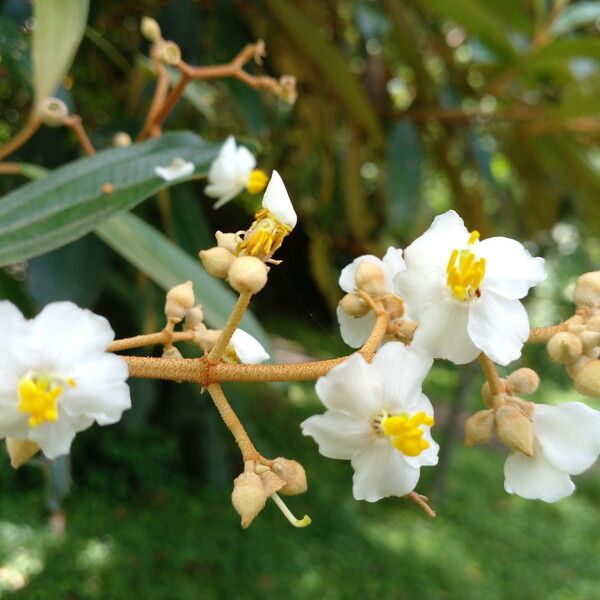
Plant Overview
Often referred to as the Capulín or Uva de Monte, Conostegia xalapensis is a tropical gem known for its velvety texture and clusters of sweet, dark berries. Native to the cloud forests and mountain slopes of Central and South America, this shrub acts as a bustling "supermarket" for local wildlife, particularly birds and small mammals who find its fruit irresistible.
🔍 How to Identify
- 🍃 The Melastome Veins: The most striking feature is the leaf pattern; look for three to five prominent longitudinal veins that arch gracefully from the base to the tip, a hallmark of its family.
- ☁️ Velvety Undersides: The leaves are large and lance-shaped, often sporting a soft, brownish-to-cinnamon fuzz on the underside that feels like felt to the touch.
- 🌸 Starry Blossoms: It produces dense clusters of small, delicate flowers that range from white to pale pink, usually featuring prominent yellow anthers that look like tiny bananas.
- 🍇 Dark Berries: As the flowers fade, they are replaced by small, round berries that transition from green to a deep, inky purple or black when fully ripe.
🏡 In Your Garden
- 🦜 A Bird Magnet: If you are looking to create a "living birdhouse," this is your plant. The berries are high in energy and will attract a diverse range of tropical songbirds to your yard.
- 💧 Thirst for Humidity: Because it originates in misty mountain regions, it thrives in high humidity. It hates "wet feet" (soggy roots), but it does require consistent moisture to prevent its large leaves from drooping.
- 🌳 The Shelter Strategy: In its youth, it prefers the dappled light of the forest understory. As it matures, it becomes much more sun-tolerant, making it a versatile choice for the edges of a garden or a privacy screen.
⚠️ Safety & Toxicity
- ✅ Safe & Edible: The berries of the Conostegia xalapensis are widely considered edible for humans and have a sweet, slightly earthy flavor.
- 🐾 Pet Considerations: While the fruit is non-toxic, the large amount of seeds and fiber can cause minor digestive upset in smaller dogs or cats if eaten in large quantities.
- 🖐️ Skin Contact: The fuzzy hairs on the leaves are generally harmless but may cause very mild itching for individuals with highly sensitive skin.
✨ Fun Fact
In many regions of Mexico and Central America, the intense purple juice from the crushed berries was historically used as a natural dye for textiles and even as a temporary "ink" for children’s games.

Detailed Care Instructions

Place in a bright room that is sun drenched almost all day. Or directly in a south-facing window.

1. Check the soil: Before watering Conostegia Xalapensis, it is important to check the soil moisture level. You can do this by sticking your finger into the soil up to the second knuckle. If the soil feels dry, it is time to water.
2. Watering frequency: Conostegia Xalapensis generally needs to be watered once a week or as needed, depending on the weather and soil type. However, it is important to ensure that the soil does not become waterlogged as this can cause root rot.
3. Watering method: It is recommended to water Conostegia Xalapensis using a watering can or a hose with a gentle flow. Direct the water towards the base of the plant and avoid getting water on the leaves to prevent fungal diseases.
4. Amount of water: The amount of water should be sufficient enough to soak the root ball but not create standing water around the plant. The amount of water given will depend on the size of the plant and the size of the pot or container it is in.
5. Consider the weather: During hot or dry spells, Conostegia Xalapensis may require more frequent watering. In cooler and more humid conditions, it may require less water.
6. Mulching: Mulching around the base of the plant can help to retain moisture in the soil and reduce the need for frequent watering. Use an organic mulch, such as bark chips or shredded leaves, to also provide nutrients for the plant.
Conostegia Xalapensis plant requires a specific type of soil for optimal growth and development. The optimal soil to use should have good drainage and be rich in organic matter. Clay soils should be avoided as they retain too much moisture and can cause root rot.
Loam soils with a pH between 5.5 and 7.5 are ideal for Conostegia Xalapensis, as they provide good nutrient availability while allowing for adequate oxygenation of the roots. Adding compost or well-rotted manure to the soil can provide additional organic matter and improve soil structure.
When planting Conostegia Xalapensis, it is important to ensure that the soil has been adequately amended and prepared. The plant should be placed in a hole that is larger than the root ball, and the soil should be backfilled around it. The soil should then be gently tamped down to ensure that there are no air pockets.
Regular watering is essential to support the growth of Conostegia Xalapensis, and the soil should be kept moist but not waterlogged. Fertilizer can also be applied during the growing season to provide additional nutrients to the plant.








