Plant Overview
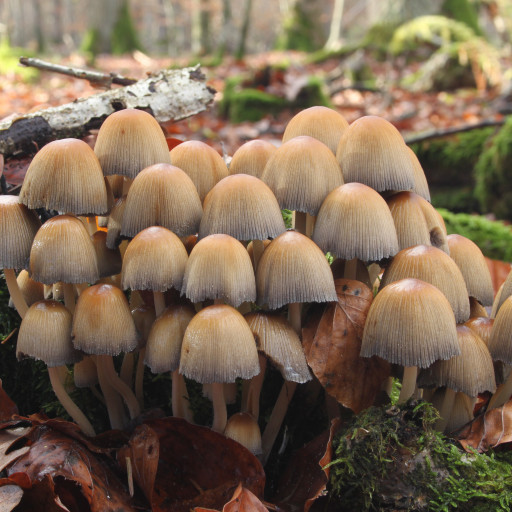
The Glistening Ink Cap, or Mica Cap, is a familiar and charming sight for city dwellers and forest hikers alike. Often appearing in dense, crowded clusters after a heavy rain, these mushrooms look as though they’ve been dusted with fine sugar or tiny diamonds. They are famous members of the "ink cap" family, known for their dramatic and slightly spooky life cycle where they dissolve themselves into a puddle of black liquid.
🔍 How to Identify
- ✨ The Sparkling Cap: The cap is bell-shaped and honey-brown, featuring fine, mica-like granules that shimmer in the light. These "crystals" are actually remnants of a protective veil, though they can be washed off by rain.
- 🖤 Inky Gills: The gills underneath start as a pale cream color, rapidly turning purple-brown and then jet black as the spores mature.
- 📏 Crowded Growth: These mushrooms are rarely loners. They typically grow in tight, overlapping bunches of dozens—sometimes hundreds—clustered at the base of trees or stumps.
🌲 Habitat & Ecology
- 🪵 The Hidden Recycler: While they often appear to be growing directly out of your lawn, they are actually feeding on buried wood or decaying tree roots beneath the soil. They are nature’s clean-up crew, breaking down dead cellulose.
- 🌦️ Rain Chasers: They are incredibly fast growers. A bare patch of ground in the morning can host a massive cluster of Mica Caps by the afternoon following a warm summer storm. However, they are fleeting and usually wither away within 24 to 48 hours.
⚠️ Safety & Toxicity
- ⚠️ WARNING: Never consume any wild mushroom unless you are 100% certain of its identity and have consulted an expert.
- 🧪 Pollution Risk: While technically listed as edible in many field guides, Mica Caps are "bio-accumulators." They easily soak up heavy metals (like lead or cadmium) and pesticides from the soil, making those found in urban yards or near roadsides potentially toxic.
- 🤢 Look-alike Caution: They can be confused with other members of the Coprinopsis family, some of which cause severe nausea if consumed with even a small amount of alcohol.
✨ Fun Fact
The "ink" produced by the melting gills of this family was historically used as actual writing ink! In the past, people would boil the mushrooms with a little cloves or oil to create a dark fluid. Because the ink contains unique microscopic spores, it was even used for important documents to prevent forgery—if the spores didn't match under a lens, the signature was a fake.

Detailed Care Instructions
Coprinellus micaceus, commonly known as the mica cap or glistening inky cap, is a species of mushroom rather than a plant. If you are interested in growing these mushrooms, here are some general guidelines:
- Find a suitable growing environment: Coprinellus micaceus typically grows on decaying logs, fallen branches, or wood chips. Choose a shady, moist area for optimal growth.
- Obtain mushroom spawn: Purchase or obtain mushroom spawn, which are the mycelium of the mushroom. You can find them in gardening stores, online retailers, or from other mushroom enthusiasts.
- Prepare the substrate: Coprinellus micaceus prefers a substrate made from wood or straw. You can use materials like wood chips, sawdust, or straw. Sterilize the substrate to remove any harmful bacteria or competing fungi.
- Mix spawn with substrate: Mix the mushroom spawn with the prepared substrate. Follow the instructions on the mushroom spawn package for the correct ratio.
- Create a suitable growing condition: Place the substrate and spawn mixture in a container or directly on the ground in your chosen growing area. Keep the substrate moist but not soaked, as excessive moisture can promote the growth of unwanted fungi or bacteria.
- Maintain humidity and temperature: Coprinellus micaceus requires a humid environment. You can mist the growing area regularly to maintain humidity levels. Ensure the temperature is between 60°F (15°C) and 75°F (24°C).
- Patience and monitoring: It can take several weeks or even months for the mushrooms to start growing. During this time, monitor the growing area for any signs of contamination or other issues. Remove any unwanted fungi that may appear.
Note: Growing mushrooms can be a complex process, and it is essential to do thorough research and follow specific instructions for the particular species you are interested in cultivating. Additionally, some mushroom species can be toxic, so it is crucial to correctly identify and ensure the mushrooms you grow are safe for consumption.

Place in a window with dappled sun or a spot in the middle of a room. Or directly in a window facing west or east.
To properly water this plant, you should start by checking the moisture level of the soil. Stick your finger about an inch into the soil to see if it feels dry or moist. If the soil feels dry, it's time to water the plant.
When watering, make sure to evenly saturate the soil with water until it begins to drain out of the drainage holes at the bottom of the container. Be careful not to overwater the plant, as this can lead to root rot and other issues.
It's important to note that this plant prefers a moist environment, so avoid letting the soil completely dry out between waterings. However, be sure not to let the soil become waterlogged or saturated for extended periods of time.
In terms of frequency, the watering schedule will vary depending on factors such as the size of the container, the amount of light and humidity the plant receives, and the temperature. In general, it's recommended to water this plant once or twice a week, but adjust the frequency as needed based on the plant's specific needs.
To fertilize this plant, you will need a balanced fertilizer with equal amounts of nitrogen, phosphorus, and potassium. Use a dilute solution of the fertilizer, and apply it to the soil around the base of the plant. Avoid getting any fertilizer on the leaves or stem of the plant. Fertilize every two weeks during the growing season, but refrain from fertilizing during the dormant period. Monitor the soil moisture to ensure it remains moist but not soggy.
The plant in question, Coprinellus Micaceus, prefers a specific type of soil. It requires a well-draining medium that is rich in organic matter and nutrients. The soil pH should be in the slightly acidic to neutral range, around 6.0 to 7.0. It is important that the soil does not become waterlogged, as this can lead to root rot and other issues.
A good soil mix for Coprinellus Micaceus can be made by combining equal parts of peat moss, perlite, and compost. This will provide a loose, well-draining substrate that retains moisture while still allowing air to circulate around the roots. Adding a small amount of gypsum can also help to improve soil structure and provide additional nutrients.
When planting, it is important to gently loosen the roots and ensure they are spread out evenly in the soil. The plant should be watered thoroughly but allowed to dry out slightly between waterings to prevent overwatering.
Overall, Coprinellus Micaceus is a hardy and adaptable plant that can thrive in a variety of soil types, but it will do best in a well-draining, nutrient-rich, slightly acidic soil mix.
To propagate this fungus, one can collect its fruiting bodies and place the spores on a nutrient-rich agar medium to germinate. The young mycelium can then be transferred to a suitable substrate, such as compost or soil, where it will form a network of filaments called a mycelial mat. As the mycelium grows, it can develop new fruiting bodies, which can be harvested and used for further propagation. This process can be repeated indefinitely, allowing the fungus to be propagated and cultivated for culinary, medicinal or scientific purposes.







