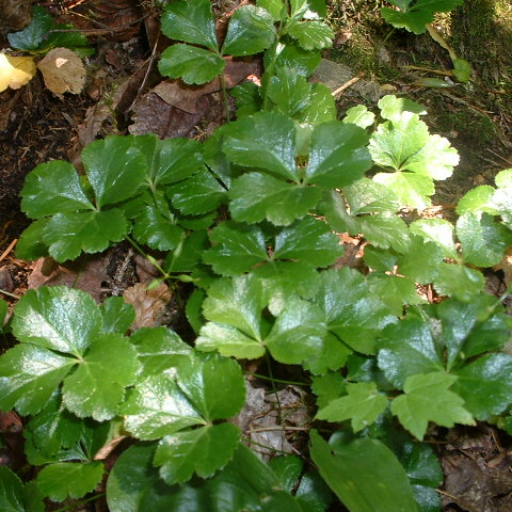
Plant Overview
Often called "Goldthread" for the brilliant, wire-like yellow roots hidden just beneath the soil, Coptis trifolia is a charming, low-growing treasure of the northern woods. This resilient evergreen has a long history in North American folk medicine, earning the nickname "Canker-root" for its effectiveness in soothing mouth sores. It forms a lush, glossy carpet in the coolest, dampest corners of the forest, acting as a tiny guardian of the mossy floor.
🔍 How to Identify
- 🌿 The Foliage: It features three shiny, dark green leaflets that look remarkably like wild strawberry or clover. The leaves are leathery to the touch and remain green even under the winter snow.
- ❄️ The Bloom: In late spring, it produces solitary, star-shaped white flowers. Look closely: the "petals" are actually white sepals, while the true petals are tiny, yellow, cup-shaped nectaries hidden in the center.
- 🟡 The Underground "Gold": The most iconic feature is the bright, golden-yellow rhizome (root) that spreads horizontally just under the leaf litter, resembling tangled strands of silk or gold thread.
🏡 In Your Garden
- 🌲 Woodland Requirements: This plant is a "specialist" that thrives in acidic, peat-rich soil. It is perfect for a shade garden or a mossy rockery where other plants might struggle with high acidity or constant moisture.
- 🐢 Slow and Steady: Goldthread is not an aggressive spreader. It grows slowly, making it an excellent companion for delicate ferns or trilliums. Because it relies on a delicate network of rhizomes, it dislikes being moved once established—plan its "forever home" carefully!
⚠️ Safety & Toxicity
- ✅ Skin Safe: Coptis trifolia is non-toxic to the touch and does not cause skin irritation, making it safe for curious gardeners.
- 🐾 Pet & Child Caution: While it contains berberine (a medicinal compound), it is not considered "poisonous" in the traditional sense. However, ingestion can cause stomach upset in pets or children. It is best enjoyed as a visual groundcover rather than a forageable plant.
✨ Fun Fact
- 💡 A Colonial Staple: Goldthread was so highly valued by early American settlers for its medicinal properties that it was once a common sight in Boston markets, sold in dried bundles alongside bundles of herbs and vegetables for use as a natural antiseptic.

Detailed Care Instructions
To grow Coptis trifolia, also known as goldthread, you can follow these steps:
- Location and Soil: Choose a location that provides partial to full shade, as this plant prefers moist areas with well-draining soil. The soil should be rich in organic matter and slightly acidic in pH (around 5.0 to 6.0).
- Planting: You can start Coptis trifolia from seeds or rhizome divisions. Sow the seeds in the fall or early spring, just covering them with a thin layer of soil. If using rhizome divisions, plant them at a depth of 1-2 inches.
- Watering: Keep the soil consistently moist but not waterlogged. Regular watering is necessary, especially during dry periods.
- Mulching: Apply a layer of mulch around the base of the plant to help retain moisture and suppress weeds.
- Fertilizer: Goldthread doesn't require heavy fertilization. However, you can add a slow-release, balanced fertilizer in early spring or use organic compost to enhance soil fertility.
- Pruning: Prune any dead or damaged foliage to maintain the plant's appearance and health.
- Pests and Diseases: Coptis trifolia is generally resistant to pests and diseases. However, keeping the plant well-maintained and inspecting it regularly can help identify and address any issues promptly.
- Propagation: If you want to propagate Coptis trifolia, you can separate rhizome divisions during the dormant season and replant them in a new location.
Remember to check if Coptis trifolia is suitable for your specific climate and growing conditions, as it is native to certain regions like North America and East Asia.

Place in a window with dappled sun or a spot in the middle of a room. Or directly in a window facing west or east.

To water this plant, provide it with evenly moist soil. Ensure that the soil is never completely dry, but also do not overwater it to the point where the soil is waterlogged. Water the plant just enough to keep the soil consistently moist. It is important to avoid water sitting in the saucer or pot, as this can lead to root rot. Additionally, use room temperature or tepid water instead of cold water to prevent shock to the plant.
To fertilize this plant, use a water-soluble fertilizer with equal amounts of nitrogen, phosphorus, and potassium. Apply the fertilizer every two weeks during the growing season, but avoid fertilizing during the dormant period. Dilute the fertilizer according to the package instructions before applying. Ensure that the plant is well-watered before applying the fertilizer. Apply the fertilizer gently to the base of the plant, avoiding contact with the leaves. Avoid over-fertilizing, as this can burn the roots and cause damage.
To cultivate this plant, it is recommended to use a well-draining soil that is rich in organic matter. The soil pH should be slightly acidic, between 5.0 and 6.5. A mixture of peat moss, perlite, and vermiculite can be used to achieve the ideal growing medium. It is important to avoid overwatering and ensure that the soil does not become waterlogged. Additionally, adding a layer of mulch around the plant can help retain moisture and regulate soil temperature.
Coptis Trifolia is a plant that can be propagated through various methods such as division, root cuttings, and seed germination. A suitable time to propagate the plant is in the early spring or autumn.
To propagate Coptis Trifolia through division, begin by carefully digging up the mature plant and separating the roots and rhizomes. Remove any dead or damaged roots. Cut the rhizomes into sections with at least one shoot and several healthy roots attached. Plant the separated sections in well-draining soil and keep them moist.
To propagate through root cuttings, carefully dig up a mature plant and cut small sections of roots. Place the cuttings in a propagation medium such as peat moss or vermiculite and keep it moist. In a few weeks, roots will begin to grow, and the cuttings can be transferred to individual containers to grow.
Propagating Coptis Trifolia through seed germination is another option. Collect mature fruits from the plant and extract the seeds. Sow the seeds in a well-draining soil mixture and keep them moist. Keep the container in a cool and moist place and wait patiently for the seeds to germinate in about several weeks. Once they germinate, the seedlings can be transplanted to their final location and carefully nurtured to grow.








