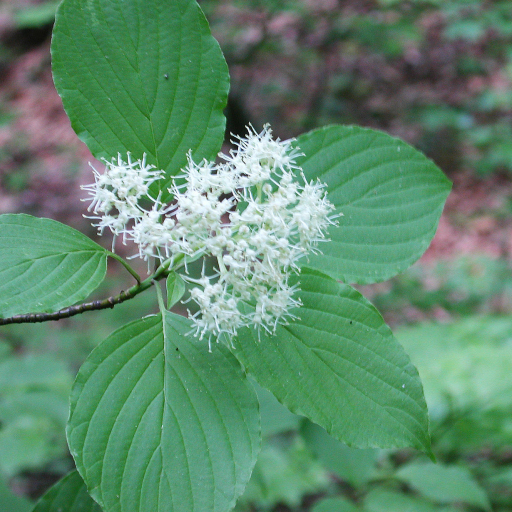
Plant Overview
Commonly known as the Pagoda Dogwood, this elegant native of North America is often called the "most architectural" of all small trees. Its nickname comes from its distinctive horizontal, tiered branching pattern that mimics the levels of a Japanese pagoda. Whether draped in lacy white flowers in spring or glowing with deep maroon foliage in autumn, it brings a sense of Zen-like structure to any landscape.
🔍 How to Identify
- 🍃 The Leaf Trick: Unlike almost every other dogwood species which have opposite leaves, this plant lives up to its name (alternifolia) by having leaves that grow alternately along the stem.
- 🌳 Layered Growth: The branches grow in flat, horizontal planes or "shelves," creating a unique, tiered silhouette that is visible even in the winter months.
- 🌸 Flat Clusters: In late spring, it produces fragrant, creamy-white flowers. Rather than the large four-petaled "bracts" seen on Flowering Dogwoods, these are small, fuzzy clusters that look like lace doilies resting on the branches.
- 🫐 Colorful Fruit: By late summer, the tree produces small, blue-black berries held on bright red stalks (pedicels), providing a striking color contrast.
🏡 In Your Garden
- 💧 Cool Feet, Happy Tree: The Pagoda Dogwood evolved in cool, moist woodland understories. It is very sensitive to heat and drought; it performs best when the soil is kept consistently moist and heavily mulched to keep the roots cool.
- 🌥️ Light Play: While it can handle some sun in cooler climates, it truly thrives in dappled shade. In hot southern regions, afternoon shade is a "must" to prevent leaf scorch and stress.
- 🐛 Wildlife Magnet: It is a vital plant for local ecology. The flowers provide nectar for pollinators, while the high-fat berries are a favorite "superfood" for migrating songbirds like Bluebirds and Catbirds.
⚠️ Safety & Toxicity
- 🐾 Mildly Toxic: While not considered deadly, the fruit and bark contain compounds that can cause mild gastrointestinal upset (nausea or vomiting) in dogs, cats, and humans if ingested in significant quantities.
- 🧤 Skin Sensitivity: Some gardeners report mild skin irritation after pruning the branches or handling the foliage extensively; wearing gloves is a good precaution for those with sensitive skin.
✨ Fun Fact
Most dogwoods are "opposites," but the Cornus alternifolia is the "rebel." Along with its cousin, the Giant Dogwood (Cornus controversa), it is one of the only dogwood species in the world to feature alternate leaf arrangements!

Detailed Care Instructions
To grow Cornus alternifolia, also known as alternate-leafed dogwood, you can follow these steps:
- Choose a suitable planting location: Cornus alternifolia prefers full to partial sunlight and well-draining soil. It also thrives in moist, fertile soils.
- Prepare the soil: If the soil is heavy and compacted, work in organic matter such as compost or well-rotted manure to improve drainage and fertility. A pH level between 5.5 and 6.5 is ideal for this plant.
- Propagation: You can propagate Cornus alternifolia through seeds or by taking softwood cuttings in early summer. Start seeds indoors during late winter or early spring and transplant the seedlings outdoors once they have developed a few sets of true leaves. For cuttings, take 4-6 inch (10-15 cm) long cuttings from new growth and plant them in a pot filled with moist soil. Keep the cuttings warm and provide them with indirect light until they root.
- Planting: Dig a hole that is slightly larger than the root ball of the plant. Place the plant in the hole, making sure it is at the same depth as it was in its nursery container. Backfill the hole with soil gently, firming it around the plant to eliminate air pockets. Water thoroughly after planting.
- Watering: Keep the soil consistently moist but not waterlogged. Water the plant deeply whenever the top inch (2.5 cm) of soil feels dry. Adjust watering frequency based on the weather and soil conditions.
- Mulching: Apply a layer of organic mulch around the base of the plant to conserve moisture, suppress weed growth, and insulate the roots from temperature extremes. Leave a small gap around the stem to prevent moisture buildup and the risk of rot.
- Pruning: Cornus alternifolia benefits from regular pruning to maintain its shape and to encourage healthy growth. Prune in late winter or early spring, removing any dead, damaged, or crossing branches. This plant grows in a graceful, tiered fashion, so prune selectively to maintain its natural form.
- Fertilizing: Apply a balanced, slow-release fertilizer in early spring to provide the plant with essential nutrients. Follow the manufacturer's instructions for application rates.
- Pest and disease control: Cornus alternifolia is generally resistant to pests and diseases. However, occasional issues with aphids, scale insects, or leaf spots may occur. Monitor the plant regularly, and take appropriate measures if you notice any problems.
Remember to keep an eye on the overall health of the plant and provide it with the necessary care, and your Cornus alternifolia should thrive and grow well.

Place in a bright room that is sun drenched almost all day. Or directly in a south-facing window.

To properly water this particular plant, it is important to note the soil conditions and the surrounding environment. This plant prefers consistently moist soil but does not like standing water. To achieve this, it is recommended to water the plant deeply and infrequently, allowing the soil to fully dry out in between watering sessions. It is also important to provide good drainage in the soil and avoid letting the plant sit in standing water. When watering, aim to water at the base of the plant and avoid getting water on the leaves to prevent the risk of disease. It is best to water in the early morning or late evening to avoid evaporation during the heat of the day. Finally, monitor the soil moisture regularly and adjust watering frequency as needed based on the plant's response.
To fertilize the Cornus Alternifolia plant, use a balanced, slow-release fertilizer in early spring before new growth appears. Apply the fertilizer around the base of the plant, taking care not to let it come into contact with the trunk or stems. Water thoroughly after fertilizing to help the nutrients penetrate the soil. Avoid fertilizing during periods of drought or excessive heat.
The ideal soil for this plant should be well-draining, fertile, and loamy. It should have a pH level between 5.5 and 7. It is recommended to mix organic matter like compost or aged manure into the soil to enhance its fertility. The plant prefers moist soil but cannot tolerate waterlogging. Therefore, it is crucial to ensure proper drainage. The addition of sand or perlite to heavy soils can also help boost drainage. This plant also requires full to partial sun exposure for optimal growth.
To propagate this plant, take cuttings from the parent plant during the dormant season. Use a sharp and clean knife to cut off 6-inch stem sections from the main plant. Remove all leaves from the 2-inch stem section at the base and dip the cut end into rooting hormone. Place the cutting in a pot filled with soil-less potting mix and keep it moist. Cover the pot and cutting with a clear plastic bag to encourage an environment that is warm and humid. Keep the pot in a bright and indirect light location and monitor the cutting daily for growth. Once roots have developed, which usually takes 4-8 weeks, the new plant can be transplanted into its permanent location.








