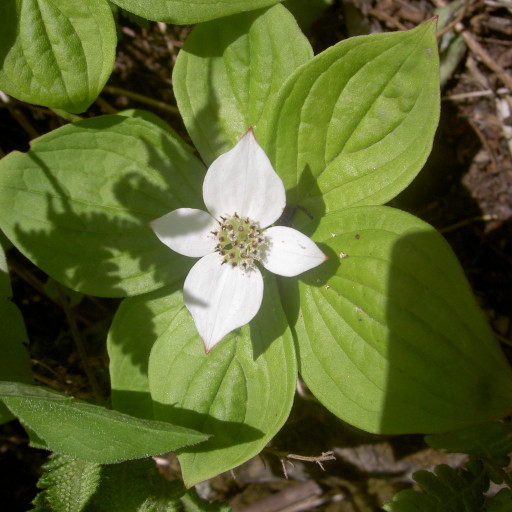
Plant Overview
Often called the Bunchberry or Creeping Dogwood, Cornus canadensis is a charming miniature version of the iconic dogwood tree. Instead of reaching for the sky, this woodland gem forms a lush, green carpet across the forest floors of North America and Greenland. It is a favorite among hikers for its bright "star" flowers and its transition into clusters of brilliant scarlet berries by late summer.
🔍 How to Identify
- 🌿 The Leaf Whorl: Most stems feature a distinctive whorl of six oval, pointed leaves at the very top, which creates a symmetrical, umbrella-like appearance close to the ground.
- 🤍 The "False" Flower: What looks like four white petals are actually "bracts" (modified leaves). The true flowers are the tiny, inconspicuous greenish-purple dots clustered in the center.
- 🔴 The Berry Bunch: In late summer, the center of the leaf whorl produces a tight cluster of spherical, bright red drupes that stand out vividly against the green foliage.
🏡 In Your Garden
- ❄️ The Need for Cool: Bunchberry is a boreal plant, meaning it thrives in cool, damp, and acidic environments. It struggles significantly in heat and humidity; if your summers are scorching, it will likely go dormant or perish without deep shade and consistent moisture.
- 🌲 Nature’s Carpet: Because it spreads via underground rhizomes, it is an excellent groundcover for "wild" or woodland gardens. It loves the company of pines, firs, and mosses, mimicking its natural habitat under the forest canopy.
⚠️ Safety & Toxicity
- ✅ Safe & Edible: Unlike many wild berries, Bunchberry fruits are non-toxic to humans and pets.
- 🥣 The Flavor Profile: While safe, the berries are often described as "mealy" or bland with a large, crunchy seed. They were traditionally used by Indigenous peoples, often mixed with other tastier berries or cooked into puddings, as they are high in pectin.
✨ Fun Fact
The Bunchberry holds a "world record" for speed! Its tiny flowers have a hair-trigger mechanism that explodes open in less than half a millisecond to launch pollen into the air. It is one of the fastest movements ever recorded in the plant kingdom—far too quick for the human eye to see without a high-speed camera.

Detailed Care Instructions
To grow Cornus Canadensis, also known as Bunchberry or Canadian dwarf cornel, follow these steps:
- Location: Choose a suitable location for your Cornus Canadensis plant. It prefers cool, moist, and shaded areas, making it perfect for woodland gardens or under the shade of trees.
- Soil: Ensure that the soil is well-draining and rich in organic matter, with a pH of 5.5 to 7.0. Amend the soil with compost or peat moss to improve its structure.
- Planting: Dig a hole slightly larger than the root ball of the plant. Place the plant in the hole, ensuring that the crown is level with or slightly higher than the soil surface. Backfill the hole with soil, firming it gently around the roots.
- Watering: Keep the soil consistently moist, especially during the plant's establishment period. Water it deeply but avoid overwatering, as it can lead to root rot. Mulch around the plant to help retain moisture and suppress weed growth.
- Light: While Cornus Canadensis prefers shaded areas, it can tolerate some direct sunlight. Ensure it receives a few hours of morning sun and dappled shade during the rest of the day.
- Fertilizer: Apply a slow-release balanced fertilizer in spring to promote healthy growth. Follow the instructions on the package for proper application.
- Pruning: Prune any dead or damaged stems as they appear. However, avoid heavy pruning, as Cornus Canadensis has a low tolerance for extensive pruning.
- Maintenance: Regularly check for pests and diseases, such as aphids or leaf spot. Treat any issues promptly with appropriate organic or chemical controls.
- Propagation: Cornus Canadensis can be propagated through division or by taking stem cuttings in early spring or autumn. Ensure each division or cutting has roots attached and plant them in suitable pots or prepared beds.
- Winter protection: In colder regions, apply a layer of mulch over the plant's root zone in late autumn to protect it from freezing temperatures.
By following these guidelines, you can successfully grow and enjoy the beauty of Cornus Canadensis in your garden.

Place in a dark room with little light, like a dark bedroom or a spot far away from a window or directly in a north-facing window.

Cornus Canadensis is a plant that requires regular watering, especially during the growing season. To effectively water this plant, you should avoid overwatering or underwatering, as it can lead to damage to the roots and foliage.
When watering Cornus Canadensis, it is important to ensure that the soil is moist but not waterlogged. You can achieve this by checking the moisture level of the soil using your finger, and watering the plant if the top one to two inches of soil is dry.
To water Cornus Canadensis effectively, you should use a watering can with a narrow spout that can reach the soil without splashing the foliage. You should also avoid watering the plant from above, as this can lead to wet foliage, which can encourage fungal diseases.
Instead, water the plant at the base, directing the water towards the soil and avoiding the stem and foliage. You should water the plant slowly, giving the water time to soak into the soil and reach the roots.
In addition to regular watering, it is also important to ensure that Cornus Canadensis is planted in well-draining soil that can retain moisture but also allow excess water to drain away. This will help prevent waterlogging and promote healthy growth of the plant.
To fertilize this plant, apply a balanced slow-release fertilizer in the spring and again in mid-summer. Use a rate of one pound of fertilizer per 100 square feet of soil surface area and spread it evenly around the plants. Be sure to water the plants thoroughly after fertilizing to help the nutrients reach the roots. Avoid applying fertilizer too close to the stems to prevent burning.
Cornus Canadensis, a perennial herbaceous plant in the Cornaceae family, requires well-drained soil with high organic matter content. The ideal soil pH for this plant ranges from 5.5 to 6.5. It is best to use a soil mixture that is rich in humus, such as a mixture of peat moss, compost, and sand or perlite. The soil should be kept consistently moist, but not waterlogged, as this plant prefers moist conditions. It is also important to ensure that the soil is not too heavy, as this can lead to root rot. A layer of mulch can be added to the soil surface to help retain moisture and suppress weed growth.
To propagate this plant, you will need to take stem cuttings of new growth in the spring or early summer. Cut a 6-8 inch stem from the parent plant just below a node (where the leaves grow from the stem). Remove the bottom leaves and any flower buds or berries. Dip the cut end of the stem in rooting hormone powder. Plant the stem cutting in a pot filled with a mixture of soil and sand. Water well and keep the plant in a shaded and humid area for several weeks until new growth appears. After two months, the young plant can be transplanted to a larger pot or outside in the proper location.
Common pests of the bunchberry dogwood include Scale insect, larvae. Make a habit of checking your bunchberry dogwood frequently for pests so that any infestations can be caught and managed early.








