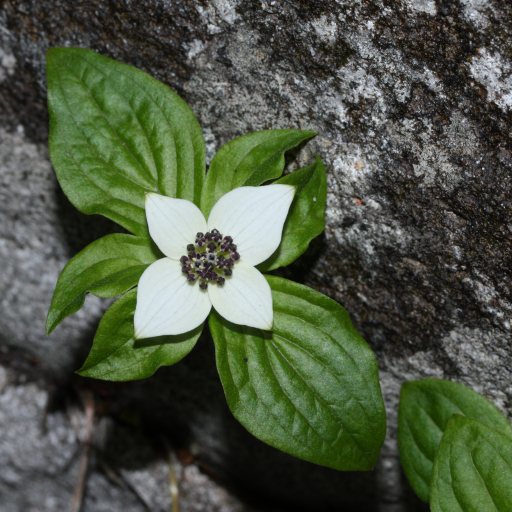
Plant Overview
The Alaskan Bunchberry (Cornus unalaschkensis) is essentially a miniature "tree" that decided to live life as a groundcover. A rugged cousin to the giant Dogwood tree, this tiny perennial carpets the damp floors of the Pacific Northwest and Alaskan forests with elegant, snowy "blooms." Often called the Western Cordilleran Bunchberry, it is a master of the forest understory, providing a lush, green tapestry where most other plants would struggle in the deep shade.
🔍 How to Identify
- ⚪ The "Fake" Flower: What look like four large white petals are actually "bracts" (modified leaves). The true flowers are the tiny, inconspicuous greenish-yellow dots huddled in the very center.
- 🌿 Whorled Foliage: The leaves are arranged in a distinctive circle or "whorl" at the top of the stem. Usually, you will see six leaves, with two being slightly larger than the others.
- 🔴 The Berry Cluster: In late summer, the center of the plant transforms into a tight bunch of brilliant, orange-red berries (drupes) that stand out vividly against the green foliage.
🏡 In Your Garden
- 🌲 Cool & Damp: This plant is a "habitat specialist." It thrives in acidic, peat-rich soil that stays consistently moist. It is perfect for a woodland garden or a shaded rockery where it can mimic the damp, mossy floor of a coniferous forest.
- ❄️ The Chill Factor: Bunchberry hates high heat and humidity. It requires a cold winter dormancy to return healthy in the spring. If you live in a warm climate, it will likely struggle; it prefers its "feet" (roots) to stay cool under a thick layer of mulch or leaf litter.
⚠️ Safety & Toxicity
- ✅ Status: Non-toxic and technically edible.
- 🐾 Details: The berries are safe for humans, dogs, and cats. While the berries are edible, they are often described as "mealy" or "bland," containing a large, crunchy seed. They are far more valuable as a snack for songbirds and small mammals than for your kitchen!
✨ Fun Fact
The Alaskan Bunchberry holds a "speed record" in the plant world! Its tiny central flowers are spring-loaded. When an insect touches them, the petals flip open in less than half a millisecond, launching pollen into the air like a catapult to ensure it sticks to the visiting bug.

Detailed Care Instructions
To grow Cornus Unalaschkensis, also known as the Pacific Dogwood or Western Dogwood, follow these steps:
- Choose the right location: Cornus Unalaschkensis prefers partial shade or dappled sunlight. It should be planted in well-draining soil that retains moisture but doesn't become waterlogged.
- Prepare the soil: Before planting, amend the soil with organic matter such as compost to improve drainage and fertility. This can be done a few weeks before planting.
- Planting: Dig a hole that is about twice as wide and deep as the root ball of the plant. Place the Cornus Unalaschkensis in the hole, ensuring that the top of the root ball is level with or slightly above the soil surface. Backfill the hole with soil, gently firming it around the roots.
- Watering: Water the plant thoroughly after planting and keep the soil consistently moist but not waterlogged. Ensure they have adequate water during dry spells, especially during the first year of growth.
- Mulching: Apply a layer of organic mulch, such as wood chips or bark, around the base of the plant to help retain moisture, suppress weed growth, and regulate soil temperature.
- Pruning: Minimal pruning is required for Cornus Unalaschkensis. Remove any dead, damaged, or diseased branches as they appear. If necessary, prune the plant in late winter or early spring to shape it or remove any crossing branches.
- Fertilizing: Cornus Unalaschkensis usually does not require regular fertilization if the soil is rich in organic matter. However, you can apply a balanced slow-release fertilizer in early spring to promote healthy growth.
- Protecting from pests and diseases: Cornus Unalaschkensis is relatively resistant to pests and diseases. However, watch out for common issues like powdery mildew or canker. Regularly inspect the plant for any signs of disease or pest infestation and take appropriate measures if necessary.
Overall, Cornus Unalaschkensis is a relatively low-maintenance plant, but good soil preparation, proper watering, and occasional pruning will help ensure its healthy growth.

Place in a bright room that is sun drenched almost all day. Or directly in a south-facing window.

To water this plant, you should aim to keep the soil consistently moist. However, it's important to avoid overwatering, which can cause root rot. You can water the plant deeply once a week, or more often if the soil dries out quickly. Make sure the water is able to penetrate deeply into the soil, and avoid watering the foliage to prevent leaf diseases. Place a layer of mulch around the base of the plant to help retain moisture in the soil. In general, monitor the plant closely and adjust your watering schedule as needed based on the current weather conditions, soil type, and other factors.
To properly fertilize this plant, you should evenly spread a fertilizer with nitrogen, phosphorus, and potassium, with a ratio of 10-10-10 or 20-10-10, around the base of the plant. It is also recommended to do this in the early spring or early fall, as the plant is establishing new growth. Be sure to water the plant after fertilizing to ensure the nutrients are absorbed properly.
Cornus Unalaschkensis plant requires a well-draining and nutrient-rich soil for optimal growth. The best soil for this plant is sandy loam or clay loam soil that has a pH range of 5.5 to 7.5. It should be rich in organic matter and should retain moisture well. The plant prefers soil that is slightly acidic and not too alkaline. It is crucial to amend the soil with compost or well-rotted manure to provide the required nutrients. The soil should be kept moist but not waterlogged as the plant doesn't tolerate stagnant water. Adding mulch to the soil surface helps to conserve moisture and suppress weeds.
To propagate this plant, the first step is to gather seeds from the mature flower heads. The seeds should be cleaned and stored in a cool, dry place until they are ready to be planted.
Next, prepare a well-draining soil mix and plant the seeds in a sterile container. Cover the container with plastic wrap or a humidity dome to help retain moisture.
Place the container in a bright, indirect light location and keep the soil moist but not waterlogged. The seeds should germinate in approximately two to four weeks.
Once the seedlings have two to three sets of leaves, they can be transplanted into individual containers or into the ground outdoors.
To propagate the plant through cuttings, select a healthy stem and cut a section that is around six inches long. Remove the lower leaves, leaving only the top two or three sets intact.
Dip the cut end into a rooting hormone and plant it into a pot filled with a well-draining soil mix. Cover the pot with plastic wrap or a humidity dome and keep it in a bright, indirect light location.
Water the cutting regularly to keep the soil moist but not waterlogged. Within several weeks, roots should begin to form and the cutting should start to grow new leaves. Once the cutting has rooted and is growing well, it can be transplanted into a larger container or into the ground outdoors.








