Plant Overview
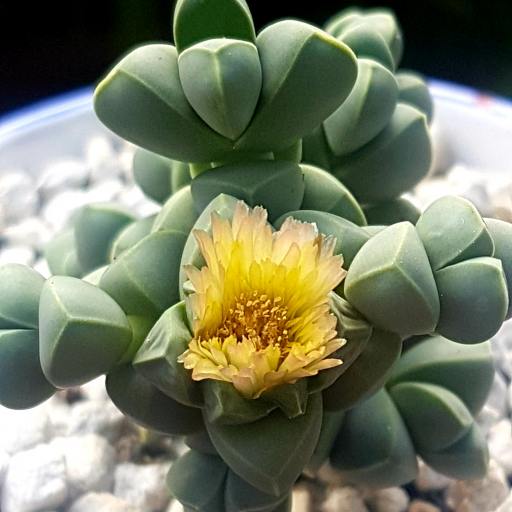
Known as the "Ice Plant" or "Lehmann’s Ice Plant," this South African native looks more like a collection of polished geometric stones than a living organism. Its architectural, gray-green leaves grow in compact, opposing pairs, making it a favorite for modern succulent arrangements and minimalist rock gardens. It is beloved by beginners because it practically "talks" to you when it’s thirsty.
🔍 How to Identify
- 📐 Angular Foliage: The leaves are exceptionally thick, three-sided (triangular in cross-section), and grow in tightly packed, opposite pairs along a woody stem.
- 🎨 Chalky Hue: The plant features a distinct glaucous, gray-green color with a waxy coating that helps reflect intense sunlight in its natural habitat.
- 🌼 Sunny Blooms: In late summer, it produces bright, daisy-like yellow flowers that sprout from the center of the leaf pairs, creating a stunning contrast against the cool-toned foliage.
🏡 In Your Garden
- 💧 The Wrinkle Tell: This plant is famous for its honesty; when it is dehydrated, its plump leaves will visibly wrinkle and shrivel. Once watered, they "inflate" and become smooth again within a day.
- ☀️ Sun Seeker: To maintain its tight, "stacked" appearance, it requires several hours of bright light. If kept in the dark, the stems will stretch (etiolate), and the leaves will grow further apart, losing their geometric charm.
- 🪨 Gritty Substrate: It hates "wet feet." Using a specialized cactus mix or adding perlite/pumice to your soil is essential to ensure water moves quickly past the roots.
⚠️ Safety & Toxicity
- ✅ Non-Toxic: Corpuscularia lehmannii is generally considered safe and non-toxic for cats, dogs, and humans.
- 🌿 Gentle Texture: Unlike many desert plants, it lacks sharp spines or irritating sap, making it a perfect choice for low-shelf displays where curious pets or children might reach it.
✨ Fun Fact
The genus name Corpuscularia comes from the Latin word "corpusculum," meaning "little body," which perfectly describes the tiny, chunky, stone-like appearance of its leaves!

Detailed Care Instructions
| Color | Green |
| Soil Ph | Around 6 (Acidic) |
| Humidity | Dry |
| Lighting | Full Sun |
| Toxicity | Non-Toxic |
| Soil Type | Well-Draining Soil; Coarse Sand And Perlite Mix |
| Bloom Time | Early Spring (Sometimes Early Summer) |
| Difficulty | Easy |
| Plant Type | Succulent |
| Mature Size | 4 – 8 Inches Tall |
| Native Area | South Africa |
| Sun Exposure | Full Sun To Partial Shade |
| Hardiness Zones | 9-11 |
To grow a Corpuscularia Lehmannii plant, also known as Ice Plant or Delosperma Lehmannii, you can follow these steps:
- Start with a suitable pot or container: Choose a pot that has drainage holes at the bottom to allow excess water to escape. Consider a pot that is wider than it is deep to accommodate the spreading nature of the plant.
- Potting mix: Fill the pot with a well-draining potting mix. You can add perlite or coarse sand to improve the drainage if necessary.
- Planting: Take the plant out of its nursery pot and gently loosen the root ball. Place the plant in the new pot, ensuring it is centered and at the same depth it was previously planted. Fill in around the plant with potting mix, gently firming it down.
- Light: Corpuscularia Lehmannii plants prefer bright, indirect sunlight or partial shade. Place them near a window that receives filtered sunlight or in a well-lit area of your garden.
- Watering: These plants are drought-tolerant, so it's best to underwater rather than overwater them. Allow the potting mix to dry out completely between waterings, and then water thoroughly. Ensure there is no standing water in the saucer or pot as it can lead to root rot.
- Temperature and humidity: Corpuscularia Lehmannii plants are native to arid regions and can tolerate high temperatures. Normal room temperatures around 65-75°F (18-24°C) are suitable. They can handle low humidity, making them suitable for indoor environments.
- Fertilizer: Feed your Ice Plant sparingly, about once every 2-3 months, with a diluted, balanced liquid fertilizer during the growing season (spring and summer). Avoid fertilizing in winter when the plant is dormant.
- Pruning: If your plant becomes leggy or unruly, you can prune it back after the flowering season to maintain a more compact shape. Additionally, removing spent flowers can encourage more blooms.
- Propagation: You can propagate Corpuscularia Lehmannii through stem or leaf cuttings. Take a cutting and allow it to dry for a few days to form a callus before planting it into a well-draining potting mix. Keep the soil lightly moist until roots develop.
- Pests and diseases: These plants are generally pest-resistant. However, keep an eye out for common succulent pests such as mealybugs or aphids. If you notice any infestation, manually remove them or use an appropriate organic pesticide following the manufacturer's instructions.
Remember to research and understand the specific requirements of Corpuscularia Lehmannii to provide them with optimal conditions for growth.

Place in a bright room that is sun drenched almost all day. Or directly in a south-facing window.

Corpuscularia Lehmannii is a type of plant that requires regular watering to thrive. To properly water this plant, you should first make sure that the soil is dry to the touch. You can test this by sticking your finger about an inch into the soil and checking for moisture. If the soil feels dry, it is time to water.
When watering, you should make sure to use room temperature water. Cold water can shock the plant and cause damage. It is also important to water the soil directly and avoid getting water on the leaves or stem. This can cause rot and other damage.
To water, slowly pour water into the soil around the base of the plant until the soil is moist but not waterlogged. You should allow the soil to drain before returning the plant to its usual location.
In terms of frequency, you should aim to water this plant about once a week during the growing season (spring and summer). During the winter, when the plant goes dormant, you can reduce watering to once every two to three weeks.
Overall, by following these tips and monitoring the moisture level of the soil, you can ensure that your Corpuscularia Lehmannii plant receives the right amount of water to stay healthy and happy.
To fertilize this plant, use a balanced houseplant fertilizer during the growing season from spring to early fall. Dilute the fertilizer to half the recommended strength and apply every two to four weeks. During the dormant period in winter, reduce fertilization to once a month or stop entirely. Water the plant thoroughly before and after fertilization to avoid root burn.
The ideal soil for this plant should have good drainage and a gritty texture to prevent waterlogging. It should also have a slightly acidic pH level. Adding perlite, sand, or pumice to the soil mix can improve drainage and aeration. Organic materials such as compost or peat should be avoided as they can retain moisture and cause root rot. Additionally, a shallow pot with a well-draining soil mix can help prevent overwatering and promote healthy growth.
Corpuscularia Lehmannii plant can be propagated through stem cuttings. First, use a sharp, sterilized knife to cut a healthy stem from the parent plant. Make sure the stem is about 2-3 inches long and has at least 2-3 leaves. Allow the cutting to dry and callus over for a few days.
Next, prepare a well-draining soil mix using a combination of sand, perlite, and peat moss. Plant the stem cutting in the prepared soil mix and water sparingly. Place the cutting in a warm, bright location but away from direct sunlight.
After about 2-3 weeks, the cutting should have taken root and developed new growth. You can gradually increase the frequency and amount of water as the plant establishes itself. Once the new growth is established, you can also gradually introduce the plant to more direct sunlight.
With proper care, your newly propagated Corpuscularia Lehmannii plant will grow into a beautiful and healthy plant.








