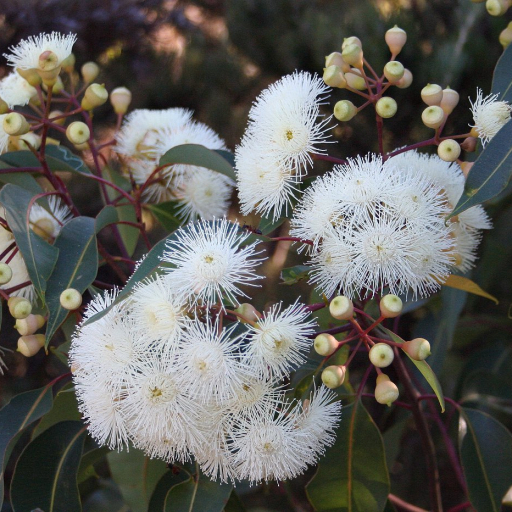
Plant Overview
Known widely as the Marri tree, this Western Australian icon is famous for its large, urn-shaped fruits affectionately called "honkey nuts." It stands as a pillar of the forest ecosystem, providing a vital lifeline for endangered black cockatoos. The name "Marri" comes from the Nyoongar word for blood, referring to the dramatic, dark red resin that "bleeds" from the trunk when the bark is damaged.
🔍 How to Identify
- 🪵 The Bark: Features a distinctive rough, tessellated (tile-like) texture that is persistent throughout the trunk, colored in shades of grey and brown.
- 🍃 The Foliage: Leaves are broad and lance-shaped, showing a deep, glossy green on the top and a much paler underside—a key way to tell it apart from other gums.
- 🌸 The Bloom: Produces massive, showy clusters of creamy-white flowers (rarely pink) that sit proudly outside the leaf canopy.
- 🌰 The "Honkey Nut": The fruit is large, woody, and urn-shaped, often reaching up to 4cm in length, with a deep opening where the seeds are housed.
🏡 In Your Garden
- 🌳 Space Requirements: This is a forest giant that can reach over 40 meters. It is best suited for large acreages or parks rather than small suburban backyards, as its root system is extensive and powerful.
- 🦜 Wildlife Magnet: If you have the space, it is one of the best trees for biodiversity. It provides essential nesting hollows and high-energy seeds for the Carnaby’s and Baudin’s Black Cockatoos.
- 💧 Resilience: Because it develops a deep taproot early in life, the Marri is incredibly drought-tolerant once established, though it dislikes being moved after its first year.
⚠️ Safety & Toxicity
- 🟢 Status: Generally non-toxic to humans, dogs, and cats.
- 🩹 The Resin (Kino): While the red sap is sticky and can stain clothes permanently, it has been used traditionally for its antiseptic properties.
- ⚖️ Physical Hazard: Like many large eucalypts, old specimens can be prone to "summer branch drop." Avoid placing seating or high-traffic paths directly under the heavy, older limbs of mature trees.
✨ Fun Fact
The "honkey nuts" of the Marri tree served as the primary inspiration for the iconic Australian children's author May Gibbs. They were the basis for the "Gumnut Babies" in the classic Snugglepot and Cuddlepie stories!

Detailed Care Instructions

The presence of a dry surface layer of soil does not indicate that the plant requires water. Instead, stick your finger 1-2" (3-5 cm) deep in the soil to feel dampness or moisture content. If the soil seems dry, it's time to water your greens. If the soil is still moist, however, it is better not to water your plant and instead wait a day or two. Overwatering or waterlogging raises the risk of root rot. So if the soil takes longer than a week to dry, check the light conditions because it's likely that the plant isn't getting enough light. It's fine if the upper layer of soil is dry between waterings, but the deeper soil layer should always have some moisture.








