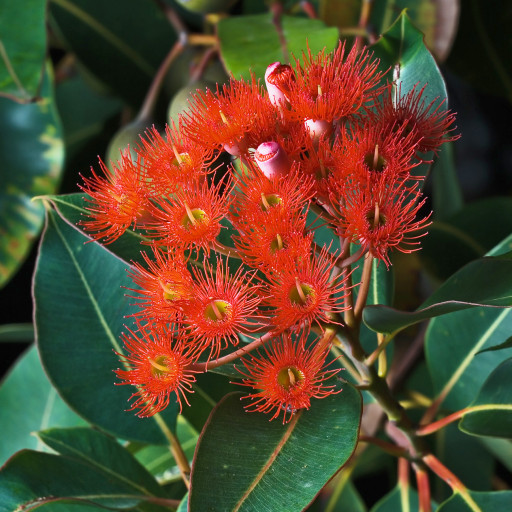
Plant Overview
Often hailed as the "Red Flowering Gum," Corymbia ficifolia is the undisputed superstar of the Australian summer. It transforms from a modest evergreen into a blazing torch of crimson, orange, or pink, often hiding its foliage entirely beneath a dense canopy of blossoms. While it originated in a tiny corner of Western Australia, its spectacular display has made it a favorite in Mediterranean climates worldwide.
🔍 How to Identify
- 🌸 The Bloom: Massed clusters of terminal flowers (at the ends of branches) that range from fiery vermilion and sunset orange to soft pink or deep burgundy.
- 🍃 The Foliage: Unlike the narrow "sickle" leaves of many gums, these are broad, ovate, and leathery. They are dark green on top with a distinctly paler underside.
- 🌰 The Gumnuts: Large, heavy, urn-shaped woody capsules. These "gumnuts" are iconic in Australian art and are often used in dried floral arrangements.
🏡 In Your Garden
- ☀️ Sun & Bloom: This tree is a dedicated sun-worshipper. To get that "carpet of color," it needs full, uninterrupted light. In shade, the flowering will be sparse and the growth may become "leggy."
- 🌱 Root Sensitivity: Corymbia species are notoriously sensitive to root disturbance. When planting, be extremely gentle with the root ball; they often suffer from "transplant shock" if the soil around the roots is broken.
- 🪴 Grafted vs. Seedling: If you want a specific color, look for a "grafted" variety. Trees grown from seeds are genetic wildcards—you might plant a red one but end up with a white-flowering tree years later!
⚠️ Safety & Toxicity
- 🐾 Pet Safety: The leaves contain essential oils and cyanogenic glycosides that can be toxic to dogs, cats, and horses if consumed in large quantities. Symptoms usually include drooling or gastrointestinal upset.
- 👶 Physical Hazards: While not poisonous to touch, the large, woody gumnuts can be a tripping hazard on hard pathways or a choking hazard for curious toddlers.
✨ Fun Fact
The specific epithet ficifolia literally means "leaves like a fig." Early botanists noticed that its broad, lush foliage looked more like a Ficus (Fig tree) than a traditional Eucalyptus, which is how it earned its name!

Detailed Care Instructions
| Lighting | Full Sun |
To successfully grow a Corymbia ficifolia plant, follow these steps:
- Climate: Check if your region's climate is suitable for growing Corymbia ficifolia. These trees thrive in Mediterranean or temperate climates with mild, frost-free winters and warm, dry summers.
- Sunlight: Plant the tree in a spot that receives full sun. Corymbia ficifolia requires at least six hours of direct sunlight per day to grow properly.
- Soil: Use well-draining soil enriched with organic matter. The pH level should be slightly acidic to neutral (pH 5.5-7.0). If your soil is clay-heavy, add some sand or compost to improve drainage.
- Watering: Provide regular watering during the first few years to help establish the tree. Once it is mature, Corymbia ficifolia is known to be drought-tolerant and requires less frequent watering. However, during extended dry periods, give it a deep soak to ensure the soil is thoroughly moistened.
- Fertilization: Apply a slow-release, balanced fertilizer in early spring to provide essential nutrients for growth. Follow the package instructions for proper dosage.
- Pruning: Prune the tree during winter to shape it and remove any dead or damaged branches. Corymbia ficifolia has a naturally attractive form, so minimal pruning is usually required.
- Mulching: Apply a layer of mulch around the base of the tree to help retain moisture, suppress weed growth, and regulate soil temperature. Avoid piling the mulch against the trunk, as it can cause rot.
- Pests and diseases: Corymbia ficifolia is generally resistant to pests and diseases. However, keep an eye out for common issues like scale insects, aphids, or fungal diseases. If necessary, treat affected parts with appropriate pesticides or insecticides.
- Propagation: You can propagate Corymbia ficifolia from seeds or by taking hardwood cuttings. Seeds should be sown in a propagating mix and kept warm and moist until germination occurs. Hardwood cuttings should be taken during winter and treated with rooting hormone before planting in a well-draining potting mix.
Remember, growing plants can vary depending on your specific climate and location, so it's always beneficial to research or consult with local gardening experts for more tailored advice.

Place in a bright room that is sun drenched almost all day. Or directly in a south-facing window.

To effectively water this plant, it is important to first understand its specific watering needs. Corymbia ficifolia prefers consistently moist soil, but not waterlogged or overly saturated soil. Water the plant deeply and thoroughly, allowing the water to penetrate the soil and reach the roots. Avoid getting water on the leaves, as this can increase the risk of fungal diseases.
The frequency of watering will depend on various factors such as the plant's size, temperature, humidity, and the potting mix used. It is generally recommended to water the plant once a week during the growing season (spring and summer) and reduce watering during the dormant season (fall and winter). Use a moisture meter or test the soil with your finger to check if the top inch of soil is dry before watering.
When watering, use room temperature water to prevent shock to the plant's roots. Water at the base of the plant, rather than from the top down, to help prevent soil erosion and ensure that the water reaches the roots. Make sure to also provide proper drainage by ensuring the pot has drainage holes and using a well-draining potting mix.
Overall, successful watering of Corymbia ficifolia involves finding the right balance between providing enough moisture to keep the plant healthy without over or under watering.
To fertilize this plant, first, choose a slow-release fertilizer that has a balanced blend of nutrients, including nitrogen, phosphorus, and potassium. Apply the fertilizer once a year during the growing season, typically in the spring or summer. Use a measuring cup to measure out the correct amount of fertilizer according to the instructions on the package, and then apply it evenly around the base of the plant. Avoid getting fertilizer on the leaves or stems of the plant, as this can cause burning. Water the plant thoroughly after fertilizing to help the nutrients soak into the soil. Repeat the process annually for best results.
For Corymbia Ficifolia plants, it is recommended to use a well-draining, slightly acidic soil that is rich in organic matter. The soil should have a pH range of 5.5 to 6.5 and should be able to retain moisture without becoming waterlogged. A mixture of sand, compost, and peat moss can be used to create the ideal soil for these plants, as they prefer a nutrient-rich growing medium. It is important to avoid using soils that are too compact and heavy, as they can inhibit root growth and lead to waterlogging. Additionally, adding a layer of mulch around the base of the plant can help to keep the soil moist while also protecting the root system from extreme temperatures and weather conditions.
To propagate this plant, you will need to take a cutting from a healthy and mature specimen. Choose a branch that is about 6 inches long and has a few leaves attached. Cut the branch at a 45-degree angle just below a node.
Remove the lower leaves from the cutting, leaving only a few at the top. Dip the cut end of the cutting in rooting hormone powder and plant it in a pot with well-draining soil. Water the cutting and cover it with a plastic bag to create a mini greenhouse.
Place the pot in a warm and bright location, but avoid direct sunlight. Check the soil moisture regularly and keep it moist but not soaked. After a few weeks, check for roots by gently tugging on the cutting. If there is resistance, the roots have formed and the plant can be gradually acclimatized to its permanent location.
Once the plant has established, it will require regular watering and fertilization to promote healthy growth and flowering.
Common pests of the redflower gum include Scale insect, mealybugs, spider mites. Make a habit of checking your redflower gum frequently for pests so that any infestations can be caught and managed early.








