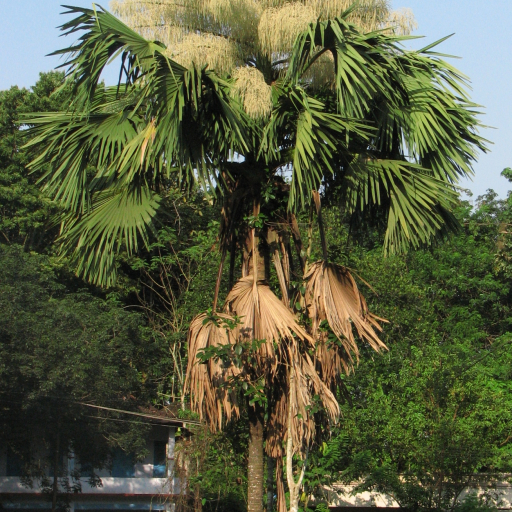
Plant Overview
The Talipot Palm is the undisputed heavyweight champion of the palm world. Often called the "Century Palm" due to its incredibly long life cycle, this majestic giant spends up to 80 years building its strength for one singular, spectacular final act. It is deeply rooted in South Asian history, where its massive leaves served as the "paper" for ancient sacred manuscripts and royal decrees.
🔍 How to Identify
- 🍃 Colossal Leaves: It features massive, fan-shaped (palmate) leaves that can reach up to 5 meters in diameter—large enough to shelter a dozen people from the rain.
- 🐘 The Trunk: A thick, grey, columnar trunk that can reach a diameter of 1 meter, looking more like a sturdy concrete pillar than a typical tree.
- ☁️ The "Cloud" Bloom: When it finally matures, it produces the largest inflorescence (flower cluster) in the world, a creamy-white plume rising 6–8 meters above the leaves.
🏡 In Your Garden
- 🏛️ A Legacy Plant: Because it takes decades to reach its full height of 25 meters, planting a Talipot is a gift for the next generation. It requires a vast amount of space, making it better suited for botanical gardens or large estates than a standard backyard.
- ⏳ The Monocarpic Cycle: This palm is monocarpic, meaning it blooms only once at the very end of its life. Once the millions of seeds drop, the tree slowly dies, having spent all its energy on its magnificent floral finale.
⚠️ Safety & Toxicity
- 🛡️ Status: Generally non-toxic, but physically formidable.
- ⚔️ Sharp Edges: The leaf stalks (petioles) are armed with short, sharp black teeth. These can cause deep scratches or cuts, so heavy-duty gloves are essential if you are pruning dead fronds.
- 🥥 Falling Fruit: Toward the end of its life, it produces thousands of golf-ball-sized fruits. These are quite hard and can be a "falling hazard" if you are standing directly beneath the canopy.
✨ Fun Fact
Before the invention of paper in Southeast Asia, the leaves of the Talipot Palm were dried and used as "Ola leaves." Ancient Buddhist scriptures were etched into these leaves with a stylus, creating books that have survived for over 500 years!

Detailed Care Instructions
Growing Corypha Umbraculifera, also known as the Talipot palm, requires careful attention to its specific needs. Here are some steps to help you grow this plant:
- Climate: Corypha Umbraculifera needs a tropical climate. It thrives in USDA Hardiness Zones 10-12. Ensure that the average temperature does not drop below 50°F (10°C).
- Soil: Use well-draining soil that retains moisture. A mixture of peat moss, compost, and sand is suitable. Ensure the soil pH is slightly acidic to neutral (around 6.0-7.0).
- Planting: Select a sunny location for planting. If you live in a colder climate, consider potting it so you can bring it indoors during winter. Plant the Corypha Umbraculifera at the same depth as its current container, or dig a hole twice as wide and deep as the root ball if planting in the ground.
- Watering: Corypha Umbraculifera requires frequent and consistent watering. Keep the soil moist but not waterlogged, as overwatering can lead to root rot.
- Fertilization: Apply a slow-release, balanced fertilizer during the growing season (spring-summer). Follow the manufacturer's instructions for the proper dosage.
- Pruning: Prune away any dead or damaged leaves while being careful not to disturb the growing bud. This keeps the plant looking neat and healthy.
- Pests and diseases: Watch out for pests like spider mites, mealybugs, and scale insects. Treat infestations with organic pesticides or insecticidal soap. Be vigilant for signs of diseases such as root rot and leaf spots, ensuring good drainage and proper watering to prevent issues.
- Patience: Corypha Umbraculifera is a slow grower and may take several years to produce its first inflorescence (flower). However, once it reaches maturity (around 30-80 years), it will produce a spectacular flower that only blooms once before dying.
Remember, growing Corypha Umbraculifera requires dedication and careful maintenance. Provide it with the right conditions, and you can enjoy the beauty of this palm tree for many years.

Place in a bright room that is sun drenched almost all day. Or directly in a south-facing window.

To water this particular plant, it is essential to ensure the soil is evenly moist but not saturated. Overwatering can lead to root rot and other diseases. It is recommended to water the plant deeply and regularly, especially during the growing season. It is best to moisten the soil to a depth of at least 6 inches during each watering. However, it is important to allow the top inch of soil to dry out before the next watering, as this will prevent the roots from sitting in water. Additionally, any excess water in the plant's saucer should be emptied after watering to prevent the plant from standing in water. Finally, it is important to note that this plant is tolerant of drought conditions, so do not overwater or give it too much water, as this could cause damage to the plant.
To fertilize this plant, you should use a balanced fertilizer with an NPK ratio of 10-10-10 or 20-20-20. Apply the fertilizer during the growing season, which is typically in the spring and summer. Dilute the fertilizer according to the instructions on the packaging, and apply it to the soil around the plant. Avoid getting fertilizer on the leaves or trunk of the plant, as this can burn the plant. Water the plant thoroughly after fertilizing. Repeat the fertilizing process every four to six weeks throughout the growing season to provide the plant with the necessary nutrients for healthy growth.
The ideal soil for cultivating Corypha Umbraculifera plant should have a pH level ranging from slightly acidic to neutral. It requires a soil that has a good drainage capacity, but still retains moisture well, and is rich in organic matter. The soil should also be loose and airy to enable the roots of the plant to grow quickly.
Additionally, the plant requires a soil that has a sufficient amount of nutrients, such as nitrogen, potassium, and phosphorus, to enable healthy growth and development. The soil should be free from any toxic substances, such as heavy metals, and should not be contaminated with chemical pollutants.
Some recommended soil additives for Corypha Umbraculifera plant include well-decomposed organic matter, such as compost, peat moss, and leaf litter. These will provide the necessary nutrients to the soil and improve its quality, texture, and structure. The soil can also be enhanced with sand or perlite to increase drainage and improve soil aeration.
Overall, Corypha Umbraculifera plant prefers a well-drained and nutrient-rich soil, which is loose, aerated, and has a good water-holding capacity.
To propagate the plant, first, select healthy and matured seeds. Soak them in water for at least 24 hours to soften the hard outer shell of the seed. Then, plant the seeds in a well-draining soil mix that is moist but not water-logged. Cover the pot with a plastic bag or a clear plastic wrap to create a mini greenhouse to retain moisture. Keep the pot in a warm and bright location, but away from direct sunlight, which can dry out the soil quickly. The seeds will germinate in about 3-6 months, or longer for some varieties.
Once the seedlings have grown to about 2 inches tall, they can be transplanted into individual pots with a well-draining soil mix. Water the young plants regularly, but be careful not to overwater them, as this can cause root rot. Provide the plant with bright, indirect sunlight and keep it at a warm temperature.
The plant can also be propagated through division of its root system. This method should be done in the spring when the plant is actively growing. Remove the plant from its pot and gently separate the roots into several sections with a sharp, sterile knife. Plant each section into an individual pot with well-draining soil mix and care for them as you would a newly-germinated seedling.
Propagation of this plant may not always be successful, and it can take a long time for the plant to reach maturity. However, with patience and care, this striking plant can be grown from seed or through division for many years of enjoyment.








