Plant Overview
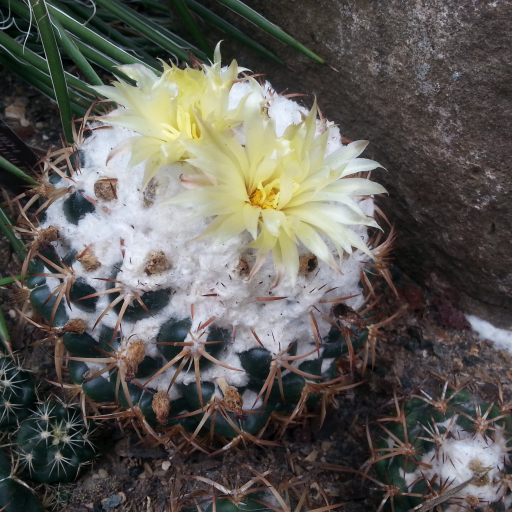
Often called the Pineapple Cactus due to its rugged, scaly appearance, Coryphantha pycnacantha is a slow-growing gem from the high-altitude deserts of Central Mexico. This cactus is highly prized by collectors for its geometric symmetry and its massive, silky yellow blooms that often appear larger than the plant itself. In the wild, it is a resilient survivor, often found clinging to rocky limestone slopes where few other things can grow.
🔍 How to Identify
- 🌵 Body Shape: A solitary, globose (ball-shaped) stem that becomes slightly cylindrical with age, characterized by large, nipple-like bumps called tubercles rather than traditional ribs.
- 🛡️ Thick Spines: It features robust, slightly curved spines that range from pale yellow to a weathered grey, which create a protective "cage" around the plant.
- 🧶 Woolly Apex: The very top of the cactus (the crown) is often covered in a dense, white woolly felt from which the flower buds emerge.
🏡 In Your Garden
- 🏺 Taproot Nuance: This species develops a thick, carrot-like taproot that acts as a water reservoir; because of this, it requires a deep pot and a very gritty, mineral-heavy soil to prevent moisture from sitting against the root.
- ☀️ Light & Ventilation: It thrives in intense light but appreciates a bit of afternoon shade in extreme heat; good airflow is critical to mimic its breezy, high-elevation native habitat.
⚠️ Safety & Toxicity
- 🌵 Physical Hazard: While not chemically toxic to humans or animals, its spines are exceptionally strong and sharp, capable of causing deep puncture wounds.
- 🐾 Pet Placement: Due to the "hooked" nature of some spines, it can easily snag fur or skin; it is best kept on high shelves or in areas where pets and children cannot stumble into it.
✨ Fun Fact
The name Coryphantha comes from the Greek words koryphe (head) and anthos (flower), highlighting the fact that, unlike many other cacti, these blooms emerge exclusively from the very top of the plant!

Detailed Care Instructions
| Humidity | Dry |
| Lighting | Full Sun |
| Difficulty | Medium |
| Temperature | 21°C - 28°C |
| Hardiness Zones | 9B - 11 |

Place in a window with dappled sun or a spot in the middle of a room. Or directly in a window facing west or east.
These plants do best in dry environments, however they do require a lot of sunlight. If these plants are kept in humid settings for an extended period of time, fungus will grow. It may result in leaf loss, pathogen attack, and plant death. However, if the relative humidity goes below 20°C (68°F), they can handle it.








