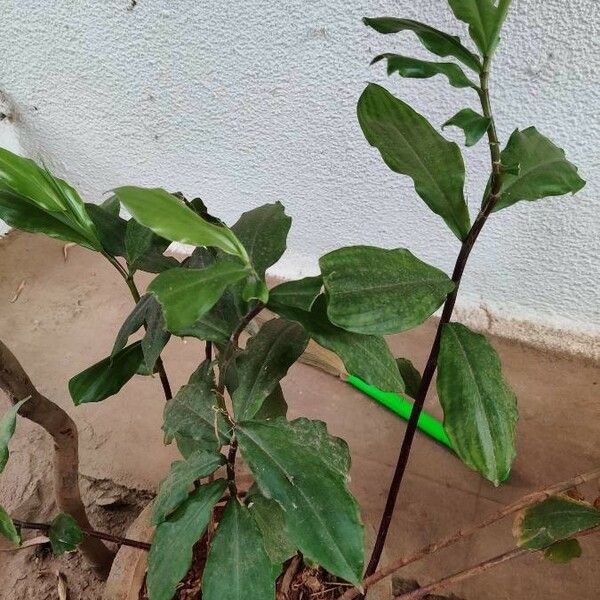
Plant Overview
Known as the Spiral Ginger or Bush Cane, Costus afer is a striking tropical beauty native to the moist forests of West and Central Africa. It is famous for its unique "spiral" growth pattern, where the leaves wind around the central stem like a green staircase. While it looks like a member of the ginger family, it belongs to its own distinct family, Costaceae, and is often grown as both a bold ornamental and a powerful medicinal herb.
🔍 How to Identify
- 🌀 Spiral Foliage: The most iconic feature is the way the glossy, dark green, elliptical leaves wrap around the stem in a perfect corkscrew pattern.
- 🎋 Cane-Like Stems: The plant produces upright, unbranched fleshy stems that can resemble thin bamboo or sugarcane, often reaching heights of 6 to 10 feet in the wild.
- 🌸 Cone-Shaped Blooms: At the very tip of the stalks, it produces a dense, green or reddish cone-shaped bract from which delicate, funnel-shaped white flowers with yellow centers emerge.
- 📄 Leaf Texture: The undersides of the leaves are often slightly hairy or velvety to the touch, distinguishing them from some other smooth-leaved ginger relatives.
🏡 In Your Garden
- 💧 Thirst for Humidity: Because it originates in tropical rainforests, this plant thrives on high humidity. If the air is too dry, the leaf edges will quickly turn brown and crispy, so misting or a pebble tray is a must for indoor hobbyists.
- 🌱 Rhizome Expansion: It grows from underground rhizomes. While it isn't "invasive" in the traditional sense, it will steadily expand to form a lush, dense clump. Give it plenty of "elbow room" in your garden or a very large pot.
- 🌡️ Cold Sensitivity: Unlike some hardy gingers, Costus afer is very sensitive to frost. If the temperature drops below 50°F (10°C), it may drop its leaves or go dormant to protect its roots.
⚠️ Safety & Toxicity
- ✅ Safe Status: Costus afer is generally considered non-toxic to humans and is even used in traditional African medicine to treat various ailments.
- 🐾 Pet Caution: While not listed as a high-risk poison, it is always best to keep curious cats and dogs from chewing on the fibrous stalks, as the high cellulose content and plant juices can cause mild stomach upset or drooling.
✨ Fun Fact
In many parts of Africa, the juice from the crushed stems of Costus afer is used as a natural remedy for coughs and even as a traditional treatment for eye inflammations. It is so deeply rooted in local culture that it is sometimes referred to as the "Ginger of the Forest."

Detailed Care Instructions

Place in a bright room that is sun drenched almost all day. Or directly in a south-facing window.

First, always check the soil moisture level before watering. Use a soil moisture meter or stick your finger into the soil up to your knuckle to check if the soil is dry. If the top inch of soil is dry, it's time to water.
When watering, give the plant a thorough soak until water flows out of the drainage holes. Avoid letting the plant sit in standing water as this can cause root rot.
Ensure that the plant is receiving adequate humidity as well, as Costus Afer prefers humid environments. You can increase humidity by misting the leaves with water or placing a tray of water near the plant.
During colder months, reduce watering and allow the top inch of soil to dry out between watering.
Overall, providing consistent moisture and humidity for Costus Afer will help to keep the plant healthy and thriving.
The preferred type of soil for this plant is a well-draining, nutrient-rich soil that is high in organic matter. It should be kept slightly moist but not waterlogged, as the plant is susceptible to root rot. A pH range of 5.5-7.0 is ideal. It is recommended to amend the soil with compost or other organic matter to provide nutrients and improve drainage. Additionally, adding perlite or sand can improve drainage and prevent water from pooling. Recommended fertilizers for this plant are organic fertilizers with higher nitrogen content.








