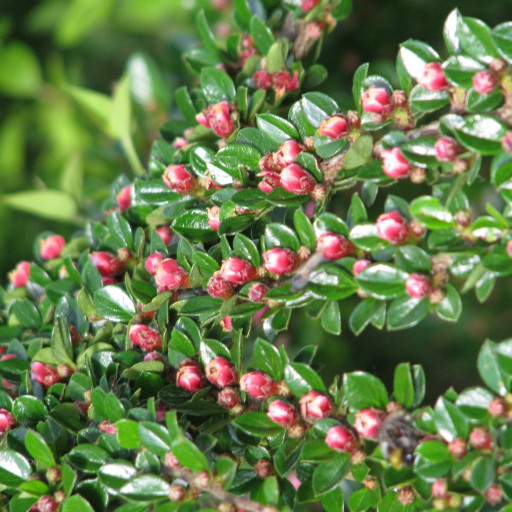
Plant Overview
Commonly known as the Rockspray Cotoneaster or the Fishbone Cotoneaster, this architectural shrub is a favorite for those looking to add structure and wildlife value to their landscapes. Originating from the rocky slopes of Western China, it is famous for its unique, fan-like branching pattern that resembles a fish skeleton. Whether it’s draping over a stone wall or acting as a textured groundcover, it provides a changing tapestry of colors across all four seasons.
🔍 How to Identify
- 🦴 Branching Pattern: Look for the distinct "herringbone" structure. The stiff, woody branches grow in flat, horizontal sprays with smaller twigs radiating out at regular angles.
- 🍃 Small Glossy Leaves: The leaves are tiny, round, and dark green with a high-gloss finish. In the autumn, they transform into brilliant shades of orange and fiery red before dropping for the winter.
- 🌸 Flowers & Berries: In late spring, it produces inconspicuous but charming pinkish-white flowers. By late summer, these turn into masses of hard, bright scarlet berries that persist long after the leaves have fallen.
🏡 In Your Garden
- 🧱 Natural Climber: While it doesn’t have tendrils like ivy, Cotoneaster horizontalis is a "wall-shrub." If planted at the base of a fence or wall, its stiff branches will naturally lean against the surface, creating a beautiful living tapestry without much training.
- 🐝 Pollinator Magnet: Though the flowers are small, they are exceptionally rich in nectar. On a sunny May morning, you will often find the plant literally "humming" with honeybees and bumblebees.
- 🌱 Tough as Nails: This plant is incredibly hardy and thrives in poor, well-drained soil. It is often used for erosion control on steep banks where other plants struggle to take root.
⚠️ Safety & Toxicity
- 🐾 Mildly Toxic: The plant is classified as having low toxicity, but caution is advised.
- 🤮 Berries: The bright red berries contain cyanogenic glycosides. If ingested in large quantities by curious children or pets (dogs and cats), they can cause stomach upset, nausea, or lethargy. It is best to admire the berries visually rather than culinary-wise!
✨ Fun Fact
The "herringbone" growth habit isn't just for decoration; in its native Himalayan habitat, this flat, hugging growth style allows the plant to survive heavy snowfall and high winds by staying low to the warm surface of the rocks!

Detailed Care Instructions
| Color | Light Pink |
| Soil Ph | 6.75-7.5 |
| Soil Type | Well-Drained; Young Plants Need Evenly Moist Soil |
| Bloom Time | Late Spring |
| Plant Type | Deciduous Shrub |
| Mature Size | 2 To 3 Feet Tall; 6- To 8-Foot Spread Feet |
| Native Area | Western China |
| Sun Exposure | Full Sun |
| Hardiness Zones | 5-7 |
To grow Cotoneaster Horizontalis plant, follow these steps:
- Choose the right location: Cotoneaster Horizontalis prefers full sun to partial shade. Ensure that the soil is well-draining.
- Prepare the soil: Loosen the soil to a depth of around 12-18 inches and mix in organic matter, such as compost, to improve drainage and fertility.
- Planting: Dig a hole that is slightly larger than the root ball of the plant. Place the plant in the hole, ensuring that the top of the root ball is level with or slightly above the soil surface. Backfill the hole with soil and gently firm it around the plant.
- Watering: Water the plant thoroughly after planting and during dry spells. Cotoneaster Horizontalis prefers slightly moist soil but does not tolerate waterlogged conditions.
- Mulching: Apply a layer of mulch around the plant to help retain moisture and suppress weed growth. Keep the mulch a few inches away from the base of the plant to avoid rot.
- Pruning: Cotoneaster Horizontalis can be pruned to maintain a desired shape and size. Prune in late winter or early spring before new growth begins. Remove dead, damaged, or crossing branches, and thin out crowded areas to improve air circulation.
- Fertilizing: Apply a balanced slow-release fertilizer in early spring and again in late spring or early summer. Follow the recommended dosage on the fertilizer package.
- Pests and diseases: Cotoneaster Horizontalis is generally resistant to pests and diseases. However, watch out for aphids, scale insects, or fire blight. Treat any infestations promptly with appropriate insecticides or horticultural oils.
- Propagation: Cotoneaster Horizontalis can be propagated through hardwood cuttings or by collecting and sowing its seeds. Hardwood cuttings should be taken in late fall or early winter and should be rooted in a well-draining soil mix.
- Winter protection: In colder climates, provide winter protection by mulching the base of the plant with a layer of straw or leaves to insulate the roots.
With proper care, Cotoneaster Horizontalis should grow and thrive, providing beautiful foliage and berries while attracting wildlife to your garden.

Place in a window with dappled sun or a spot in the middle of a room. Or directly in a window facing west or east.

The best way to water this plant is to gently pour water onto the soil at the base of the plant, being careful not to wet the leaves or branches. Aim to water the plant deeply, soaking the soil to a depth of at least a few inches. It is important to avoid overwatering, as this can cause root rot and other problems. The plant should be allowed to dry out slightly between waterings, but not to the point of wilting. In general, a thorough watering once a week should be sufficient, although this may vary depending on the climate and soil conditions. It is also important to ensure good drainage, as standing water can also cause root problems.
To fertilize this plant, begin by preparing the soil around the base of the shrub. Use a rake or garden fork to loosen the top layer of soil. Then, choose a fertilizer that is high in nitrogen, such as a 10-10-10 or 15-15-15 blend. Apply the fertilizer evenly around the base of the plant, following the manufacturer's instructions for dosage. Be careful not to apply too much fertilizer, as this can burn the plant's roots. Water the fertilizer into the soil thoroughly, making sure that it reaches the roots. Repeat this process once every six to eight weeks, during the growing season.
Cotoneaster Horizontalis is a shrub that requires well-draining soil that is rich in organic matter. The soil should be slightly acidic to neutral with a pH level between 5.5 and 7.0. Avoid using heavy clay soils as they can retain too much water and lead to root rot. Instead, use a mixture of sandy loam soil and organic compost to improve drainage. The soil should be moist but not waterlogged as this can also lead to root rot. It is important to regularly check the soil moisture and adjust watering accordingly. A layer of mulch can also be added to the soil surface to help retain moisture while also suppressing weed growth.
One can propagate this plant through a process called hardwood stem cuttings. First, one needs to select a healthy stem from the previous year’s growth that is approximately 6 to 8 inches in length. This stem should have at least two nodes (areas where leaves emerge).
Next, remove any leaves and side shoots from the bottom half of the cutting. The bottom should be cut at a 45-degree angle just below a node.
Dip the bottom of the cutting in rooting hormone powder and insert it into a mixture of perlite and peat moss. The cutting should be planted to a depth where at least one node is buried, leaving one or two nodes above the soil.
Water the cutting thoroughly and cover it with a clear plastic bag to create a humid environment. Place the cutting in an area with bright, indirect light, but avoid direct sunlight.
In about eight weeks, the cutting should start to develop roots. Once there are a significant number of visible roots, the cutting can be transplanted into a larger pot or outdoors in a desired location.
Common pests of the rock cotoneaster include Scale insect, mealybugs, spider mites, aphids. Make a habit of checking your rock cotoneaster frequently for pests so that any infestations can be caught and managed early.








