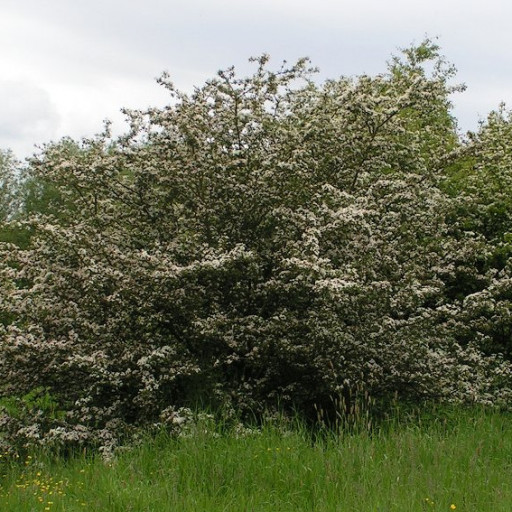
Plant Overview
Often called the "May-tree," the Common Hawthorn is a cornerstone of the European countryside and a staple of ancient folklore. Steeped in myth, it was once believed that bringing its blossoms indoors would invite bad luck—or even the fairies—into your home. Today, it is cherished as a "living fence" that guards gardens with its dense, thorny embrace and spectacular spring blooms.
🔍 How to Identify
- 🍃 Lobed Foliage: The leaves are deeply lobed, often cut more than halfway to the midrib, creating a jagged, fan-like appearance that turns yellow-orange in autumn.
- 🌸 May Blossoms: In late spring, the tree is smothered in clusters of highly fragrant white flowers, each featuring a single style (which distinguishes it from its cousin, the Midland Hawthorn).
- 🔴 Autumn Haws: By late summer, the flowers turn into "haws"—small, berry-like red fruits that hang in heavy bunches and provide a vital food source for winter birds.
🏡 In Your Garden
- 🛡️ The Perfect Hedge: Hawthorn is incredibly "plastic," meaning it responds beautifully to hard pruning. Its sharp thorns and dense growth habit make it an impenetrable, decorative, and secure boundary.
- 🦋 Wildlife Magnet: This plant is an ecological powerhouse, supporting over 300 species of insects. If you want to attract pollinators in the spring and songbirds in the autumn, this is the tree to plant.
- 🌱 Tough as Nails: It is famously unfussy about soil, thriving in everything from chalk to heavy clay, though it performs best in a spot where it can soak up plenty of direct sunlight.
⚠️ Safety & Toxicity
- 🗡️ Mechanical Hazard: The primary danger is physical. The branches are armed with sharp, stiff thorns that can easily pierce skin or garden gloves; always wear heavy-duty protection when pruning.
- 🐾 Pet & Human Safety: The fruit (haws) are technically edible and often used in jellies, but the seeds inside contain amygdalin (which converts to cyanide). While eating a few berries is unlikely to cause harm, large quantities of seeds should be avoided by children and pets.
✨ Fun Fact
- 🧚 The Fairy Gate: In Irish mythology, solitary Hawthorn trees growing in the middle of fields are known as "Fairy Thorns." It is still considered extremely bad luck to cut one down, as they are thought to be sacred portals to the spirit realm. Even modern highway projects in Ireland have been rerouted to avoid disturbing a single Hawthorn!

Detailed Care Instructions
| Color | White, Pink, Red |
| Soil Ph | 6-7 |
| Humidity | High |
| Invasive | Weed |
| Lighting | Part Sun |
| Toxicity | Poisonous |
| Soil Type | Well-Drained |
| Bloom Time | Spring/Early Summer |
| Difficulty | Easy |
| Plant Type | Deciduous Tree |
| Hibernation | Cold Period |
| Mature Size | 6 To 30 Feet Tall |
| Native Area | Europe, North Africa |
| Temperature | 18°C - 28°C |
| Sun Exposure | Full Sun |
| Hardiness Zones | 3-9 |
Growing Crataegus monogyna (common hawthorn) plants can be done by following these steps:
- Choose a suitable location: Crataegus monogyna prefers full sun to partial shade. Select a site that has well-draining soil and enough space for the plant to grow to its full size, as these plants can reach heights of 15-30 feet (4.5-9 meters).
- Soil preparation: Prepare the soil by removing any weeds or grass and amending it with organic matter such as compost. This will improve soil fertility and drainage.
- Planting: Dig a hole that is deep enough to accommodate the plant's root system. Place the plant in the hole, making sure the top of the root ball is level with the soil surface. Backfill the hole with soil, gently firming it around the roots. Water the plant thoroughly after planting.
- Watering: Keep the soil evenly moist, especially during the first year while the plant is establishing its root system. Avoid overwatering, as hawthorn plants prefer moderately moist soil rather than constantly saturated conditions.
- Mulching: Apply a layer of organic mulch, such as wood chips or bark, around the base of the plant. Mulch helps retain soil moisture, suppresses weeds, and regulates soil temperature.
- Pruning: Prune Crataegus monogyna plants in late winter or early spring to remove any dead, damaged, or crossing branches. This promotes airflow and sunlight penetration, reducing the risk of disease and encouraging healthy growth.
- Fertilization: You may fertilize your Crataegus monogyna plant with a balanced, slow-release fertilizer in early spring. Follow the package instructions for application rates.
- Pest and disease control: Monitor the plant for common pests such as aphids, caterpillars, or scale insects. If an infestation occurs, consider using organic insecticides or insecticidal soaps to control them. Additionally, keep an eye out for diseases like fire blight or leaf spot, and promptly take appropriate measures, such as pruning affected branches or using fungicides if necessary.
Remember that growing a Crataegus monogyna plant may take time and patience. Providing proper care and maintenance will help ensure the plant's healthy growth and longevity.

Place in a window with dappled sun or a spot in the middle of a room. Or directly in a window facing west or east.

Crataegus Monogyna is a plant that requires regular watering in order to thrive. When watering this plant, it is important to ensure that the soil around the roots is moist, but not waterlogged. Overwatering can lead to root rot and other problems, so it is important to monitor the soil moisture level regularly.
To water this plant, start by checking the soil with your finger or a soil moisture meter. If the top inch or so of soil feels dry to the touch, it is time to water. Use a watering can or hose to slowly water the soil around the base of the plant, taking care to avoid getting water on the leaves or flowers.
To prevent water from pooling around the base of the plant, water in a circular pattern, starting from the outer edge of the plant and working your way in. This will help to distribute the water evenly and ensure that all of the roots are adequately hydrated.
It is also important to avoid watering this plant too frequently. Overwatering can lead to problems like root rot and fungal infections, which can be difficult to treat. Instead, aim to water deeply but infrequently, allowing the soil to dry out slightly between waterings.
In addition to regular watering, it is also important to provide proper drainage for this plant. Make sure that the soil around the roots is well-draining, and consider adding a layer of gravel or other drainage material to the bottom of the planting hole.
By following these tips and monitoring your Crataegus Monogyna plant carefully, you can ensure that it receives the proper amount of water and grows strong and healthy.
To fertilize this plant, apply a balanced fertilizer with equal amounts of nitrogen, phosphorus, and potassium in the spring just before new growth appears. Use a slow-release fertilizer or a liquid fertilizer diluted to half strength. Avoid fertilizing during the winter months or when the plant is dormant. Apply the fertilizer evenly around the base of the plant and water in thoroughly.
It is recommended to use a well-draining soil mix with good moisture retention for this plant. The soil should be rich in organic matter and slightly acidic with a pH level between 6.0 and 7.0. It is also important to ensure that the soil is not compacted and allows for adequate root aeration. A mix of sand, peat moss, and loam soil is a good option to provide these conditions. Additionally, regular fertilization with a balanced fertilizer can help promote healthy growth and flowering in this plant.
Crataegus Monogyna is a plant species that can be propagated by using various methods. One common method is by taking hardwood cuttings in the late autumn to early winter. These cuttings should be around 20-30cm long and should be taken from the lower part of the plant. The cuttings should then be planted in moist, well-draining soil, and kept in a shaded area until they have rooted.
Another method that can be used to propagate Crataegus Monogyna is by using seeds. The seeds can be collected from the plant in the autumn and then sown immediately in a seed tray filled with a mixture of compost and sand. The tray should be kept in a cooler area until spring when the seedlings can be transplanted to bigger pots or directly outside.
Another method that can be used to propagate this plant is by layering. This involves taking a branch or stem and bending it towards the ground, where it is then buried in soil. This encourages the branch to grow roots and once new growth appears, it can be separated from the parent plant and replanted in a new area.
Lastly, Crataegus Monogyna can also be propagated by using suckers that grow from the base of the plant. These suckers can be separated from the parent plant and replanted in a new area.
Common pests of the hawthorn include Aphids, larvae. Make a habit of checking your hawthorn frequently for pests so that any infestations can be caught and managed early.








