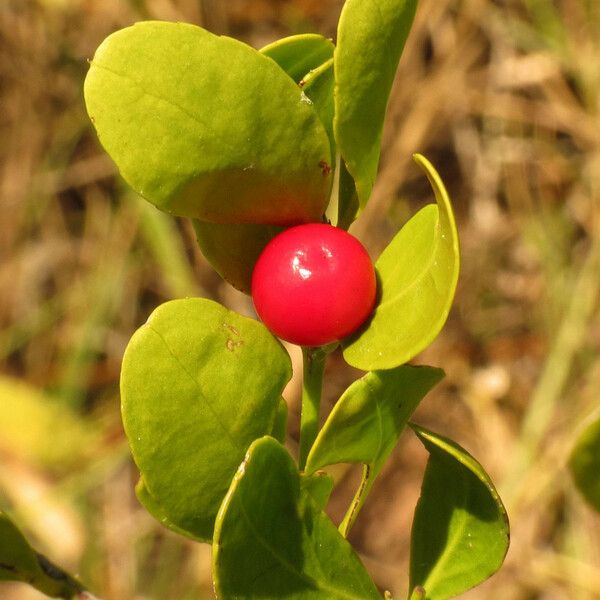
Plant Overview
Known as the Maidenberry or Rhacoma, this understated evergreen is a quiet hero of the Florida, Caribbean, and Central American coastlines. With its delicate, lacy flowers and vibrant red fruit, it bridges the gap between wild coastal scrub and refined garden aesthetics. It is a favorite for those looking to create a "living birdfeeder" in their backyard without the mess of larger, more aggressive trees.
🔍 How to Identify
- 🍃 The Foliage: Leaves are small, leathery, and arranged oppositely along the stems. They usually have a subtle, scalloped or "toothed" edge and a deep green luster that stays vibrant year-round.
- 🍒 The Berries: Its most striking feature is the clusters of tiny, brilliant red drupes. These berries ripen at various times, often providing a constant pop of color against the green leaves.
- 🌸 The Blooms: The flowers are minuscule and can be greenish-white or reddish-brown. You might need a magnifying glass to see their intricate, four-petaled structure, which appears in small clusters at the leaf axils.
🏡 In Your Garden
- 🏖️ Coastal Resilience: Maidenberry is exceptionally salt-tolerant. It has evolved to thrive in coastal hammocks and pinelands, making it a "must-have" for seaside gardens where salt spray often kills less hardy ornamental plants.
- 🪴 Low Maintenance: It has a naturally slow growth rate and a tidy, rounded habit. This means you rarely have to reach for the pruning shears; it maintains its compact shape with almost no intervention from the gardener.
- 🦋 Wildlife Hub: If you want to attract songbirds like Catbirds or Mockingbirds, this is your plant. The berries provide a high-energy snack, while the dense branching offers excellent nesting cover for smaller birds.
⚠️ Safety & Toxicity
- ✅ Safe Profile: Crossopetalum rhacoma is generally considered non-toxic to humans and pets upon contact. It is a "friendly" shrub for high-traffic areas.
- 🐦 For the Birds: While the berries are a gourmet treat for local bird populations, they are not considered a human food source. Always discourage children from tasting wild berries to avoid potential stomach upset.
✨ Fun Fact
The genus name Crossopetalum is derived from the Greek words krossos (meaning "fringe") and petalon (meaning "petal"). If you look closely at the tiny flowers, you will see the delicate, fringed edges that give the plant its scientific name!

Detailed Care Instructions
To successfully grow Crossopetalum Rhacoma plant, also known as Cape Gooseberry or Ground Cherry, follow these tips:
- Climate: This plant thrives in warm and tropical climates. It requires temperatures ranging from 65-80°F (18-27°C) to grow well.
- Soil: Choose well-draining soil with a pH around 6-7. The soil should be rich in organic matter and moisture-retentive.
- Planting: Start by obtaining seeds or seedlings. Sow the seeds indoors in seed trays or pots, or directly outdoors after the last frost. Plant the seeds at a depth of approximately half an inch (1.25 cm) and keep them evenly moist. Once the seedlings have grown a few inches tall, transplant them into bigger pots or directly into the ground, allowing 2-3 feet (60-90 cm) of space between plants.
- Sunlight: Place the plants in a location where they will receive full sun for at least 6-8 hours a day. Crossopetalum Rhacoma performs best in bright sunlight.
- Watering: Keep the soil consistently moist, especially during dry spells or in hot weather. However, avoid overwatering as it may lead to root rot. Watering once or twice a week, depending on the soil moisture level, should be sufficient. Mulching around the plants can help retain soil moisture.
- Fertilizing: Apply a balanced, slow-release fertilizer or organic compost during the growing season to provide necessary nutrients. Follow the instructions on the fertilizer packaging for appropriate dosage.
- Pruning: Prune the plant to maintain its shape and remove any dead or diseased branches. Regular pruning also helps promote better airflow and increases fruit production.
- Pests and diseases: Keep an eye out for common pests like aphids, whiteflies, or caterpillars. Treat any infestation promptly with organic insecticides or horticultural oils. The plants may also be susceptible to fungal diseases, so ensure good air circulation and avoid overhead watering which can promote fungal growth.
- Harvesting: Crossopetalum Rhacoma fruit is ready for harvest when the husks turn papery and golden-brown, indicating maturity. Harvest the fruits by gently twisting and pulling them from the stem. They are typically ripe within 70-80 days after planting.
By following these guidelines, you can successfully grow Crossopetalum Rhacoma plants and enjoy their delicious fruits.

To effectively water this particular plant, it is important to consider several factors. First, it is essential to ensure that the soil is well-draining, as the plant may be susceptible to root rot if left in standing water. Secondly, it is recommended to water the plant deeply and thoroughly, allowing the water to penetrate the soil and reach the roots. This can be done by watering until the excess water runs out of the drainage holes in the pot. It is also important to avoid over watering the plant, as this can lead to issues such as leaf yellowing or leaf drop. Lastly, it is recommended to allow the soil to dry out slightly between waterings, as this can help prevent issues related to over watering.
To fertilize this plant, apply a balanced fertilizer with an NPK ratio of 10-10-10. Apply the fertilizer every two to three months during the growing season, which is typically spring to summer. Be sure to follow the manufacturer's instructions on the amount of fertilizer to use. Water the plant thoroughly before and after fertilizing to prevent root burn. Additionally, try to avoid getting fertilizer on the foliage or stem of the plant, as this could cause damage or burn.
Crossopetalum Rhacoma, known by various common names, is a plant that requires well-draining soil that is slightly acidic in nature. The ideal soil mix would include a combination of peat, perlite, and sand or gritty materials to improve drainage. The plant also prefers nutrient-rich soil, so adding organic matter such as compost or aged manure is recommended. The pH level of the soil should be around 5.5-6.5. The plant should be planted in a container with drainage holes to prevent waterlogging. It is important to avoid heavy clay soils or soils that have poor drainage.
To propagate this plant, first select a healthy stem cutting that is 4-6 inches long. Remove any leaves from the bottom 2 inches of the stem. Dip the cut end of the stem in rooting hormone. Plant the stem in well-draining soil and keep it moist but not waterlogged. Place the cutting in a warm, bright spot with indirect sunlight. Ensure that the temperature remains above 60°F. Roots will generally form within 2-4 weeks. After the roots have developed, the cutting can be transplanted into a larger pot or planter.








