Plant Overview
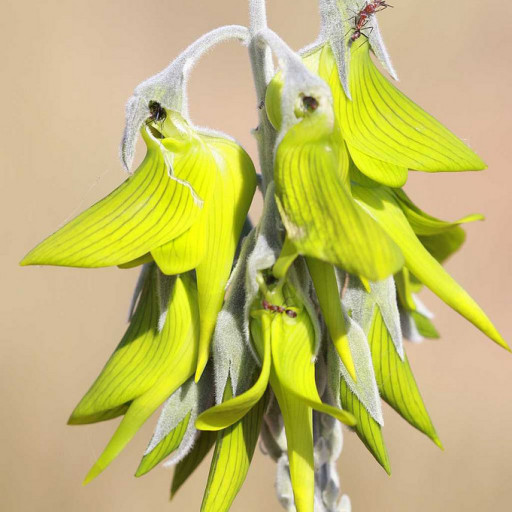
Often called the "Green Birdflower," this Australian native looks like a flock of tiny emerald hummingbirds frozen in mid-flight. Thriving in the harsh, sandy environments of the Outback, it is a member of the pea family that has gained viral fame for its uncanny optical illusions. It is a hardy survivor that brings a touch of whimsical mimicry to any arid landscape.
🔍 How to Identify
- 🦜 The "Bird" Bloom: The most striking feature—large, pea-like flowers of vivid lime green with dark purple veins, shaped exactly like a tiny bird with its beak attached to the stalk.
- 🍃 Velvety Foliage: The leaves are large, oval, and covered in fine, silvery-grey hairs, giving the entire plant a soft, felt-like texture.
- 🪵 Shrubby Habit: A perennial shrub that can grow up to 9 feet tall, featuring thick, woody stems and a branched, upright structure.
🏡 In Your Garden
- 🏜️ Sand & Drainage: Coming from coastal sand dunes, this plant demands exceptional drainage. It thrives in sandy or gravelly soils and will quickly suffer from "wet feet" and root rot in heavy clay.
- ☀️ Sun & Heat: It is a true sun-worshipper. To produce its iconic bird-shaped flowers, it requires full sun and high temperatures; it is not frost-hardy and should be moved indoors or protected in winter.
- 🪴 Taproot Sensitivity: Like many desert plants, it develops a deep taproot to seek out moisture. This makes it very difficult to transplant, so choose its "forever home" in your garden carefully.
⚠️ Safety & Toxicity
- 🚫 Toxicity Level: High if ingested. Like many members of the Crotalaria genus, it contains pyrrolizidine alkaloids.
- 🐾 Details: These compounds are toxic to livestock, horses, and household pets. Ingestion can lead to cumulative liver damage, so it is best kept out of reach of curious animals and children.
✨ Fun Fact
While the flowers look remarkably like birds to human eyes, scientists believe this is a "happy accident" of evolution (automorphism) rather than a defense mechanism. To its actual pollinators, like bees and honeyeaters, the "bird" shape is simply a highly efficient landing platform for nectar collection!

Detailed Care Instructions

Place in a bright room that is sun drenched almost all day. Or directly in a south-facing window.

To water this particular plant, it is important to check the soil moisture level before watering. This can be done by sticking a finger into the soil up to the second knuckle. If the soil feels dry, it is time to water. When watering, it is best to soak the soil thoroughly, allowing the water to penetrate deep into the roots. It is important not to overwater the plant, as this can lead to root rot. Watering once or twice a week is usually sufficient, but the frequency may depend on the climate and the growing conditions. It is also important to avoid getting water on the leaves, as this can promote fungal growth.
To maintain their leaves healthy and green, these plants need a lot of nitrogen. Because they rely on fertilizers to grow, fertilize them once a week with diluted fertilizers. The plants housed in containers need fertilizers more frequently. However, adding excessive fertilizers makes it hard for the roots to take up water that causes their leaves to turn yellow or brown.
You may use All Purpose Plant Food for your Birdflower Rattlepod
The most suitable type of soil for the plant you mentioned is a well-draining sandy loam soil with a pH of between 5.5 and 7.5. This plant prefers a nutrient-rich soil that is high in organic matter and is well-aerated. It is important to ensure that the soil is not water-logged, as this can lead to root rot and other issues. Additionally, it is recommended to fertilize the plant with a balanced fertilizer every two months during the growing season. Overall, this plant thrives in a soil that is well-draining, nutrient-rich, and has a pH within a certain range.
Common pests of the birdflower rattlepod include Scale insect, mealybugs, spider mites, aphids. Make a habit of checking your birdflower rattlepod frequently for pests so that any infestations can be caught and managed early.








