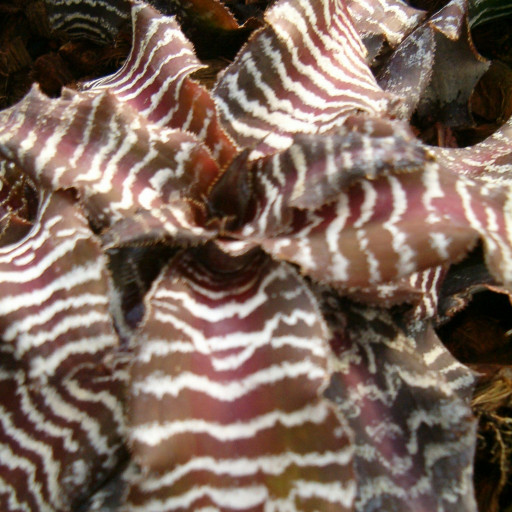
Plant Overview
Often called the "Earth Star" or "Zebra Plant," Cryptanthus zonatus is a low-profile beauty that brings a touch of the Brazilian rainforest floor to your home. Unlike its air-dwelling bromeliad cousins that cling to trees, this plant prefers to stay grounded, forming a striking, flat rosette that looks like a fallen star etched with cosmic patterns. Its slow growth and dramatic foliage make it a favorite for terrarium enthusiasts and coffee table displays alike.
🔍 How to Identify
- 🌟 The Rosette: It grows in a very low, flat, spreading star shape that hugs the soil, rarely exceeding 4 to 6 inches in height.
- 🦓 Zebra Stripes: The leaves are famously marked with horizontal, wavy bands of silver or creamy white against a dark green or bronzy-purple background.
- 🦷 Serrated Edges: Each leaf is stiff and features slightly wavy margins lined with tiny, sharp teeth—a classic defense mechanism of the bromeliad family.
🏡 In Your Garden
- 🌱 Rooted in Soil: Unlike most bromeliads (epiphytes), the Earth Star is terrestrial. It has a functional root system and requires a moisture-retentive but well-draining potting mix rather than just being mounted on wood or bark.
- ☁️ Humidity & Light: It is a champion of high-humidity environments. If you notice the leaf tips turning brown, it is likely thirsty for more ambient moisture. While it loves bright, indirect light to keep its "zebra" colors vivid, harsh direct afternoon sun can bleach the leaves.
⚠️ Safety & Toxicity
- 🐾 Pet Friendly: Good news for pet owners—the Cryptanthus zonatus is generally considered non-toxic to cats, dogs, and horses.
- 🌵 Prickly Texture: While it isn't poisonous, the tiny spines along the leaf edges can be quite sharp. Handle with care during repotting to avoid minor skin irritation or scratches.
✨ Fun Fact
The name Cryptanthus is derived from the Greek words kryptos (hidden) and anthos (flower). This is because its tiny, white three-petaled flowers are often tucked so deeply into the center of the rosette that you might miss them entirely!

Detailed Care Instructions
To grow Cryptanthus Zonatus (also known as Earth Star) successfully, follow these steps:
- Choose the right pot: Select a pot that is shallow and wide, as these plants have shallow root systems. Ensure the pot has drainage holes to prevent waterlogging.
- Soil: Use a well-draining potting mix suitable for succulents or bromeliads, or create your own blend by mixing equal parts of peat moss, perlite, and coarse sand.
- Lighting: Cryptanthus Zonatus plants thrive in bright, indirect light. Place them near a window that receives filtered sunlight or provide artificial grow lights if necessary. Avoid placing them in direct sunlight, as it can scorch the leaves.
- Temperature and Humidity: These plants prefer warm temperatures between 65-85°F (18-29°C). Maintain a humidity level of 40-60% by misting the leaves occasionally or placing the pot on a tray filled with pebbles and water.
- Watering: Water the plant when the top inch of the soil feels dry. Avoid overwatering, as it can lead to root rot. Pour water into the center of the rosette (where the leaves meet) until it drains out of the bottom. Empty any excess water from the saucer to prevent the plant from sitting in water.
- Fertilization: Feed the plant with a balanced liquid fertilizer diluted to half the recommended strength every 2-4 weeks during the growing season (spring and summer). Avoid fertilizing during winter or when the plant is not actively growing.
- Propagation: Cryptanthus Zonatus can be propagated by removing the offsets (pups) that form around the base of the plant. Gently remove the pup and plant it in its pot with well-draining soil. It will gradually develop into a full-sized plant over time.
- Maintenance: Trim off any dead or damaged leaves with sharp, sterilized scissors. Gently remove any dust or debris from the leaves using a soft, damp cloth.
By following these guidelines and providing the right care, your Cryptanthus Zonatus plant should grow and thrive for years to come.

Place in a dark room with little light, like a dark bedroom or a spot far away from a window or directly in a north-facing window.

Cryptanthus Zonatus is a tropical plant that requires moderate watering. It is important to ensure that the soil is moist but not waterlogged. You can use a watering can or a spray bottle to water the plant. Watering should be done when the top layer of soil feels dry to the touch. Pour water slowly near the base of the plant, making sure not to wet the leaves. Overwatering can lead to root rot and kill the plant, so it is best to err on the side of under watering. It is also recommended to use room temperature or warm water as cold water can shock and damage the roots of the plant. Additionally, make sure that the pot has proper drainage to prevent water from accumulating at the bottom of the pot.
- Choose a balanced fertilizer with an N-P-K ratio of 10-10-10.
- Dilute the fertilizer according to the manufacturer's instructions.
- Water the plant before fertilizing.
- Apply the diluted fertilizer evenly around the base of the plant.
- Avoid fertilizing directly on the leaves or in the center of the rosette.
- Repeat fertilization every two to three months during the growing season (spring and summer).
- Reduce fertilization to once every six months during the dormant season (fall and winter).
- Monitor the plant for any signs of overfertilization, such as yellowing or wilting leaves, and adjust accordingly.
For optimum growth and health, it is recommended to use a well-draining soil mix that is rich in organic matter. The soil should have a balanced pH level of around 6.0-7.0. Avoid heavy, water-retentive soils that may cause root rot. It is also important to avoid using soil that has been previously used for growing plants that are susceptible to diseases. A mix of peat moss, perlite, and vermiculite is often a good choice for growing Cryptanthus Zonatus. Additionally, it is recommended to add some sand or grit to the soil to improve drainage.
To propagate this plant, start by selecting a healthy mother plant with multiple offsets or pups growing at its base. Using a clean, sharp blade or scissors, carefully separate the pups from the main plant, ensuring that each pup has its own set of roots and a small portion of the mother plant's stem.
Next, prepare a well-draining potting mix by combining equal parts of peat, perlite, and sand. Choose a small pot with drainage holes and fill it halfway with the potting mix. Place the pup in the center of the pot and gently press the soil around it, ensuring that the pup is at the same depth as it was in the mother plant. Water the soil until it is moist but not waterlogged and allow the excess water to drain away.
Place the newly planted pup in a bright location with indirect sunlight and maintain a consistent temperature between 65-75°F (18-24°C). Keep the soil evenly moist but not waterlogged, as Cryptanthus Zonatus plants do not like to sit in wet soil.
Within a few weeks, the pup should start to develop new roots and begin growing. Once the plant has established itself and begun producing new leaves, it can be fertilized with a balanced, water-soluble fertilizer every two to four weeks. With proper care and attention, your newly propagated Cryptanthus Zonatus plant will thrive and grow into a beautiful specimen.
Common pests of the earth star include Scale insect, mealybugs, spider mites. Make a habit of checking your earth star frequently for pests so that any infestations can be caught and managed early.








