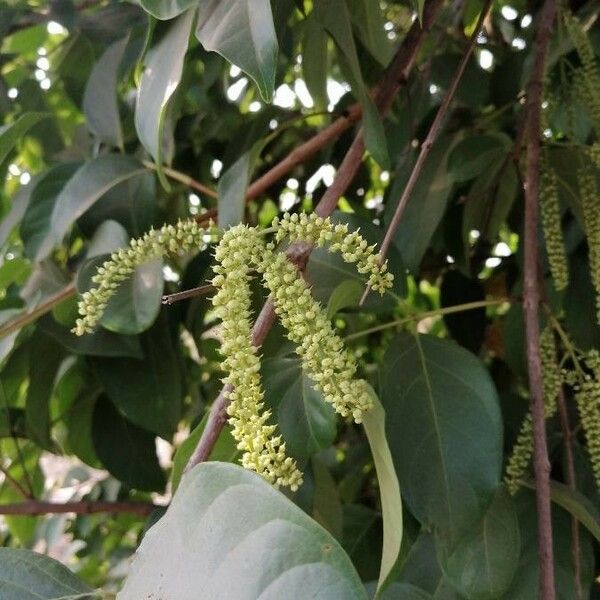
Plant Overview
Known in many parts of Southeast Asia as the Bekoi or Hairy Crypteronia, this tree is a quiet giant of the tropical rainforest. Often found leaning over riverbanks or towering in moist valleys, it is prized for its sturdy timber and its role as a cornerstone of the forest canopy. While rarely seen in urban backyard gardens, it is a legendary figure in the jungles of Malaysia and Thailand.
🔍 How to Identify
- 🍃 The Leaves: They are large, oval, and grow in pairs directly opposite each other. If you look closely at the underside, you’ll notice a fine, velvety hairiness that gives the "hairy" species its name.
- 🌸 The "Panicle" Flowers: Its scientific name, paniculata, refers to its branching flower clusters. These tiny, greenish-white blossoms lack petals and look like delicate, fuzzy sprays emerging from the branch tips.
- 🌳 The Bark: The trunk is usually straight and greyish-brown, with bark that tends to flake off in thin, rectangular strips as the tree matures.
🏡 In Your Garden & Habitat
- 💧 Water Enthusiast: In the wild, this tree is a "riparian" specialist, meaning it loves being near moving water. It thrives in deep, loamy soils that stay consistently moist but never stagnant.
- ☀️ Sun Seeker: As a forest tree, it starts its life in the dappled shade of the understory but eventually pushes through to the canopy to soak up full, intense tropical sunlight.
- 🌱 Root Room: Because it can grow quite tall (reaching up to 30 meters), it is not suitable for pots or small residential gardens. It requires vast underground space for its stabilizing root system.
⚠️ Safety & Toxicity
- ✅ General Safety: Crypteronia paniculata is generally considered non-toxic to touch. It does not possess stinging hairs or caustic sap.
- 🐾 Pet & Child Safety: While there are no records of it being highly poisonous, it is not an edible plant. In traditional medicine, the leaves are sometimes used topically for skin issues, but they should never be ingested without expert guidance.
✨ Fun Fact
The name Crypteronia comes from the Greek words kryptos (hidden) and eros (love). This poetic name refers to the plant’s tiny, "hidden" reproductive parts within its very small flowers!

Detailed Care Instructions

Place in a window with dappled sun or a spot in the middle of a room. Or directly in a window facing west or east.

When the top few inches of soil dry out, water your plants. If the top few inches of soil are still moist, do not water your plant. Wait a few days, then poke your finger into the soil to see if anything has changed. Overwatering poses a disease risk, such as the development of fungal diseases in the roots. These plants have adaptations in there leaves that allow them to survive in low water supply.








