Plant Overview
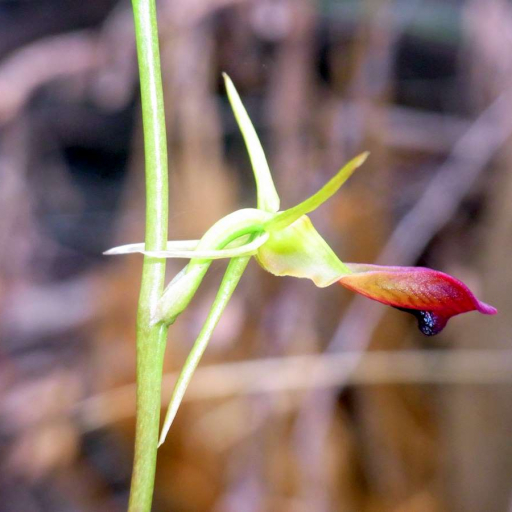
Often called the Large Tongue Orchid, this Australian native is a master of disguise and deception. Rising from the damp heaths and coastal forests of Eastern Australia, it looks less like a traditional flower and more like a strange, maroon-colored insect perched on a tall green stem. It is a terrestrial orchid, meaning it grows directly from the ground rather than clinging to trees like its tropical cousins.
🔍 How to Identify
- 👅 The Labellum: The standout feature is a large, leathery, reddish-brown "tongue" (the labellum) that points upwards. This is unusual, as most orchids have their "lip" pointing toward the ground.
- 🌿 The Leaf: A single, stiff, lance-shaped leaf appears at the base. It is dark green on the surface and often carries a subtle purple or reddish tint on the underside.
- 📏 The Stem: A smooth, slender, and upright flowering stalk that can reach heights of nearly 3 feet (80cm), hosting multiple flowers that bloom one after another.
🏡 In Your Garden
- 🧪 Fungal Friendships: This orchid is a "wild child" and is notoriously difficult to grow in home gardens. It relies on a complex "mycorrhizal" relationship with specific soil fungi to absorb nutrients; without this invisible partner, the plant will eventually fade away.
- 💧 Wetland Preferences: In its natural habitat, it thrives in "wallum" country—sandy, coastal areas that stay seasonally damp. If you encounter it in the wild or a specialized native garden, it indicates acidic, moist, and well-draining soil.
- 🚫 Leave It Be: Because of its delicate root system and fungal dependency, it rarely survives being transplanted. It is best enjoyed in its natural habitat rather than being brought indoors.
⚠️ Safety & Toxicity
- 🐾 Safe for Pets: There are no known toxic effects for dogs, cats, or horses. Like most members of the Orchidaceae family, it is generally considered non-toxic.
- 🌱 Fragile Anatomy: While not poisonous to humans, the plant is physically vulnerable. Its underground rhizomes are easily crushed by foot traffic, and its reproductive success depends entirely on its environment remaining undisturbed.
✨ Fun Fact
The Large Tongue Orchid is a romantic scammer! It produces no nectar. Instead, it emits a chemical scent that perfectly mimics the pheromones of a female Orchid Wasp. Male wasps are so convinced by the smell and the "insect-like" shape of the flower that they attempt to mate with it, inadvertently picking up pollen to carry to the next orchid.

Detailed Care Instructions

Some plants require more regular watering than others, which should be done every few days. It's critical to maintain the soil moist all of the time. The water requirements of the same plant placed in pots with varying sizes will differ. Because the water in the smaller pot evaporates faster than the water in the larger pot, it will require more watering. Regardless of pot size, the surface should constantly be maintained moist.








