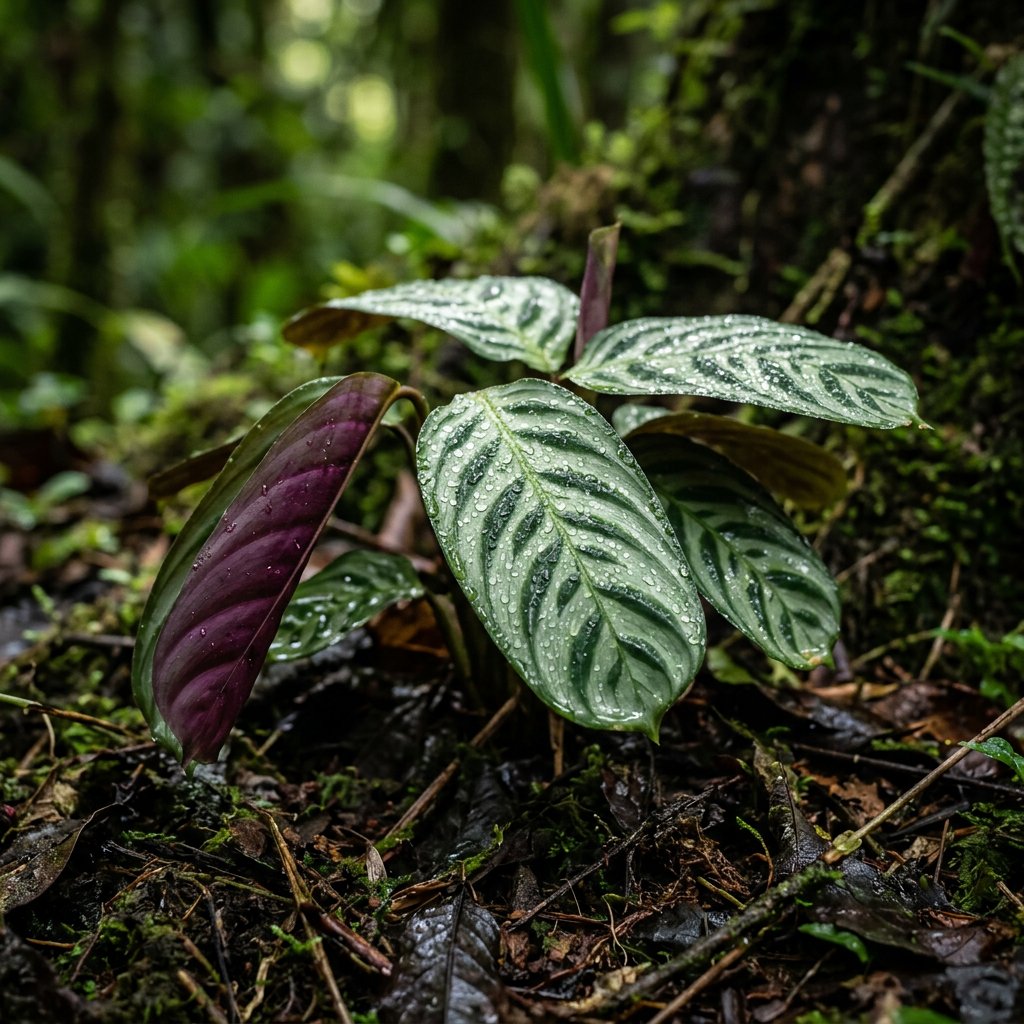
Plant Overview
Known as the "Fishbone Prayer Plant," this striking Brazilian native is named after the legendary landscape architect Roberto Burle Marx. It belongs to the Marantaceae family, famous for their "prayer" habits where they fold their leaves upward at night as if in quiet meditation. With its bold, graphic patterns, it looks less like a plant and more like a piece of living mid-century modern art.
🔍 How to Identify
- 🌿 Leaf Pattern: Oval-shaped leaves featuring a dark green "herringbone" or fishbone pattern that radiates from the central vein against a pale silver-green background.
- 🍷 Undersides: Flip a leaf over to find a deep, rich burgundy or matte purple underside, which provides a stunning flash of color when the plant "prays."
- 📏 Growth Habit: It is a low-growing, clumping perennial that spreads via underground rhizomes, creating a dense, bushy appearance rather than climbing upwards.
🏡 In Your Garden
- ☁️ Humidity is King: This plant hails from the humid tropical floor of Brazil. If the air in your home is too dry, the edges of those beautiful leaves will quickly turn brown and crispy as a cry for help.
- 🚿 Water Sensitivity: It can be a bit of a "diva" regarding tap water. It prefers rainwater or filtered water to avoid the chlorine and fluoride that often cause spotty, yellowing leaf tips.
- 🌖 The Light Dance: To keep its patterns vibrant, it needs bright, indirect light. Direct afternoon sun will "bleach" the colors out of the leaves, while deep shade may stop its nightly movement.
⚠️ Safety & Toxicity
- 🐾 Pet-Friendly: Unlike many other tropical houseplants, the Ctenanthe is non-toxic to cats and dogs, making it a "worry-free" choice for pet owners.
- 👶 Child Safe: It is considered non-toxic to humans. It lacks the irritating sap found in plants like Philodendrons, making it safe for curious toddlers.
✨ Fun Fact
- 🕰️ Circadian Rhythm: The movement of the leaves is controlled by a pressure-changing "joint" called a pulvinus. This allows the plant to follow the sun’s path during the day and fold up at night to collect dew or prevent water from sitting on its foliage.

Detailed Care Instructions
| Color | White, But Insignificant |
| Soil Ph | Acidic, Neutral |
| Humidity | Normal |
| Lighting | Part Sun |
| Toxicity | Poisonous |
| Soil Type | Well-Drained, Moist |
| Bloom Time | Varies Depending On Conditions |
| Difficulty | Medium |
| Plant Type | Perennial, Evergreen |
| Mature Size | Leaves May Reach Up To 12″ Inches In Length |
| Native Area | Central And South America |
| Temperature | 26°C - 31°C |
| Sun Exposure | Partial Shade |
| Hardiness Zones | 9-12 |
To grow a Ctenanthe Burle-marxii plant, follow these steps:
- Lighting: These plants prefer bright, indirect light. Avoid direct sunlight, as it can scorch the leaves. Place them near a window that receives bright, filtered light or use artificial grow lights.
- Temperature: They thrive in temperatures between 65-75°F (18-24°C). Keep them away from drafts or sudden temperature changes.
- Humidity: Ctenanthe Burle-marxii plants appreciate high humidity levels, ideally around 50-60%. You can increase humidity by misting the leaves regularly or placing the pot on a pebble tray filled with water.
- Watering: Keep the soil consistently moist but not waterlogged. Water the plant when the top inch of soil feels slightly dry. Avoid letting it dry out completely or sitting in standing water.
- Soil: Use well-draining soil that retains some moisture. A mixture of peat moss, perlite, and regular potting soil works well. Avoid heavy clay soils.
- Fertilizer: Feed your Ctenanthe Burle-marxii with a balanced liquid fertilizer diluted to half the recommended strength during the growing season (spring to summer). Reduce or stop fertilizing in the winter.
- Propagation: You can propagate the plant by division. Carefully separate the plant into smaller clumps so each has some roots attached. Replant them in separate pots with fresh soil.
- Pruning: Remove any yellow or dead leaves regularly. Pruning can also help maintain a compact and neat appearance.
- Repotting: Repot the plant when it becomes root-bound or every 1-2 years. Choose a pot slightly larger than the current one and use fresh potting soil.
- Pests and diseases: Monitor your plant for common pests like aphids, spider mites, and mealybugs. If you notice any infestations, treat the plant accordingly with safe pest control measures.
By following these guidelines, your Ctenanthe Burle-marxii plant should grow healthy and vibrant.

Place in a window with dappled sun or a spot in the middle of a room. Or directly in a window facing west or east.

To properly water this plant, it is important to consider the environment in which it is growing. The soil should be kept consistently moist, but not waterlogged. It is best to water deeply when the top inch of soil feels dry to the touch. This can be achieved by watering until water starts to drain from the bottom of the pot, allowing excess water to escape. It is important to avoid letting the plant sit in standing water, as this can lead to root rot. Additionally, it is important to ensure that the water used is not too cold, as this can shock the plant and stunt its growth. Ideally, water should be allowed to come to room temperature before use. Lastly, it is important to note that this plant prefers humidity, so misting the leaves, or using a humidifier nearby can provide additional moisture.
To fertilize the plant, a balanced liquid fertilizer can be used during the growing season (spring and summer) every two weeks. During the dormant season (fall and winter), fertilization can be reduced to once a month. It is important to dilute the fertilizer according to the manufacturer's instructions and avoid getting the fertilizer on the leaves. Over-fertilization can lead to burning and damaging the roots.
To grow the Ctenanthe Burle-marxii plant, it is recommended to use a well-draining soil mixture that is rich in organic matter. A pH level of 6.0 to 7.0 is suitable for optimal growth. You can use a mix of peat moss, perlite, and a small amount of sand to improve drainage. Adding compost or other organic matter can also provide the necessary nutrients for the plant's growth. Avoid using heavy or compacted soil, as it may lead to waterlogging and root rot. It is also important to ensure that the soil is moist but not waterlogged, as this plant prefers consistent moisture but can be sensitive to overwatering.
To propagate this plant, you can take stem cuttings from the parent plant. Select a healthy stem with several leaves and make a clean cut using sharp, sterilized pruning shears. Remove any lower leaves from the stem, leaving only a few at the top.
Dip the cut end of the stem in rooting hormone and place it in a pot filled with moist, well-draining soil. Cover the pot with a plastic bag or a clear plastic lid to create a humid environment.
Place the pot in a warm, bright location but out of direct sunlight. Keep the soil evenly moist but not waterlogged, and mist the cutting regularly to maintain humidity.
Check the cutting after a few weeks by gently tugging on it. If you feel resistance, it has rooted and can be removed from the plastic bag or lid. If it has not rooted yet, reseal the plastic and check again in a week or two.
Once the cutting has rooted, begin to acclimate it to lower humidity by gradually removing the plastic covering. Transplant it into a larger pot with regular potting mix and care for it as you would a mature Ctenanthe Burle-marxii plant.








