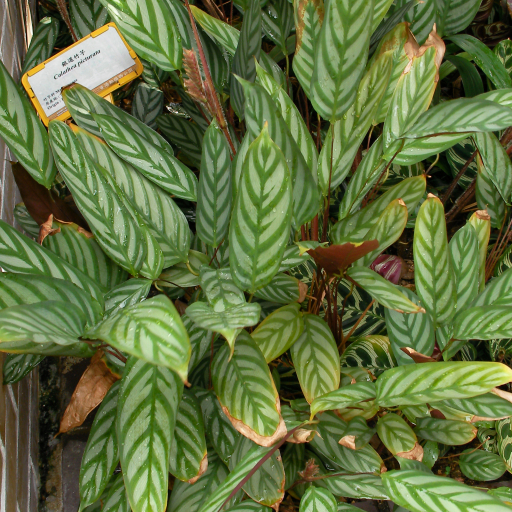
Plant Overview
Known as the "Grey Star" or the "Never-Never Plant," this Brazilian beauty is a rhythmic masterpiece for the indoor jungle. A prominent member of the prayer plant family (Marantaceae), it is famous for its "nyctinasty"—the daily ritual of folding its leaves upward at night as if in prayer and lowering them again to catch the morning sun.
🔍 How to Identify
- 🎨 Silvery Foliage: The leaves are long, lance-shaped, and feature a stunning metallic silver-grey upper surface.
- 🌿 Fishbone Veins: Look for distinct, dark green veins that branch out from the center in a "herringbone" or fishbone pattern.
- 🍷 Burgundy Underside: Flip a leaf over to find a striking, deep wine-red or burgundy underside that provides a dramatic contrast.
- 📏 Stately Stature: Unlike some of its low-growing cousins, the Setosa can reach heights of nearly 3 feet, standing on elegant, bamboo-like stems.
🏡 In Your Garden
- ☁️ Humidity is Key: Coming from the humid rainforest floor, this plant "breathes" through moisture. If your indoor air is too dry, it will signal its distress by curling its leaves or developing crispy, brown edges.
- 💧 The "Diva" Factor: It is notoriously sensitive to chemicals found in tap water, such as fluoride and chlorine. If the leaf tips turn brown despite high humidity, it’s likely a reaction to your water source; try using rainwater or distilled water instead.
- ⛅ Indirect Light: Because it naturally grows under the dense canopy of trees, direct sunlight will "bleach" the silver color and burn the delicate leaves. It prefers "dappled" or bright, indirect light.
⚠️ Safety & Toxicity
- 🐾 Pet Friendly: Great news for animal lovers! Ctenanthe setosa is considered non-toxic to cats and dogs.
- 👶 Child Safe: It is generally safe for households with curious toddlers, as it contains no known major toxins.
- 🧼 Cleanliness: Keep the large leaves dust-free with a damp cloth to ensure the plant can photosynthesize efficiently and stay pest-free.
✨ Fun Fact
The "joint" at the base of each leaf, called the pulvinus, acts like a tiny muscle. It changes pressure to move the leaf toward the light throughout the day, making the Ctenanthe one of the most "active" and expressive plants you can own!

Detailed Care Instructions
Readily available in garden stores, Ctenanthe species are often mislabeled as Calathea, and Calathea plants are mislabeled as prayer plants. Calathea plants tend to grow more upright and bushy, and they a seemingly endless leaf colors and patterns, while Ctananthe species have much more limited variations.
How hard it is to grow Ctenanthe setosa 'Grey Star' outdoors?
It's kept mostly as a houseplant, but if you can offer Ctenanthe setosa enough humidity and water, it can also make a lush and relatively hardy addition to a shady, tropical-type garden. They can thrive in containers on shady and warm patios, and they will add a striking contrast when grown alongside dense ground covers.
Why do Ctenanthe plants fold up their leaves at night?
This phenomenon of folding up their leaves at night is why Ctenanthe plants are called prayer plants. This behavior is known as "nyctinasty" in the horticulture world. Although the exact reason isn't clear, the plant may be responding to changes in light, temperature, and it may just be a way of efficiently protecting itself from pests.
To grow Ctenanthe Setosa, also known as the Grey Star Prayer Plant, you can follow these steps:
- Choose a suitable location: Ctenanthe Setosa prefers bright, indirect light. It should be placed in an area that receives partial sunlight or bright, filtered light. Avoid direct sunlight as it can scorch the leaves.
- Provide the right temperature and humidity: This plant thrives in warm temperatures between 65-80°F (18-27°C) during the day and slightly cooler temperatures at night. It also prefers high humidity levels. If the air is dry, consider using a humidifier or placing a tray of water near the plant to increase humidity.
- Watering: Keep the soil consistently moist, but not soggy. Allow the top inch of the soil to dry before watering again. Avoid overwatering as it can lead to root rot. Use room temperature, filtered water to prevent mineral build-up.
- Fertilizing: Feed the plant once a month during the growing season (spring and summer) with a balanced houseplant fertilizer diluted to half strength. Avoid fertilizing during the winter months when the plant is in its dormant phase.
- Pruning: Trim off any brown or yellow leaves to maintain the plant's overall health and appearance. Pruning can also help manage the plant's size.
- Repotting: Once every two years, or when the plant becomes root-bound, repot it into a slightly larger pot with fresh, well-draining soil. This will provide the plant with fresh nutrients and space to grow.
- Propagation: Ctenanthe Setosa can be propagated through division. Carefully separate the offshoots that develop at the base of the plant and plant them in separate pots with well-draining soil.
- Pest control: Keep an eye out for common houseplant pests like spider mites or mealybugs. If spotted, use insecticidal soap or neem oil to control the infestation.
Remember to observe and respond to the specific needs of your Ctenanthe Setosa plant. With proper care and attention, it should grow and thrive.

Place in a window with dappled sun or a spot in the middle of a room. Or directly in a window facing west or east.

To water this plant, fill a watering can with room temperature water and pour it slowly onto the soil around the base of the plant. Allow the soil to fully absorb the water before watering again. Ensure that the soil remains moist but not waterlogged, as too much water can cause root rot. Avoid getting water on the leaves as this may lead to fungal growth. Water the plant more frequently during hot, dry weather and reduce watering during the winter when the plant is not actively growing.
- Use a balanced, water-soluble fertilizer.
- Dilute the fertilizer according to package instructions.
- Apply the fertilizer every two weeks during the growing season (spring and summer).
- Do not fertilize during the dormant season (fall and winter).
- Water the plant thoroughly before and after fertilizing.
- Avoid getting fertilizer on the leaves or stems as this can cause burns.
It is recommended to use a well-draining potting mix for this plant to avoid waterlogged soil, which can lead to root rot. A mix of peat moss, perlite or vermiculite, and coarse sand can be used. Additionally, organic matter such as compost or worm castings can be added to provide additional nutrients. It is important to avoid using heavy or clay soils that can lead to poor drainage.
To propagate this plant, first choose a healthy and robust stem. Using a sterile pair of scissors, cut a portion of the stem that is at least 3-4 inches long and includes 2-3 leaves.
Remove the lower leaves from the stem cutting, leaving only the top few leaves. Dip the bottom end of the stem cutting into rooting hormone powder and then insert it into a well-draining potting mix. To help retain moisture, cover the pot with a plastic bag or cling wrap.
Place the pot in a warm, bright but indirect light area. Ensure that the soil remains moist, but not waterlogged. After a few weeks, the cutting should begin to root, and new growth should emerge.
Once new growth begins, remove the plastic bag or cling wrap and gradually expose the plant to more light. Transplant the new plant to a larger pot when it outgrows its current container.
Remember to keep the plant away from direct sunlight, as it can scorch the delicate leaves. Water the plant regularly and allow the soil to dry out slightly between watering.








