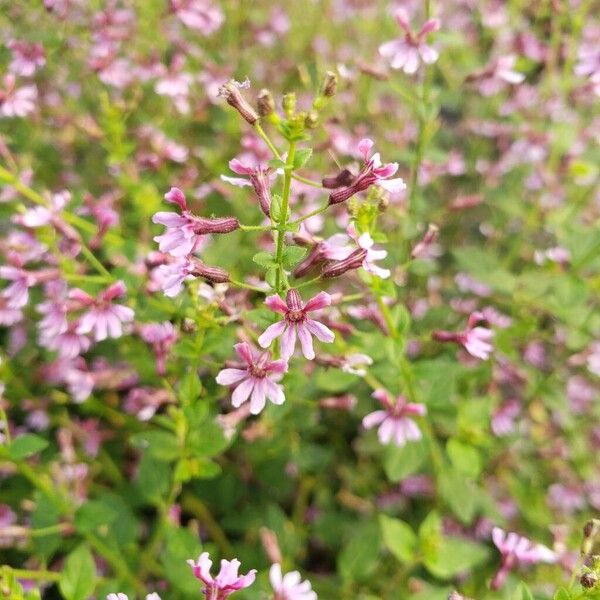
Plant Overview
Known for its dainty, purple-hued blossoms and its ability to act as a tireless pollinator magnet, Cuphea ramosissima is the airy, cloud-like relative of the more famous "Cigar Plant." Native to South America, particularly the vibrant landscapes of Brazil, it creates a delicate haze of color in garden borders. It is often affectionately nicknamed "Mexican Heather" by mistake, though it boasts a much more intricate, multi-branched structure that gives it a unique, bushy elegance.
🔍 How to Identify
- 🌸 Petal Power: Features tiny, asymmetrical flowers with six petals—the top two are usually larger—appearing in shades of lavender, violet, or deep pink.
- 🌿 Dense Branching: True to its name (ramosissima means "most branched"), it grows in a tight, rounded shrublet shape with hundreds of thin, wiry stems.
- 🍃 Fine Foliage: The leaves are small, narrow, and lance-shaped, arranged oppositely along the stems to create a dense, green backdrop for the flowers.
🏡 In Your Garden
- 🦋 Pollinator Magnet: This plant is a high-energy fuel station for hummingbirds and butterflies, who are drawn to the nectar hidden within its tubular flower bases.
- 💧 Thirsty but Resilient: It thrives in consistent moisture and "hates" having its feet dry out completely. If the soil becomes parched, the plant may drop its lower leaves as a defense mechanism.
- ☀️ Self-Cleaning: One of the best features for hobbyists is that it is "self-cleaning," meaning it sheds spent blooms naturally, so you don't have to spend time deadheading to keep it looking tidy.
⚠️ Safety & Toxicity
- ✅ Non-Toxic Status: Cuphea ramosissima is generally considered safe and non-toxic for humans, dogs, and cats, making it a "worry-free" addition to family gardens.
- 🧤 Mild Irritation: While not poisonous, the stems are covered in tiny, sticky hairs that can occasionally cause very mild skin redness in gardeners with high sensitivity.
✨ Fun Fact
The genus name Cuphea is derived from the Greek word kyphos, which means "curved" or "humped." This refers to the unique, slightly bent shape of the seed capsules that look like tiny, swollen pouches!

Detailed Care Instructions







