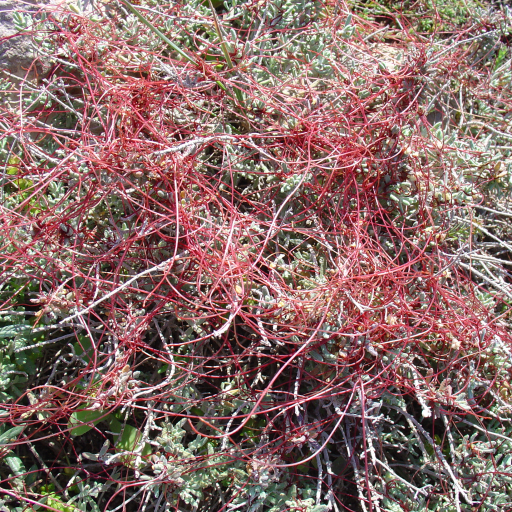
Plant Overview
Often called "Devil’s Guts," "Hellweed," or "Witch’s Hair," Cuscuta epithymum (Lesser Dodder) is the true vampire of the botanical world. Lacking leaves and chlorophyll, this parasitic vine doesn't bother with photosynthesis; instead, it survives by stealing life-giving sap from its neighbors. In ancient folklore, its sudden, tangled appearance in fields was often whispered to be the work of dark magic.
🔍 How to Identify
- 🧶 The Stems: Look for thin, thread-like stems that resemble reddish or purplish spaghetti. They lack green color because the plant contains almost no chlorophyll.
- 🌸 The Flowers: In summer, it produces tiny, bell-shaped flowers that are white to pale pink. These grow in dense, globe-like clusters along the leafless stems.
- 🌀 The Growth Pattern: It grows in a chaotic, twining mass. Unlike typical vines that use tendrils to climb, Dodder wraps its entire body tightly around the host plant.
🏡 In Your Garden
- 🧛 The Parasitic Habit: This plant is an "obligate parasite." Once it finds a host—usually clover, thyme, or small shrubs—it pierces the host’s "skin" with tiny pegs called haustoria to suck out water and nutrients.
- 🛑 Management Nuance: If you find this in your garden, you must act quickly. Because it "fuses" its circulatory system with the host, you often cannot remove the Dodder without pruning away the host plant's affected branches entirely.
- 👃 Scent Seekers: Interestingly, Lesser Dodder "sniffs" its prey. Seedlings can actually sense volatile chemicals released by nearby plants and will grow toward their preferred victim.
⚠️ Safety & Toxicity
- 🟢 Status: Non-toxic to touch or accidental ingestion.
- 🌾 Ecological Danger: While not poisonous to humans or pets, it is a high-level threat to your garden's health. It can weaken or even kill host plants by depriving them of energy and spreading plant viruses from one victim to another.
✨ Fun Fact
Dodder is a plant that "forgot" how to be a plant. Because it relies entirely on its host, it has actually shed many of the genes that normal plants use to grow roots and leaves, making its DNA some of the most specialized in the vegetable kingdom!

Detailed Care Instructions
To grow Cuscuta epithymum, also known as dodder, follow these steps:
- Obtain Cuscuta epithymum seeds from a reputable source or purchase a young plant from a nursery.
- Choose a suitable location that receives full sunlight for at least six to eight hours a day.
- Prepare the soil by loosening it with a garden fork or tiller. The soil should be well-draining and fertile.
- Sow the seeds or transplant the young plant into the prepared soil. If sowing seeds, sprinkle them on the soil and lightly press them into the surface.
- Water the planting area thoroughly after sowing or transplanting to ensure good moisture penetration into the soil.
- Keep the soil consistently moist but not waterlogged. Water the plant whenever the top 1-2 inches of soil feels dry.
- Cuscuta epithymum is a parasitic plant that relies on a host plant for nutrients. As it grows, it will wrap itself around nearby plants. Ensure there are suitable host plants nearby for the dodder to attach to. Common host plants include lettuce, tomatoes, morning glory, and chrysanthemums.
- Monitor the dodder growth regularly and remove any unwanted infestations if necessary.
- As the plant matures and produces flowers, it may self-seed and spread on its own, forming new plants in the area.
Note: While some gardeners intentionally cultivate cuscuta species, it is important to note that some species of dodder can be invasive and detrimental to crop production. Therefore, it is essential to research and understand the specific species you are growing and its potential impact on local flora before introducing it into your garden or landscape.

Place in a bright room that is sun drenched almost all day. Or directly in a south-facing window.

Cuscuta Epithymum, also known as Dodder, is a parasitic plant that does not have roots and relies on host plants for water and nutrients.
To water Cuscuta Epithymum, it is important to identify the plants it is attached to and water those plants instead of directly watering the Dodder. When watering the host plants, make sure to target the roots and soil surrounding them.
Avoid over-watering, as this can lead to root rot and fungal diseases for both the host plant and the Dodder. Instead, water the host plant when the soil is dry to the touch.
It is also important to monitor the health of the host plant, as any stress or damage to the host can impact the Dodder's growth and survival.
Overall, watering Cuscuta Epithymum requires a careful balance of providing enough water for the host plant while avoiding excessive moisture and maintaining the health of both the host and the Dodder.
- Begin fertilizing the plant after it has established its roots and begun to grow.
- Use a general-purpose fertilizer with a balanced N-P-K ratio.
- Prepare the fertilizer according to the manufacturer's instructions.
- Apply the fertilizer evenly around the base of the plant.
- Water immediately after fertilizing to help the nutrients absorb into the soil.
- Fertilize once every two weeks during the growing season.
- Avoid over-fertilizing, as this can damage the plant and cause it to produce an excessive amount of foliage instead of flowers or fruits.
- Monitor the plant's growth and adjust the fertilization schedule as needed.
The Cuscuta Epithymum plant prefers a well-draining soil with good porosity. It grows best in soil that is rich in organic matter and nutrients. The ideal soil pH for this plant is in the mildly acidic to neutral range.
It is important to note that the Cuscuta Epithymum plant is a parasitic plant that does not have roots or chlorophyll. As such, it does not need soil or nutrients to survive. Instead, it attaches itself to the stems of other plants and derives its nutrients and water from the host plant. Therefore, it is not necessary to provide soil for the Cuscuta Epithymum plant.
To propagate this plant, first locate a healthy stem with mature leaves and flowers. Cut a 6-8 inch segment of the stem and remove any leaves from the bottom third of the cutting. Dip the cut end of the stem in rooting hormone powder and plant it in a well-draining soil mix. Water the cutting lightly and cover it with a plastic bag to maintain humidity. Place the container in a spot with bright, indirect light and keep the soil moist but not waterlogged. The cutting should root within 2-4 weeks. Once it has established roots, transplant it to a larger container or outdoors in a garden bed with well-draining soil and partial shade.








