Plant Overview
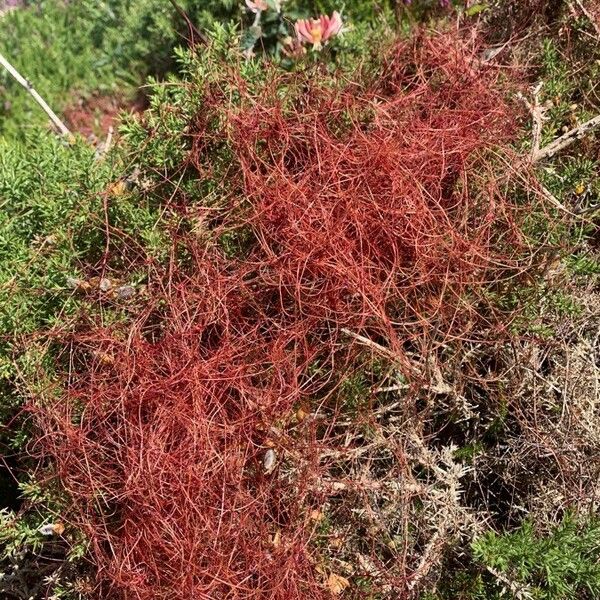
Known by the haunting nicknames "Devil’s Hair," "Hellweed," and "Witch’s Hair," Cuscuta planiflora is one of nature’s most effective botanical thieves. This leafless, rootless parasite looks more like a tangled pile of orange spaghetti than a typical plant. It survives by wrapping itself around a host and literally siphoning the life out of it, making it a fascinating—if slightly villainous—addition to the landscape.
🔍 How to Identify
- 🧶 The Stems: Look for extremely thin, thread-like stems that are typically vibrant yellow, orange, or reddish. They lack green chlorophyll because the plant doesn't perform photosynthesis.
- 🌸 The Flowers: It produces tiny, bell-shaped white or pale-pink flowers that grow in tight, fleshy clusters along the vine.
- 🌀 The Grip: Unlike climbing vines that use tendrils to hold on, Dodder wraps its entire body tightly around the host plant, often forming a dense, messy mat that completely obscures the plant beneath.
🏡 In Your Garden & Ecology
- 🧛 The Vampire Strategy: As an adult, this plant has no roots in the soil. It uses specialized organs called "haustoria" to pierce the stems of its host, stealing water and nutrients directly from the host's vascular system.
- 🌾 A Selective Menace: While it is a wild native in many regions, it can be a nightmare for gardeners and farmers. It particularly loves to target legumes, clover, and small shrubs. If you find it in your garden, it’s usually best to remove the infected host plant entirely to stop the spread.
- 🕵️ The Search: When a Dodder seed germinates, it has only a few days to "sniff out" a host. It actually grows toward the chemical scent of nearby plants. If it doesn't find a victim within a week, the seedling dies.
⚠️ Safety & Toxicity
- 🐾 Mildly Concerning: While not typically considered "poisonous" to touch, Cuscuta species can be toxic to livestock (especially horses) if consumed in large quantities, leading to digestive upset or "staggers."
- 🌱 Garden Threat: The primary "safety" concern is for your other plants. Because it can transmit plant viruses from one host to another through its shared straw-like connection, it is considered a serious agricultural pest.
✨ Fun Fact
Cuscuta planiflora is a botanical bloodhound! Research has shown that Dodder seedlings can actually "smell" their preferred hosts. In laboratory tests, they consistently grew toward the scent of a tomato plant rather than a flask of plain water.

Detailed Care Instructions
Growing Cuscuta planiflora, commonly known as flat-flowered dodder, can be quite a challenge due to its parasitic nature. Here are some key steps to cultivate this plant:
Understanding Cuscuta planiflora
Cuscuta planiflora is a parasitic plant that depends on a host for nutrients. It wraps around the stems and leaves of other plants and uses specialized structures called haustoria to extract water and nutrients.
Steps for Cultivation
- Select a Suitable Host Plant: Since Cuscuta planiflora is parasitic, you need a healthy host plant for it to thrive. Common hosts include a variety of herbaceous plants such as clover, nettle, and some crop plants.
- Prepare the Soil and Host Plant:
- Plant the host in nutrient-rich soil if it’s not already established in the ground.
- Ensure the host is well-watered but not waterlogged, as both the host and Cuscuta can suffer from root rot in overly wet conditions.
- Plant the host in nutrient-rich soil if it’s not already established in the ground.
- Sowing Seeds:
- Collect seeds of Cuscuta planiflora or purchase them from a reputable supplier.
- Spread the seeds near the base or on the lower stems of the host plant.
- Collect seeds of Cuscuta planiflora or purchase them from a reputable supplier.
- Germination:
- The seeds will germinate and the seedlings will start to search for a host.
- Make sure the area is warm and receives ample sunlight, as Cuscuta tends to thrive in warm conditions.
- The seeds will germinate and the seedlings will start to search for a host.
- Encouraging Attachment:
- Once the seedlings germinate, they will reach out and attach themselves to the host plant.
- If attachment does not occur naturally, you may gently direct them towards the host stems manually.
- Once the seedlings germinate, they will reach out and attach themselves to the host plant.
- Monitor Growth:
- After attachment, Cuscuta planiflora will start to derive nutrients from its host.
- Regularly check for the health of the host plant and ensure no fungal infections or pests take over.
- After attachment, Cuscuta planiflora will start to derive nutrients from its host.
- Maintenance:
- Minimal intervention is often best after successful attachment. Overwatering or excessive fertilization can harm the host plant, thereby affecting the dodder as well.
- Prune the host plant only if it becomes overly vigorous, as too much biomass might stifle Cuscuta's growth.
Ethical and Legal Considerations:
- Minimal intervention is often best after successful attachment. Overwatering or excessive fertilization can harm the host plant, thereby affecting the dodder as well.
- Invasive Behavior: Cuscuta planiflora can be highly invasive and might cause significant harm to the host plants and overall biodiversity of the area. Consider potential ecological impacts.
- Legal Restrictions: Some regions have restrictions on the cultivation of parasitic or invasive species. Check local regulations to ensure compliance.
Growing Cuscuta planiflora requires careful consideration and responsible management to avoid unintended ecological consequences.

Place in a bright room that is sun drenched almost all day. Or directly in a south-facing window.

The plant should be watered regularly and deeply, ensuring that the soil is moist but not oversaturated. It is recommended to water in the morning or evening when temperatures are cooler to avoid evaporation. Avoid getting water on the foliage or flowers, as this can lead to fungal disease. During periods of drought, it may be necessary to increase watering frequency. It is important to monitor the plant closely and adjust watering as needed based on the plant's individual needs and environmental conditions.
Cuscuta planiflora is a parasitic plant that derives its nutrients from host plants. Because of its parasitic nature, it does not require traditional fertilization. Instead, it relies entirely on hooking into the vascular systems of host plants to obtain water and nutrients. Here are some general guidelines to ensure the overall health and compatibility of the parasitic plant with its host:
- Host Selection:
- Choose healthy and vigorous host plants. The vigor of the host will affect the growth and health of the parasitic plant.
- Make sure the host plant is compatible with Cuscuta planiflora, as some hosts are more susceptible than others.
- Choose healthy and vigorous host plants. The vigor of the host will affect the growth and health of the parasitic plant.
- Host Plant Care:
- Maintain the health of the host plant by providing appropriate sunlight, water, and nutrients.
- Apply appropriate fertilizers to the host plant, according to its specific needs, to ensure it remains healthy and robust enough to support the parasitic plant.
- Maintain the health of the host plant by providing appropriate sunlight, water, and nutrients.
- Monitoring:
- Regularly check the health of both the host plant and the Cuscuta planiflora. Ensure that the host is thriving and not overly stressed by the parasitic presence.
- Manage any signs of diseases or pests promptly to prevent them from spreading to both the host and the parasitic plant.
It's important to recognize that fertilizing efforts should be directed primarily towards maintaining the health of the host plant, which in turn supports the parasitic plant.
- Regularly check the health of both the host plant and the Cuscuta planiflora. Ensure that the host is thriving and not overly stressed by the parasitic presence.
When planting Cuscuta Planiflora, it is important to use a soil that is well-draining and rich in nutrients. The pH level of the soil should be slightly acidic to neutral, with a range of 6.0 to 7.5. The soil should also have a good amount of organic matter, such as compost or manure, as this will help to provide the plant with the nutrients it needs to thrive. Additionally, it is important to ensure that the soil is not compacted, as the plant relies on a loose soil structure to spread its stems and attach to its host plants. Overall, a fertile, well-draining soil with ample organic matter is ideal for growing Cuscuta Planiflora successfully.
Cuscuta planiflora is a parasitic plant that propagates through seeds. Here are the detailed steps for propagating this plant:
Material You Will Need:
- Mature seeds of Cuscuta planiflora
- Host plants (preferably herbaceous or woody plant species)
- Garden gloves
- Watering tools
Steps for Propagation:
- Site Preparation:
Identify an area with a suitable host plant. This plant typically requires a healthy and thriving host as it is a parasitic species. Clear any debris or unwanted vegetation to reduce competition.
- Seed Collection:
Collect mature seeds from an existing Cuscuta planiflora plant. The seeds are typically small, hard, and can be harvested from the dried-up capsules of the plant during late summer to early fall.
- Seed Treatment:
Scarification: To improve the germination rate, lightly scarify the seeds. This can be done by gently rubbing them with sandpaper or immersing them in hot water for a brief period (not boiling) to weaken the hard seed coat.
- Sowing Seeds:
- Sow the treated seeds near the base of the host plant.
- Ensure the seeds make good contact with moist soil, but do not bury them too deep; a light covering is sufficient.
- Water the area lightly to keep the soil moist but not waterlogged.
- Sow the treated seeds near the base of the host plant.
- Germination:
Germination usually requires warm temperatures, so it’s best to sow the seeds in late spring or early summer when the soil is warm. Maintain consistent moisture without waterlogging to support germination.
- Attachment to Host:
Once the seedlings emerge, they will need to find and attach to the host plant. The young shoots of Cuscuta planiflora will begin to twine around the stems or branches of the host plant. This process is crucial for the parasitic plant to establish itself.
- Maintenance:
- Ensure the host plant continues to thrive, as the health of Cuscuta planiflora depends on the vigor of its host.
- Monitor the area for competing vegetation and manage as needed.
- Water the area during dry spells to maintain adequate moisture levels.
- Ensure the host plant continues to thrive, as the health of Cuscuta planiflora depends on the vigor of its host.
- Growth Monitoring:
The plant will start drawing nutrients from the host plant as it matures. Keep an eye on both the host and the parasitic plant to ensure healthy development and manage any signs of stress or imbalance.
Notes:
- Propagating a parasitic plant like Cuscuta planiflora should be done with caution, as it can potentially harm the host plants. It is also important to consider the ecological impact, as this plant can be invasive and detrimental to the growth of other species.
- Always follow local guidelines and regulations regarding the cultivation and propagation of parasitic plants.
By following these detailed steps carefully, you can successfully propagate Cuscuta planiflora while minimizing negative effects on the local environment and other plant species.








