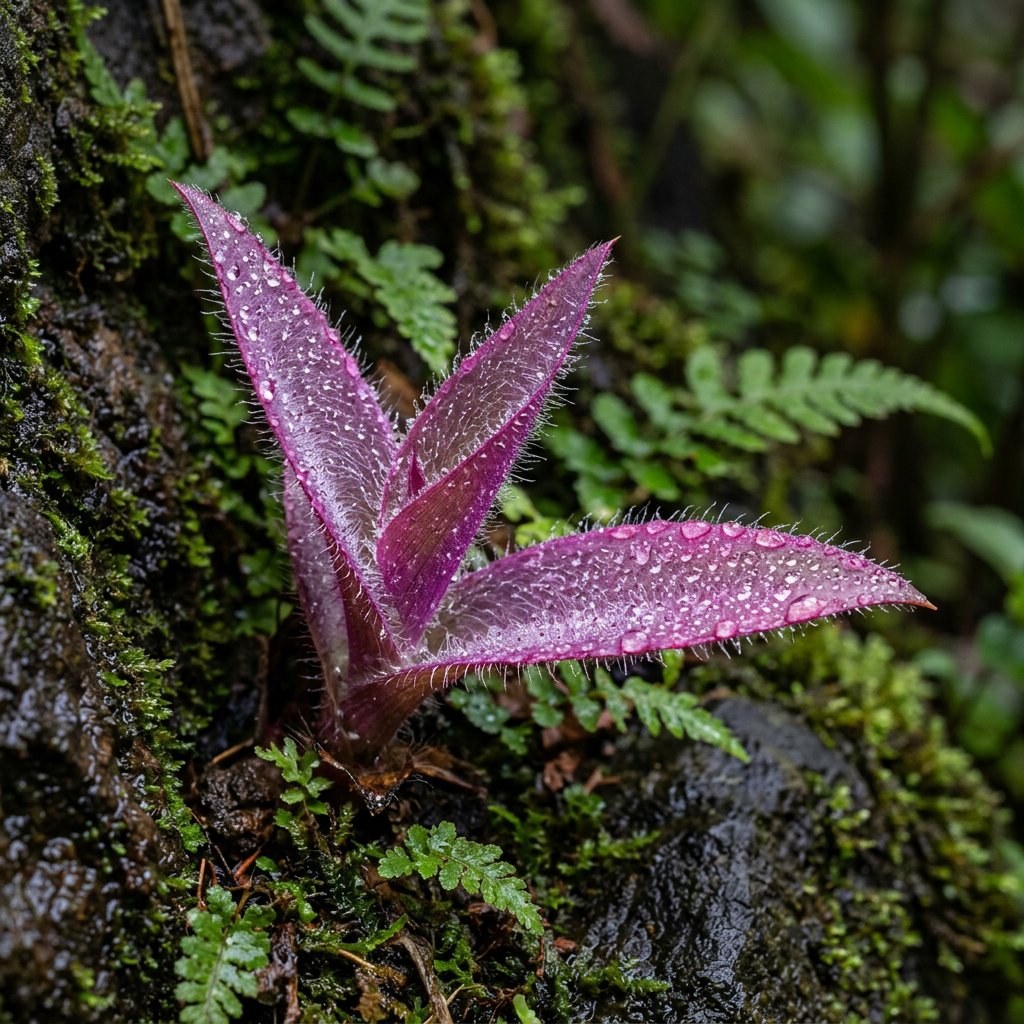
Plant Overview
The Cyanotis beddomei, affectionately known as the "Teddy Bear Vine," is perhaps the cuddliest plant you will ever encounter. Originating from the rocky terrains of Southern India, this charming succulent-relative is prized for its miniature size and its dense coating of soft, cinnamon-colored fur. It’s the perfect "pet plant" for those who want something tactile and unique on their windowsill.
🔍 How to Identify
- 🧸 Fuzzy Foliage: The most striking feature is the dense, brownish-red or "tawny" hairs that cover every inch of the leaves and stems, giving it a velvety appearance.
- 🍃 Leaf Shape: The leaves are small, lance-shaped, and grow in a tight, alternating pattern along the trailing stems.
- 🌸 Hidden Blooms: In the right conditions, it produces tiny, three-petaled flowers that are typically a soft violet or bluish-purple, emerging from hairy bracts.
🏡 In Your Garden
- 💧 Hairs and Hydration: Because of its thick "fur," this plant is highly susceptible to rot if the leaves stay wet. Always water the soil directly beneath the foliage; the hairs are excellent at trapping moisture, which can lead to fungal issues if they don't dry quickly.
- ☀️ Light and Color: While it enjoys bright, indirect light, a bit of morning sun helps deepen the reddish-brown color of the hairs. If the plant looks too green or "leggy," it is likely stretching for more light.
- 🪴 A Hanging Specialist: Due to its low-growing, creeping habit, it looks best in hanging baskets where the "fuzzy" stems can cascade over the sides.
⚠️ Safety & Toxicity
- ✅ General Safety: Cyanotis beddomei is generally considered non-toxic to humans and common household pets.
- ☁️ Skin Irritation: While not poisonous, the tiny hairs can occasionally act as a mild mechanical irritant to people with very sensitive skin or to curious pets who might try to nibble on the "furry" texture.
✨ Fun Fact
The plant is named after Richard Henry Beddome, a famous 19th-century British army officer and botanist who spent his life documenting the diverse flora of India. Despite its soft appearance, this plant is a rugged survivor, adapted to grow in the crevices of sun-drenched rocks!

Detailed Care Instructions
To grow Cyanotis beddomei (also known as Bunny Ears or Teddy Bear Vine), follow the steps below:
- Choose a suitable location: Select a spot that receives bright, indirect sunlight. This plant can tolerate some direct sunlight, but too much can scorch the leaves. Avoid placing it in a dark corner or an area with constant drafts.
- Soil requirements: Use well-draining soil that retains some moisture. A mixture of peat moss, perlite, and sand works well for this plant.
- Planting: Fill a pot with the prepared soil mixture and make a hole in the center. Place the plant gently in the hole and cover its roots with soil. Avoid burying the stem too deeply; it should be level with the soil surface.
- Watering: Keep the soil evenly moist but not soggy. Water thoroughly whenever the top inch of soil feels dry to the touch. Avoid overwatering as it can cause root rot.
- Humidity: This plant prefers moderately high humidity. To increase humidity, you can place a tray filled with water near the plant or use a humidifier. Misting the leaves regularly can also help.
- Temperature: Ideal temperatures for Cyanotis beddomei range between 60-80°F (15-26°C). Avoid exposing the plant to extreme temperature fluctuations.
- Fertilizing: Feed the plant with a balanced, water-soluble fertilizer every 2-3 weeks during spring and summer. Dilute the fertilizer to half strength to prevent over-fertilization.
- Pruning: Trim the plant regularly to maintain its shape and encourage bushier growth. Pinch back the tips of the stems to promote branching. You can also propagate new plants from the cuttings.
- Propagation: Cyanotis beddomei can be easily propagated through stem cuttings. Take a healthy cutting with at least two nodes and remove the lower leaves. Dip the cut end in rooting hormone and plant it in a pot filled with moist soil. Keep it warm and slightly humid until roots develop.
- Pests and diseases: Watch out for pests such as mealybugs and spider mites. Inspect the plant regularly and treat any infestations promptly. Avoid overwatering to prevent root rot.
By following these guidelines, you should be able to successfully grow Cyanotis beddomei and enjoy its beautiful foliage.

Place in a bright room that is sun drenched almost all day. Or directly in a south-facing window.

To water this plant, it is important to first check the soil moisture level by touching it with your fingers. If the soil feels dry to the touch, it is time to water the plant. Use lukewarm water and pour it slowly around the base of the plant, allowing the water to be absorbed by the soil. Avoid getting water on the leaves as this can cause damage. Ensure that excess water drains out of the pot to prevent waterlogging the roots. It is recommended to water this plant once a week, or when the soil feels dry to the touch.
This plant prefers a well-draining soil with a balanced fertilizer that has equal amounts of nitrogen, phosphorus, and potassium. Fertilize every two weeks during the growing season and reduce fertilization in the winter. Dilute the fertilizer to half-strength to prevent burning the roots. Water thoroughly after fertilization to prevent salt buildup in the soil. Avoid over-fertilizing as it can cause damage to the plant and harm the environment.
Cyanotis Beddomei plant requires a well-draining soil with a neutral pH level. It is recommended to use a soil mix that consists of around 50% peat moss, 20% vermiculite, 20% perlite, and 10% organic compost. The peat moss helps retain moisture, while the vermiculite and perlite improve drainage and aeration. Organic compost adds nutrients to the soil, which is important for the growth of the plant. It is recommended to avoid using heavy clay soils or soils with high amounts of sand as they can impair the plant's growth and vitality. The soil should also be sufficiently moist, but not waterlogged, as this can cause root rot.
To propagate this plant, one should first take a cutting from the parent plant. This can be done by making a clean cut just below a node (where a leaf attaches to the stem). The cutting should be approximately 4-6 inches long and have at least one node.
Once the cutting has been taken, it should be allowed to dry for a day or two to prevent rotting. After this, it can be planted in a potting mix that is well-draining and has high organic content. The cutting should be inserted into the soil about 1-2 inches deep.
The newly propagated plant should then be placed in a warm, bright location that receives indirect sunlight. It should be watered regularly, but not over-watered, as this can lead to root rot. Over the course of several weeks, the cutting should start to produce new growth.
Once the plant has established a robust root system, it can be repotted into a larger container or transplanted into a garden bed. With proper care, the newly propagated plant will continue to grow and thrive.
Common pests of the teddy-bear vine include Mealybugs, thrips. Make a habit of checking your teddy-bear vine frequently for pests so that any infestations can be caught and managed early.








