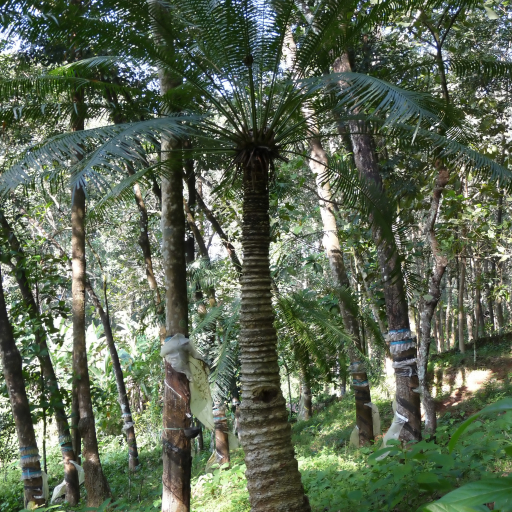
Plant Overview
Commonly known as the Queen Sago Palm, this stately plant is a "living fossil" that has remained virtually unchanged since the age of the dinosaurs. Despite its palm-like appearance and name, it is actually a cycad, making it more closely related to pine trees than true palms. With its elegant, feathery fronds and regal stature, it brings an air of prehistoric mystery to any tropical landscape or bright indoor space.
🔍 How to Identify
- 🌿 Feathery Fronds: The leaves are long, arching, and deep green, featuring soft, needle-like leaflets that grow in a perfectly symmetrical circular rosette.
- 🪵 The Trunk: It develops a thick, woody, dark-brown trunk that resembles a rough, textured pillar as the plant matures over many decades.
- 🥥 The "Pine Cone": Instead of traditional flowers, mature plants produce large central cones; male plants have elongated, upright cones, while females produce woolly, leaf-like clusters that hold seeds.
🏡 In Your Garden
- 🏖️ Drainage is Key: This plant is highly sensitive to "wet feet." It requires extremely well-draining soil, as sitting in stagnant water will quickly lead to root rot.
- ☀️ Light Nuances: While it thrives in bright light, the delicate "fingers" of its leaves can scorch in intense, direct afternoon sun. It prefers filtered sunlight or partial shade in hotter climates.
- 🐢 Slow and Steady: Because it grows at a glacial pace, it hates being disturbed. Choose its location carefully, as it resents being repotted or transplanted once established.
⚠️ Safety & Toxicity
- 🚫 Toxic Status: EXTREMELY POISONOUS. All parts of the Queen Sago are highly toxic if ingested by humans or animals.
- 🐾 Pets & Kids: The seeds (which often appear as bright, attractive nuggets) contain the highest concentration of cycasin. This toxin can cause permanent liver damage or death in dogs, cats, and small children. Always wear gloves when pruning to avoid skin irritation from the sharp leaflets.
✨ Fun Fact
- 🦖 Dinosaur Diet: Cycads like Cycas circinalis were at their evolutionary peak during the Jurassic period. When you look at this plant, you are looking at the exact same foliage that a Brachiosaurus would have munched on millions of years ago!

Detailed Care Instructions
To grow a Cycas circinalis plant, also known as a Queen Sago Palm, you can follow these steps:
- Obtain a healthy plant: Purchase a healthy Cycas circinalis plant from a reputable nursery or garden center. Look for a plant with sturdy fronds and a well-established root system.
- Choose the right location: Cycas circinalis prefers bright, indirect sunlight. Place the plant in a location where it will receive plenty of indirect light throughout the day, such as near a north-facing window.
- Prepare the soil: Use a well-draining, sandy soil mix. You can add perlite or coarse sand to improve drainage. Make sure the pot or planting area has drainage holes to prevent waterlogging.
- Planting: Gently remove the plant from its container and loosen the roots. Place the plant in the center of the pot or in a prepared hole in the ground, ensuring the crown of the plant sits at or slightly above soil level. Backfill with soil and firm down gently to eliminate any air pockets.
- Watering: Keep the soil evenly moist but not waterlogged. Allow the top inch of soil to dry out slightly between waterings. Avoid waterlogging or letting the soil dry out completely, as either extreme can harm the plant. Adjust the frequency of watering based on the specific conditions of your environment.
- Fertilization: Use a balanced, slow-release palm fertilizer or a general-purpose granular fertilizer during the growing season. Follow the package instructions for proper application rates. Apply the fertilizer evenly around the plant, avoiding contact with the trunk or fronds.
- Pruning: Remove dead or yellowing fronds periodically to maintain the plant's appearance. Use clean, sharp pruning shears to make clean cuts, avoiding any damage to the remaining healthy fronds.
- Temperature and humidity: Cycas circinalis prefers warm temperatures between 70°F (21°C) and 85°F (29°C). It can tolerate some fluctuations, but avoid exposing it to frost or extreme cold. Maintain a humidity level of around 50% or higher, which can be achieved by placing a tray of water near the plant or using a humidifier.
- Pests and diseases: Monitor the plant regularly for signs of pests such as scale insects or mealybugs. Treat any infestations with an appropriate insecticide, following the label instructions. Ensure good airflow around the plant to prevent fungal diseases.
Remember, Cycas circinalis is a slow-growing plant and may take several years to reach its full size. Patience and consistent care will help your plant thrive and grow successfully.

Place in a window with dappled sun or a spot in the middle of a room. Or directly in a window facing west or east.

Cycas Circinalis plant needs to be watered thoroughly, but less frequently. It is important to allow the topsoil to dry out slightly before watering it again. Over-watering can cause root rot and damage to the plant.
When watering the plant, make sure to water the soil directly to reach the roots and not the foliage. The foliage should be kept dry to avoid fungal infections in the plant.
During winter or cooler months, reduce the frequency of watering as the plant goes dormant during this time.
It is also important to note that the plant prefers well-draining soil to avoid waterlogging. If the soil is clayey, it is advisable to add sand or perlite to improve drainage.
To fertilize this plant, you may use a slow-release granular fertilizer with a 2:1:2 or 3:1:2 ratio of nitrogen, phosphorus, and potassium. Apply the fertilizer evenly around the base of the plant, but avoid direct contact with the roots. Water the plant thoroughly after fertilizing to help distribute the nutrients effectively. Additionally, you may want to fertilize the plant once every six months during the growing season, which typically occurs in spring and summer.
For optimal growth, it is recommended to use a well-draining soil that is rich in nutrients. The soil should be slightly acidic with a pH level of 5.5-6.5. It should also be able to hold moisture but not stay waterlogged, as this can lead to root rot. A soil mix with a combination of sand, perlite, and peat moss can be ideal for Cycas Circinalis plants. Additionally, adding some organic matter to the soil can help improve nutrient content and soil structure. Avoid using heavy and compacted soil that can restrict root growth and drainage.
Propagation of this plant can be done by using either seeds or offsets. To propagate using seeds, one must first collect the ripe seeds and then remove their outer coat. The seeds can then be soaked in water for a day and then planted in well-draining soil mix. The soil should be kept moist but not waterlogged and placed in a warm and bright area. The seedlings will emerge in about 2-3 months.
Propagation through offsets requires removing the baby plants from the base of the mother plant. This is usually done during repotting when the offset is at least one-third the size of the mother plant. The offset is carefully removed with its own roots and potted in a well-draining soil mix. It should be kept in a warm and bright area with moist soil and protected from direct sunlight until it establishes its own roots.








