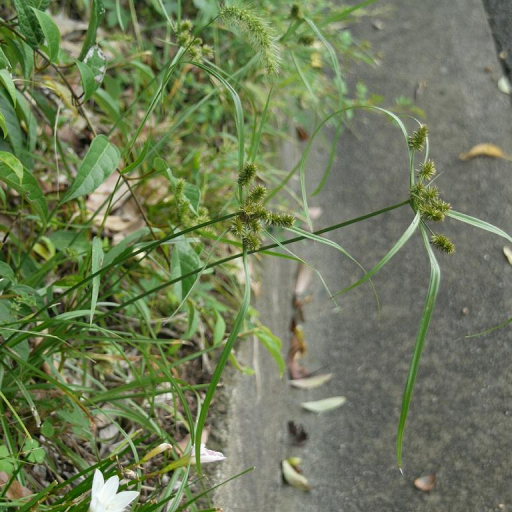
Plant Overview
Often called the Sumatran Sedge or the Umbrella Sedge, Cyperus cyperoides is a resilient perennial that looks like a miniature, exploding green firework. Native to tropical and subtropical regions across Africa, Asia, and Oceania, it is frequently found dancing in the breeze along roadsides and damp meadows. While some gardeners view it as a persistent weed, others admire its architectural, "palm-tree-like" silhouette.
🔍 How to Identify
- 📐 The "Edges": Like most sedges, it follows the rule "sedges have edges." If you roll the stem between your fingers, you’ll feel a distinct, solid triangular shape.
- ☂️ Umbrella Bracts: At the very top of the stem, a cluster of 5 to 10 leaf-like bracts radiates outward, creating a flat, umbrella-like canopy that shades the flowers.
- 🌾 Spikelet Cylinders: The flowers appear as dense, greenish-yellow cylindrical spikes. As they mature, they turn a golden-brown and eventually break apart to scatter seeds.
🏡 In Your Garden
- 💧 Damp Foundations: This plant is a "moisture seeker." It thrives in heavy clay soils and poorly drained areas where typical lawn grasses might struggle or drown.
- 🌱 Opportunistic Growth: It spreads primarily through seeds and short underground rhizomes. Because it is so efficient at colonizing open soil, it is best kept in controlled containers if you want to prevent it from taking over your garden beds.
⚠️ Safety & Toxicity
- ✅ Safe Status: Cyperus cyperoides is generally considered non-toxic to humans, cats, and dogs.
- 👅 Texture Warning: While not poisonous, the leaves have a high silica content and can be quite sharp or fibrous. If a curious pet chews on them, it might cause minor mouth irritation or an upset stomach simply due to the rough texture.
✨ Fun Fact
Botanists use a famous rhyme to tell these plants apart from their look-alikes: "Sedges have edges, rushes are round, and grasses are hollow straight to the ground." The sharp triangular stem of the Sumatran Sedge is the perfect example of those "edges!"

Detailed Care Instructions
To grow Cyperus Cyperoides plant, follow these steps:
- Choose an appropriate location: Cyperus Cyperoides plant prefers full sun to partial shade. It also thrives in wet or boggy soil, so select a spot with good drainage or consider planting it near a water feature.
- Prepare the soil: Cyperus Cyperoides prefers moist soil, so it is essential to provide adequate water retention. Mix organic matter, such as compost or peat moss, into the soil to improve its water-holding capacity.
- Planting: Dig a hole that is slightly larger than the root ball of your Cyperus Cyperoides plant. Place the plant in the hole, making sure the crown is level with or slightly above the soil surface. Gently fill the hole with soil, firming it around the plant.
- Watering: Immediately after planting, thoroughly water the plant to settle the soil and eliminate air pockets. Cyperus Cyperoides plant requires consistent moisture, so water it regularly, keeping the soil evenly moist but not waterlogged.
- Mulching: Apply a layer of organic mulch, such as wood chips or straw, around the plant. Mulch helps retain soil moisture, suppresses weed growth, and regulates soil temperature.
- Fertilizing: Cyperus Cyperoides usually doesn't require regular fertilization. However, if growth seems slow or weak, you can apply a balanced liquid fertilizer once or twice during the growing season.
- Maintenance: Keep the planting area weed-free, as weeds compete with the Cyperus Cyperoides for nutrients and water. Remove any weeds that emerge. Also, periodically check for pests or diseases and address them promptly.
- Winter care: In colder regions, Cyperus Cyperoides may not be hardy and can die back during winter. In this case, cut back the foliage to ground level in late fall, after the first frost. You can also apply a layer of mulch over the plant to provide some protection during the winter months.
By following these steps, you can successfully grow Cyperus Cyperoides plant and enjoy its attractive appearance in your garden or landscape.

Place in a bright room that is sun drenched almost all day. Or directly in a south-facing window.

Cyperus Cyperoides is a plant that requires constant moisture to grow properly, so watering is important. To water this plant, you should use a gentle stream of water and ensure that the soil is evenly moist throughout. Watering too much or too little can harm the plant, so it is important to monitor the soil moisture level and adjust watering frequency and amount accordingly.
One way to check if the plant needs water is to touch the soil surface with your fingertip. If it feels dry, it's time to water. Another method is to use a moisture meter to measure the level of water in the soil.
When watering, avoid getting water on the leaves and stems as this can cause fungal infections. Instead, water the soil around the base of the plant, allowing the water to penetrate deep into the soil.
In general, Cyperus Cyperoides plants prefer small, frequent waterings rather than infrequent heavy waterings. During hot, dry weather or if the plant is growing in a warm, dry environment, you may need to water more often.
Remember that over-watering can be just as harmful as under-watering, so it is important to strike a balance and monitor the plant's water needs regularly.
To properly fertilize this plant, it is important to use a balanced fertilizer that contains equal amounts of nitrogen, phosphorus, and potassium. Apply the fertilizer in early spring, just as the plant starts to emerge from dormancy. Use a slow-release fertilizer and apply it according to the package instructions. It is also important to ensure that the plant is well-watered after fertilization to prevent the roots from being burned. Avoid over-fertilizing, as this can cause excess growth and weaken the plant's overall health.
Cyperus Cyperoides plant thrives in soil that is rich in organic matter and has good drainage. It prefers a soil with a pH level between 5.5 to 6.5. A good soil recommendation would be moist, well-draining potting soil that includes a mix of perlite, peat moss, and mature compost. Avoid using heavy clay soil or soil that does not allow water to drain properly. Adding granulated slow-release fertilizer or liquid fertilizer can help provide necessary nutrients for healthy growth. Regularly check the moisture level of the soil and water when the top inch of soil feels dry to the touch.
Cyperus Cyperoides can grow new plants through vegetative propagation, specifically through division and rhizome cuttings. To propagate through division, carefully remove the plant from its pot or soil and gently pull apart the roots, ensuring that each section has roots and a healthy shoot. Plant each division into its own pot filled with well-draining soil. For propagating through rhizome cuttings, select a healthy rhizome and cut it into sections, each section should have at least one node and a few roots. Plant each section in a well-draining potting mix and keep the soil moist until new shoots appear. It's also possible to propagate Cyperus Cyperoides from seed, but it's less common. To do so, collect the mature seeds and start them in a well-draining soil mix. Keep the soil moist and warm until seedlings emerge. Overall, propagating Cyperus Cyperoides is relatively easy and can be done with a bit of patience and attention to detail.








