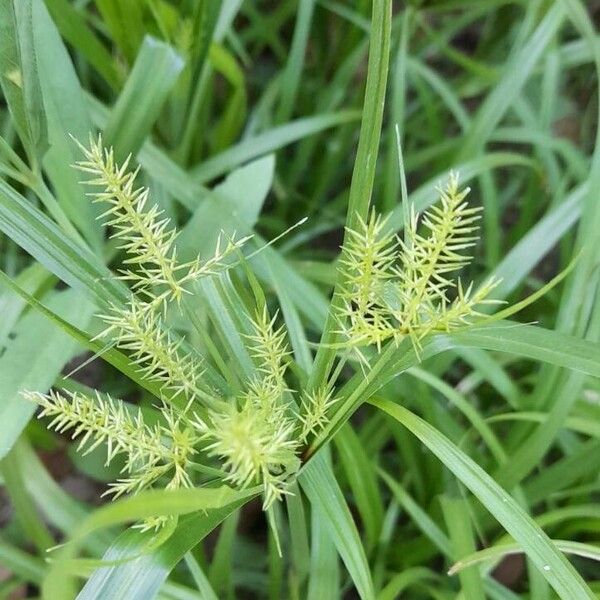
Plant Overview
Often called the "Architectural Sedge," Cyperus meyenianus is a graceful, moisture-loving perennial that adds a prehistoric, geometric flair to any landscape. Native to tropical and subtropical regions of the Americas, it belongs to the same ancient family as the Papyrus used by Egyptians to create the world's first paper. It is a master of the "wet feet" lifestyle, often found dancing near pond edges or in marshy meadows.
🔍 How to Identify
- 📐 Triangular Stems: Like most members of its family, this plant follows the rule "Sedges have edges." If you roll the stalk between your fingers, you will feel its distinct three-sided, triangular shape.
- 🌟 Umbrella Bracts: At the summit of each tall stem, a series of long, leaf-like bracts radiate outward like the ribs of a green umbrella, framing the central flower clusters.
- 🌾 Golden-Brown Spikes: The inflorescence consists of dense, flattened spikelets that start a pale green and transition into a warm, toasted cinnamon color as they mature.
🏡 In Your Garden
- 💧 The Moisture Lover: This plant is the perfect solution for "problem" areas in the yard where water tends to pool. Unlike most garden plants that suffer from root rot, Cyperus meyenianus thrives in boggy, saturated soil.
- 🌱 Natural Filtration: Because of its vigorous root system and love for water, it acts as a natural filter in rain gardens, helping to clean runoff water and prevent soil erosion along embankments.
⚠️ Safety & Toxicity
- 🐾 Pet Safety: Cyperus meyenianus is generally considered non-toxic to cats and dogs. In fact, many indoor "Cat Grass" kits actually contain related Cyperus species.
- ✂️ Physical Irritation: While not chemically toxic, the leaves have high silica content and serrated edges. Handling the plant without gloves can occasionally lead to tiny, "paper-cut" style nicks on the skin.
✨ Fun Fact
Botanists and nature lovers use a famous rhyme to distinguish sedges from other grass-like plants: "Sedges have edges, rushes are round, and grasses are hollow right up from the ground!" If you feel those three sharp corners on the stem, you know you're holding a sedge!

Detailed Care Instructions
To grow Cyperus Meyenianus plant, also known as Umbrella Papyrus, follow these steps:
- Choose a suitable location: Cyperus Meyenianus thrives in full sun to partial shade conditions. It can be grown both indoors and outdoors, but it requires a warm and humid environment.
- Prepare the planting container: Use a container that is wide and shallow, as this plant has fibrous roots that spread horizontally. The container should have drainage holes to prevent waterlogging.
- Soil preparation: Prepare a well-draining soil mix by combining equal parts of potting soil, sand, and peat moss. This plant prefers slightly acidic soil with a pH level of 5.5 to 6.5.
- Planting: Place the plant in the container, ensuring that the crown of the plant sits just above the soil level. Fill the container with the prepared soil mix, lightly firming it around the roots.
- Watering: Keep the soil consistently moist, but not waterlogged. Water the plant when the top inch of soil feels dry. Avoid letting the soil dry out completely, as this can stress the plant.
- Fertilization: Use a balanced liquid fertilizer every 2-4 weeks during the growing season (spring and summer). Follow the package instructions for proper dosage.
- Pruning: Trim any dead or yellowing leaves to maintain the plant's appearance and overall health.
- Humidity: Cyperus Meyenianus prefers high humidity levels. If you are growing it indoors, place a tray filled with water near the plant or use a humidifier to increase the humidity around the plant.
- Lighting: Place the plant in a location that receives at least 4-6 hours of bright, indirect sunlight daily. If growing indoors, find a spot near a sunny window or use artificial grow lights to provide adequate light.
- Temperature: This plant prefers temperatures between 70-85°F (21-29°C). Avoid placing it in drafts or areas with fluctuating temperatures.
- Transplanting: Over time, the Cyperus Meyenianus may outgrow its current container. When the plant starts becoming root-bound, transplant it into a larger container to allow for further growth.
By following these steps, you can successfully grow and care for your Cyperus Meyenianus plant.

Place in a bright room that is sun drenched almost all day. Or directly in a south-facing window.

To water this plant, start by checking the moisture level in the soil. Stick your finger about an inch into the soil to feel for any moisture. If the soil is dry, it's time to water.
Use room temperature water. Avoid using water that is too cold or too hot, as extreme temperatures can shock the plant.
Slowly pour water onto the soil around the base of the plant, being careful not to get water on the leaves. Water until you see it start to come out of the drainage holes in the bottom of the pot.
Allow the soil to drain completely before placing the plant back in its original spot.
Be sure not to overwater this plant, as it can lead to root rot. Wait until the top inch or so of the soil is dry before watering again.
To fertilize this plant, use a balanced fertilizer with equal parts nitrogen, phosphorus, and potassium. Apply the fertilizer every two weeks during the growing season, which is usually spring and summer. During the dormant period, reduce the frequency of fertilization to once a month. Always follow the instructions on the fertilizer packaging for proper application and dosage. Avoid over-fertilization as it can damage the plant's roots.
Cyperus Meyenianus prefers moist, well-draining soil that is rich in nutrients. It is important to avoid using heavy soils that may retain too much water and cause root rot. A mixture of peat moss, perlite, and sand is perfect for this plant. Adding organic matter such as compost to the soil will improve the overall quality and help promote healthy growth. It is important to ensure that the soil pH is between 5.5 and 6.5, as this is the range that Cyperus Meyenianus prefers. It is also important to avoid over-fertilizing this plant, as it can cause damage to the roots. A well-draining soil will ensure that the plant gets enough water without becoming water-logged. Overall, the soil for Cyperus Meyenianus should be rich, well-draining, and with a slightly acidic pH.
To propagate this plant, you will need to obtain a healthy stem cutting. Select a stem that is at least 3 inches long and has a few leaves on it. Cut the stem at a 45-degree angle using a sharp and sterilized pair of scissors or pruning shears.
Next, remove the bottom leaves from the stem, leaving only a few leaves at the top. Then, dip the cut end of the stem in rooting hormone powder to increase the chances of successful propagation.
Fill a small pot with well-draining soil mix and make a small hole in the center. Insert the stem cutting into the hole and gently press the soil around it, ensuring that the stem is stable and upright.
Water the cutting well and place it in a bright and warm location, ideally with indirect sunlight. Keep the soil moist but not waterlogged and mist the leaves regularly to maintain high humidity.
After a few weeks, you should see new growth emerging from the stem cutting, indicating successful rooting and propagation. You can then transplant the new plant into a larger pot or the garden bed.








