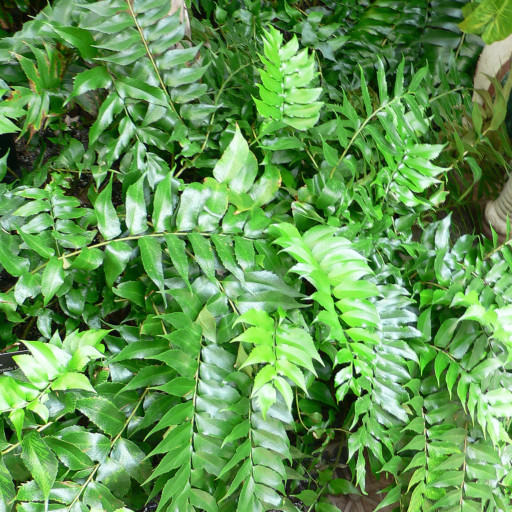
Plant Overview
Known as the Japanese Holly Fern, this architectural beauty brings a touch of prehistoric elegance to shady corners. Unlike the delicate, lacy fronds most people associate with ferns, Cyrtomium falcatum boasts bold, leathery foliage that looks more like a holly bush than a typical forest fern. Native to the rocky cliffs of East Asia, it is a rugged survivor that thrives in the dim, cool spaces where other plants might struggle.
🔍 How to Identify
- 🍃 Holly-Like Pinnae: The leaflets (pinnae) are stiff, glossy, and sickle-shaped with slightly serrated edges, bearing a striking resemblance to holly leaves.
- 🌿 Fountain Growth: The fronds emerge from a central crown and arch outward in a symmetrical, fountain-like clump that can reach up to two feet in height.
- ✨ Waxy Sheen: The top surface of the leaves has a deep, "plastic-like" luster that reflects light, while the undersides are a matte, paler green.
🏡 In Your Garden
- 🌑 The Shade Champion: This fern is a specialist for "trouble spots." It excels in deep shade, north-facing entryways, or under heavy tree canopies where most flowering plants refuse to grow.
- ⛰️ Drainage is Key: While it loves consistent moisture, its thick, scaly rhizomes are sensitive to standing water. It prefers "chunky" soil rich in organic matter that allows oxygen to reach the roots.
- 🌬️ Coastal Toughness: Unlike many ferns that shrivel at the first sign of a breeze, the Japanese Holly Fern is surprisingly salt-tolerant and can handle coastal winds better than its more delicate cousins.
⚠️ Safety & Toxicity
- 🟢 Non-Toxic: Good news for pet owners—the Japanese Holly Fern is considered non-toxic to cats, dogs, and horses according to the ASPCA.
- 👶 Family Friendly: It is generally safe for households with children, though the stiff, pointed tips of the leaves can be a bit scratchy if someone brushes against them too quickly.
✨ Fun Fact
If you flip a mature leaf over, you’ll see neat rows of tiny brown dots called "Sori." New gardeners often mistake these for a pest infestation like scale insects, but these are actually the plant's spore cases, used for reproduction since ferns don't produce flowers or seeds!

Detailed Care Instructions
| Humidity | High |
| Lighting | Shade |
| Difficulty | Hard |
| Temperature | 15°C - 23°C |
| Hardiness Zones | 7A - 11B |
To grow a Cyrtomium falcatum plant, also known as the Japanese holly fern, you can follow these steps:
- Choose the right location: Cyrtomium falcatum plants prefer partial shade to full shade. Select an area with indirect sunlight or a spot with dappled shade. Avoid direct sunlight as it can scorch the leaves.
- Prepare the soil: The soil should be well-draining and rich in organic matter. Amend the soil with compost or well-rotted manure to enhance its fertility and drainage.
- Planting: Dig a hole slightly larger than the root ball of the fern. Place the fern in the hole, ensuring that the top of the root ball is level with the soil surface. Gently backfill the hole with soil and pat it down to eliminate air pockets.
- Watering: Keep the soil consistently moist but not waterlogged. It is important to avoid allowing the soil to dry out completely, as it can stress the plant. Water whenever the top inch of soil feels dry. Use a watering can or a gentle spray to water the plant, focusing on the soil rather than the foliage.
- Mulching: Apply a layer of organic mulch, such as wood chips or shredded leaves, around the base of the plant. This helps to lock in moisture, regulate soil temperature, and suppress weed growth. Leave some space between the mulch and the plant's crown to prevent rotting.
- Fertilization: Feed the fern in spring and mid-summer with a balanced slow-release fertilizer high in organic matter. Follow the instructions on the fertilizer package for application rates. Be careful not to over-fertilize, as it can cause leaf burn.
- Pruning: Remove any dead or damaged fronds by cutting them at the base of the plant. This helps to promote new growth and maintain a neat appearance.
- Winter protection: If you live in a region with cold winters, provide some protection for the fern by mulching hea

Place in a dark room with little light, like a dark bedroom or a spot far away from a window or directly in a north-facing window.

To water this plant, you should wait until the top layer of soil feels dry to the touch before watering it. When watering, it is important to saturate the soil thoroughly until water starts to drain from the bottom of the pot. Avoid leaving standing water in the saucer or pot as this can lead to root rot. Additionally, it is important to use room temperature water and not cold water, as this can shock the plant. Finally, ensure that the plant is not placed in direct sunlight or in very dry conditions as this can lead to leaf browning and the plant drying out.
To fertilize this plant, apply a balanced fertilizer with equal amounts of nitrogen, phosphorus, and potassium every two weeks during the growing season (spring and summer). Make sure to dilute the fertilizer in water according to the package instructions. Avoid fertilizing during the dormant season (fall and winter) as the plant may not be actively growing and may not need the extra nutrients.
Cyrtomium Falcatum prefers to grow in a well-draining soil that is rich in organic matter. The soil should be moist but not soggy, as prolonged wetness can lead to root rot. A pH range of 6 to 7 is optimal for growth. Adding compost or peat moss to the soil mix can help retain moisture and improve soil structure. Perlite or sand can also be added to ensure better drainage. It is recommended to repot the plant every 2-3 years and replace the soil to ensure continued healthy growth.
There are multiple ways to propagate Cyrtomium Falcatum plants. One way is to take a rhizome or a section of the root and plant it in a pot or in the ground. This method takes time as the plant will need to grow from the roots. Another way is to take spores from mature fronds and sow them in soil. To do this, mature fronds need to be collected and placed in a paper bag. The spores will be shed from the fronds and can then be sown in soil and kept moist until they sprout. A third way to propagate Cyrtomium Falcatum is by division. Mature plants can be divided into smaller sections and replanted. This method is best done in the spring.
Common pests of the japanese holly fern include Mealybugs, spider mites, aphids. Make a habit of checking your japanese holly fern frequently for pests so that any infestations can be caught and managed early.








