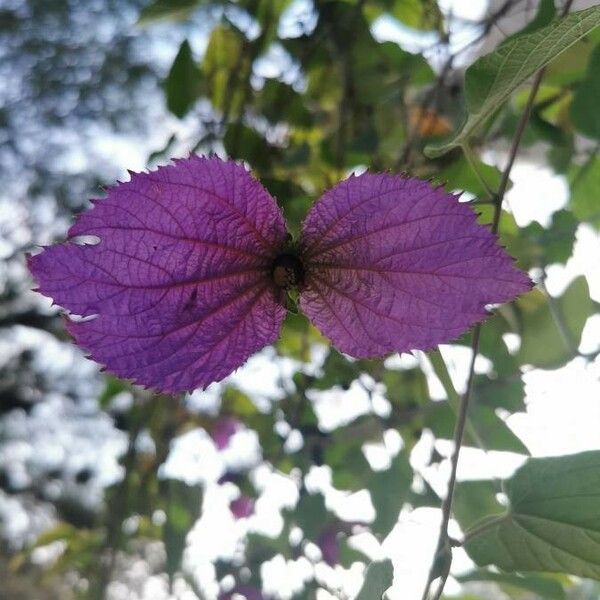
Plant Overview
Often called the Purple Winged Dalechampia or the False Dutchman’s Pipe, this exotic climber from the Peruvian rainforests is a master of botanical disguise. While its name suggests a relation to the Aristolochia (Dutchman's Pipe) genus, it is actually a member of the Spurge family that has evolved to mimic the foliage of its neighbors to confuse herbivores.
🔍 How to Identify
- 🦋 Winged Bracts: The "flowers" are actually two large, heart-shaped, deep purple or burgundy bracts that frame the tiny, true flowers inside like a pair of butterfly wings.
- 🍃 Mimic Foliage: It features lush, heart-shaped green leaves that look remarkably similar to the Dutchman's Pipe vine, a clever evolutionary trick.
- 🌿 Twining Stems: A delicate but persistent vine that lacks tendrils, instead using its slender, flexible stems to spiral upward around any available support.
🏡 In Your Garden
- 🧗 The Need for Support: Because this is a soft-stemmed climber, it requires a trellis, obelisk, or a neighboring shrub to lean on. Without a structure, the plant will sprawl along the ground, hiding its unique "blooms."
- 🌤️ Dappled Sunlight: Reflecting its rainforest origins, it prefers bright, filtered light. Too much direct afternoon sun can scorch the delicate purple bracts, while too much shade will prevent flowering.
⚠️ Safety & Toxicity
- 🧪 Irritant Sap: As a member of the Euphorbiaceae family, the plant contains a milky white latex sap. This can cause skin redness or "contact dermatitis" upon touch for sensitive individuals.
- 🐾 Keep Away from Pets: The sap and foliage are considered mildly toxic if ingested, potentially causing mouth irritation or stomach upset in cats, dogs, and small children.
✨ Fun Fact
Instead of offering sweet nectar like most flowers, many Dalechampia species produce a specialized sticky resin. Female bees visit the "wings" to collect this resin, using it as a high-quality "glue" to build and waterproof their nests!

Detailed Care Instructions
To grow a Dalechampia Aristolochiifolia plant, follow these steps:
- Choose a suitable location: Select a spot that receives bright, indirect sunlight for most of the day. This plant prefers warm temperatures, ideally between 65-75°F (18-24°C).
- Prepare the soil: The soil should be well-draining and rich in organic matter. If your soil doesn't drain well, consider adding perlite or sand to improve drainage.
- Planting: Dig a hole slightly larger than the root ball of the plant. Place the plant in the hole, ensuring that the top of the root ball is level with the soil surface. Fill the hole with soil, gently firming it around the plant.
- Watering: Water the newly planted Dalechampia Aristolochiifolia thoroughly, ensuring that the soil is evenly moist. Afterward, only water when the top inch of soil feels dry to the touch. Avoid overwatering, as it can lead to root rot.
- Fertilizing: Use a balanced, water-soluble fertilizer every 2-4 weeks during the growing season (spring to early fall). Follow the instructions on the fertilizer packaging for the correct dosage.
- Pruning: Trim back any dead or damaged growth to encourage healthy plant development. You can also prune to maintain the desired shape and size of the plant.
- Support: The Dalechampia Aristolochiifolia plant is a climbing vine, so provide it with a support structure such as a trellis or stake for it to cling onto. Make sure the support is sturdy enough to withstand the plant's growing weight.
- Pests and diseases: Watch out for common houseplant pests such as aphids, mealybugs, or spider mites. If detected, treat the infestation promptly using an appropriate insecticidal soap or horticultural oil.
- Propagation: You can propagate Dalechampia Aristolochiifolia through stem cuttings. Take 4-6 inch (10-15 cm) cuttings from healthy, mature stems and remove the lower leaves. Dip the cut end in a rooting hormone powder and plant it in a well-draining potting mix. Keep the soil moist and place the cutting in bright, indirect light until roots develop.
Remember to research and understand specific plant care requirements to ensure optimal growth and health of your Dalechampia Aristolochiifolia plant.
To properly water this particular plant, first ensure that the soil is completely dry to the touch before each watering. When watering, slowly pour water onto the soil around the base of the plant, avoiding wetting the leaves or flowers. Allow the water to soak into the soil completely before draining any excess water from the saucer or container. Additionally, it is important not to overwater this plant as it can cause root rot and other issues.
To fertilize this plant, use a balanced, water-soluble fertilizer once a month during the growing season (spring and summer). Dilute the fertilizer to half strength and apply it directly to the soil. Avoid getting fertilizer on the foliage as it may burn the leaves. Ensure the plant is well-watered before and after fertilizing. Reduce fertilization in the fall and winter months.
To provide optimal growing conditions for the Dalechampia Aristolochiifolia plant, it is recommended to use well-draining soil that has good moisture retention properties. The soil should be rich in organic matter and have a slightly acidic to neutral pH level, between 6.0 and 7.0. Avoid using heavy clay soils as they do not drain well and can lead to root rot. Provide ample drainage and aeration by adding sand or perlite to the soil mixture. It is also recommended to fertilize the plant every few weeks during the growing season with a balanced, water-soluble fertilizer to encourage healthy growth and blooming.
To propagate this plant, you will need to take stem cuttings. Cut a stem that is healthy and has not yet flowered, making sure it has several leaves. Next, remove the lower leaves from the stem and make a clean cut just below a node, which is where the leaves attach to the stem. You may also want to dip the cut end in rooting hormone, which can help stimulate root growth.
Prepare a pot or container with well-draining soil and irrigation holes, and water the soil until it is moist but not soggy. Place the stem cutting in the soil and firm the soil around it so that it is secure. Place the pot or container in a bright location but out of direct sunlight. Keep the soil moist and mist the leaves regularly to promote humidity.
After a few weeks, you should see roots starting to form. Once the plant has established roots, you can gradually increase the amount of sunlight it receives. Make sure to keep the soil moist but not too wet, and avoid overwatering. Over time, your propagation should grow into a healthy, mature plant that you can enjoy for years to come.








