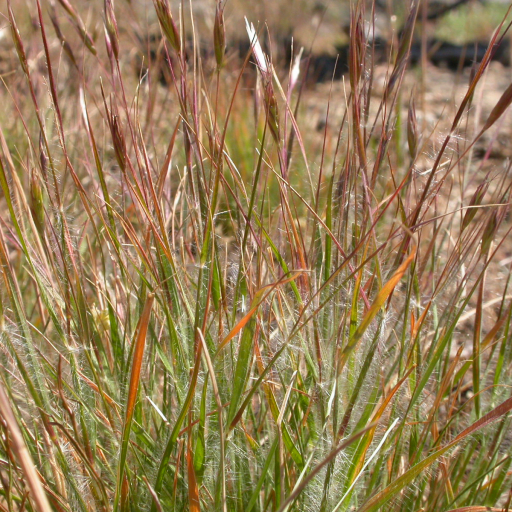
Plant Overview
Often overlooked in the vast western landscapes of North America, Danthonia unispicata, commonly known as One-spike Oatgrass, is a resilient survivor of the rocky foothills. Its name hints at its minimalist beauty, usually bearing a single, prominent seed head that dances in the mountain breeze. It is a humble but vital player in stabilizing thin, fragile soils where other plants struggle to take hold.
🔍 How to Identify
- 🌾 The "One-Spike" Habit: True to its name, this grass is most easily identified by its stems which typically support only one large, straw-colored spikelet at the very top, rather than a branching cluster.
- 🌿 Low-Profile Tufts: It grows in dense, compact "bunches" or tussocks. It is a relatively short grass, rarely reaching more than 8 to 10 inches in height, giving it a neat, mounded appearance.
- 🧵 Twisted Awns: If you look closely at the seeds, you’ll see tiny, bristle-like "awns." These are often bent or twisted, a clever mechanical feature that helps the seed "screw" itself into the dirt as humidity changes.
🏡 In Your Garden
- ⛰️ The Rock Specialist: In a home landscape, this grass is the perfect candidate for a "rock garden" or a native meadow. It thrives in thin, poor, or gravelly soils where more delicate ornamental grasses might wither.
- ☀️ Sun and Space: It loves the spotlight and requires full sun exposure. Because it grows in distinct tufts, it doesn't spread aggressively like lawn grass, making it a great "accent" plant that plays well with native wildflowers.
⚠️ Safety & Toxicity
- ✅ Non-Toxic Status: One-spike Oatgrass is generally considered safe and non-toxic for humans, dogs, cats, and horses.
- 🐾 Foraging Friendly: While it isn't a primary "forage" grass due to its small size, it is a natural and safe part of the ecosystem for grazing wildlife like deer and rabbits.
✨ Fun Fact
This clever grass has a "secret backup plan" for survival known as cleistogamy. In addition to the flowers you see on the spike, it often grows hidden, self-pollinating flowers tucked inside its lower leaf sheaths near the ground. This ensures that even if a fire or a hungry grazer eats the top of the plant, it can still produce seeds to keep the next generation going!

Detailed Care Instructions

Place in a bright room that is sun drenched almost all day. Or directly in a south-facing window.

Danthonia Unispicata is a type of perennial grass that requires regular watering to maintain optimal growth and health. To water this plant, start by determining the soil moisture level. Check the top inch of soil to see if it feels dry to the touch. If it does, it is time to water.
When watering, use a gentle stream of water to avoid disturbing the soil or damaging the plant's delicate root system. Water the soil around the plant, making sure to moisten the root zone. Avoid getting water on the leaves or stems, as this can promote fungal growth and disease.
During hot and dry weather, Danthonia Unispicata may require more frequent watering than during cooler periods. Pay attention to the plant's growth and foliage, as these can be good indicators of its overall health and hydration status.
To ensure optimal water retention, it is helpful to apply a layer of mulch around the base of the plant. This can help to reduce moisture loss and regulate soil temperature, promoting healthier growth overall.
Overall, Danthonia Unispicata is a relatively low-maintenance plant, but regular watering is essential to keep it healthy and thriving.
It is recommended to use a well-draining soil with good fertility for this plant. The soil should be moderately moist and have a slightly acidic to neutral pH level. Avoid using heavy clay soils or soils with poor drainage as this can lead to root rot and other problems. A soil mix with a combination of compost, perlite, and topsoil is ideal for this plant. It is also important to ensure that the plant is grown in a location with full sun to partial shade exposure.








