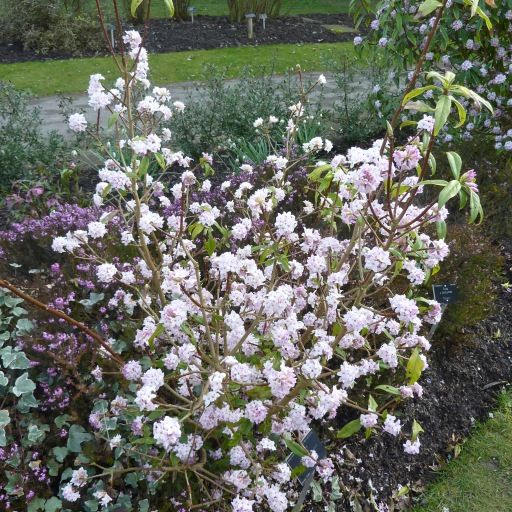
Plant Overview
Commonly known as the Nepalese Paper Plant, Daphne bholua is a winter-blooming jewel from the high-altitude forests of the Himalayas. While it may look like a modest shrub for much of the year, it transforms into a sensory powerhouse in the depths of January, filling the cold air with a perfume so sweet and potent it can be smelled from several yards away.
🔍 How to Identify
- 🌸 The Blooms: Clusters of waxy, tubular flowers that are usually white or pale pink on the inside with deep purplish-pink exteriors.
- 🍃 Foliage: Narrow, leathery, dark-green leaves that typically stay on the plant year-round (semi-evergreen), though they may drop in exceptionally harsh winters.
- 📏 Growth Habit: An upright, slightly leggy shrub that can reach up to 6–8 feet, often looking elegant and airy rather than dense.
🏡 In Your Garden
- 🧘 The "Stay Put" Rule: This plant is notoriously fussy about its roots. It possesses a sensitive taproot system that resents being disturbed; once you plant it, avoid moving it at all costs, as it rarely survives a transplant.
- 🌤️ Sheltered Sanctuaries: It thrives best in a spot that mimics a forest edge—dappled shade and protection from the harsh morning sun, which can scorch frozen flower buds and prevent them from opening properly.
- 🌿 Pruning Patience: It requires very little pruning. In fact, heavy cutting can stress the plant. Only remove dead or crossing branches immediately after the flowering season has ended.
⚠️ Safety & Toxicity
- 🚫 Highly Toxic: Every part of this plant—including the beautiful berries, leaves, and bark—is poisonous if swallowed by humans, cats, or dogs.
- 🧤 Skin Irritant: The sap contains daphnin, a compound that can cause blistering or rashes. It is highly recommended to wear gloves when pruning or handling a broken branch to avoid contact with the skin.
✨ Fun Fact
📜 Ancient Stationery: In its native Nepal, the inner bark of this plant is harvested to create traditional "Lokta" paper. This paper is legendary for its durability and natural resistance to insects and humidity, which is why it was used for centuries to record official government documents and sacred religious texts.

Detailed Care Instructions
To grow a Daphne Bholua plant, you can follow these steps:
- Location: Choose a suitable location for your Daphne Bholua plant. It prefers well-draining soil and partial shade to full sun exposure.
- Soil Preparation: Prepare the soil by adding organic matter such as compost or well-rotted manure to improve its fertility and drainage. Daphne Bholua prefers a slightly acidic soil.
- Planting: Dig a hole twice the size of the plant's root ball. Place the plant in the hole, ensuring that the top of the root ball is level with the surrounding soil. Fill the hole with soil, gently firming it around the plant.
- Watering: Keep the soil consistently moist, especially during the plant's establishment period. However, avoid overwatering, as this can lead to root rot. Water deeply but infrequently to encourage the plant's roots to grow deeply.
- Mulching: Apply a layer of organic mulch around the base of the plant to help retain moisture, suppress weed growth, and regulate soil temperature.
- Pruning: Daphne Bholua benefits from light pruning after flowering to maintain its shape and encourage bushier growth. Remove dead, damaged, or crossing branches, and cut back long, leggy growth to promote compactness.
- Fertilizing: Feed the plant with a balanced, slow-release fertilizer in early spring to provide it with necessary nutrients for healthy growth.
- Protection: Protect the plant from harsh winter conditions, especially strong winds and heavy snowfall. Consider covering it with burlap or providing a windbreak.
- Pests and Diseases: Daphne Bholua can be susceptible to pests such as aphids and spider mites. Monitor the plant regularly and address any pest infestations promptly. It may also be susceptible to diseases such as powdery mildew or root rot; ensure good airflow around the plant and avoid overwatering to prevent these issues.
Remember that Daphne Bholua can be temperamental and may require patience and careful maintenance. It is a slow-growing plant, but its fragrant flowers and glossy foliage make it a beautiful addition to any garden.

Place in a window with dappled sun or a spot in the middle of a room. Or directly in a window facing west or east.

To water this plant, it is important to first ensure that the soil is dry before watering. Over-watering can lead to root rot, which can be detrimental to the plant's health. When watering, gently apply water to the base of the plant, avoiding getting water on the foliage as this can cause spotting and other issues. Allow the soil to soak up the water before applying more, as watering too quickly can lead to water runoff and potential loss of nutrients. It is also important to water this plant consistently and regularly, rather than giving large amounts of water infrequently. This will help to maintain consistent moisture levels in the soil, which is important for the plant's overall health.
To fertilize this plant, use a well-balanced fertilizer that is high in nitrogen. Apply the fertilizer in the early spring, just before new growth begins, and then again in the summer. Be sure to water the soil thoroughly both before and after applying the fertilizer to avoid burning the roots. It is also a good idea to use a slow-release fertilizer to ensure that the plant receives a steady supply of nutrients throughout the growing season.
Daphne Bholua plant prefers a well-draining soil that is rich in organic matter. The ideal soil pH for this plant is slightly acidic, with a range of 5.5-6.5. It is important to avoid heavy clay soils that can retain too much moisture and cause root rot. A mix of equal parts of peat moss, high-quality compost, and perlite or sand can be used as a potting mix for this plant. In the garden, amending the soil with compost or well-rotted manure can improve drainage and soil structure. Avoid using chemical fertilizers on this plant as it is sensitive to excess nutrients.
Daphne Bholua plant can be propagated through several techniques. One way is by taking cuttings from the healthy stems of the plant. Use clean and sharp scissors to cut a 6-inch stem from the plant, making sure to cut just below a leaf node. Remove the lower leaves from the stem, leaving only two or three at the top. Dip the bottom of the stem in rooting hormone powder and plant it in a pot with well-draining soil. Water the plant and cover it with a plastic bag to create a humid environment around the cutting. Keep the plant in a bright, indirect light and water it regularly until roots develop.
Another way to propagate Daphne Bholua is through layering. Choose a healthy branch of the plant and bend it down to the ground, making a small cut on the underside of the branch where it meets the soil. Cover the cut with soil and secure the branch in place with a heavy object like a rock. Over time, roots will grow from the cut area, and the branch can be severed from the main plant and transplanted.
Lastly, Daphne Bholua can be propagated through seed germination. Collect the seeds from mature fruit and soak them in water overnight. The next day, plant the seeds in a pot with well-draining soil and cover it with a plastic bag. Keep the soil moist and place the pot in a warm area with bright, indirect light. The seeds should germinate in a few weeks, and the seedlings can be transplanted once they are large enough to handle.








