Plant Overview
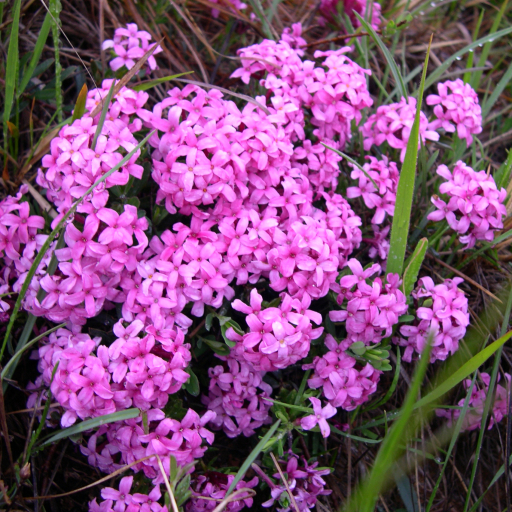
Often called the "Garland Flower," this alpine beauty is a low-growing evergreen that commands attention with its neon-pink blooms and intoxicating, spicy scent. In the wild, it hugs the rocky slopes of Central and Southern Europe, acting as a fragrant, flowering carpet. It is a plant of contradictions—tough enough to survive harsh mountain winters, yet famously finicky about being moved once it finds a home.
🔍 How to Identify
- 🌸 Bloom Style: The deep pink, four-petaled flowers grow in dense, rounded clusters (umbels) at the tips of the stems, creating a "garland" effect that hides the foliage during peak spring.
- 🍃 Foliage: The leaves are small, leathery, and narrow, resembling dark green rosemary needles. They stay glossy and green all year round.
- 🌱 Growth Habit: It is a "prostrate" shrub, meaning it stays very low to the ground (rarely exceeding 12 inches) and spreads outward to form a lush, mounded cushion.
🏡 In Your Garden
- 🪨 Soil & Drainage: This plant craves alkaline (lime-rich) soil and impeccable drainage. It thrives in rock gardens where its roots can stay cool under stones while its "head" enjoys the full sun.
- 🚫 The "No-Move" Rule: Rose Daphne is notoriously "transplant-shy" due to its sensitive root system. Choose its location carefully, as digging it up to move it later is often a death sentence for the plant.
⚠️ Safety & Toxicity
- 🚫 Status: Highly Toxic. All parts of the plant, including the sap and the occasional red berries, are poisonous if ingested.
- 🐾 Details: It contains daphnetoxin, which can cause severe internal distress in pets and humans. The sap is also a skin irritant; it is highly recommended to wear gloves when pruning or handling the plant to avoid contact dermatitis.
✨ Fun Fact
🏺 A Mythical Transformation: The genus is named after the Greek nymph Daphne, who, according to legend, was transformed into a laurel tree to escape the pursuit of the god Apollo. While Daphne cneorum isn't a true laurel, its fragrant, evergreen leaves share a striking resemblance to the ancient crown-making branches.

Detailed Care Instructions
| Humidity | Normal |
| Lighting | Part Sun |
| Difficulty | Easy |
| Temperature | 13°C - 30°C |
| Hardiness Zones | 4A - 6 |
To grow Daphne Cneorum, also known as garland flower or Mountain Daphne, follow these steps:
- Choose a suitable location: Daphne Cneorum thrives in full sun to part shade. Make sure the area has well-draining soil with slightly acidic to neutral pH.
- Prepare the soil: Amend the soil with organic matter like compost or peat moss to improve drainage. Work the soil to a depth of about 12 inches, removing any rocks or debris.
- Planting: Dig a hole twice as wide and slightly deeper than the root ball of the plant. Place the plant in the hole, ensuring that the top of the root ball is level with or slightly above the soil surface. Fill the hole with amended soil and pat it gently to eliminate air pockets.
- Watering: Give the plant a thorough watering immediately after planting, saturating the soil around the root zone. Afterward, water regularly, particularly during dry periods or in the plant's first year of growth. Avoid overwatering, as it can cause root rot.
- Mulching: Apply a layer of organic mulch, such as bark chips or straw, around the base of the plant. This helps retain moisture, regulates temperature, and suppresses weed growth.
- Pruning: Daphne Cneorum typically requires minimal pruning. However, you can remove any dead, diseased, or damaged branches. Light trimming after flowering can promote better form and encourage bushier growth.
- Fertilizer: Fertilize sparingly in early spring with a slow-release, balanced fertilizer specifically formulated for shrubs or perennials. Follow the package instructions for proper application rates.
- Maintenance: Monitor for pests like aphids or scale insects and treat them promptly if detected. Additionally, ensure the plant receives adequate airflow to prevent fungal diseases. Avoid excessive foot traffic around the plant, as it can damage the delicate root system.
By following these steps, you should be able to successfully grow Daphne Cneorum and enjoy its fragrant flowers and attractive foliage.

Place in a window with dappled sun or a spot in the middle of a room. Or directly in a window facing west or east.

Water the plant deeply and slowly, ensuring that the soil is evenly moist but not waterlogged. This plant prefers consistently damp soil, so it may be necessary to water more frequently in hot, dry weather. Avoid getting water on the leaves, as this can cause damage or disease. Allow the soil to dry slightly before watering again. It is important to use a well-draining soil mix and a container with drainage holes to prevent water from pooling around the roots.
To fertilize this plant, use a slow-release, balanced fertilizer in early spring or early fall. Apply the fertilizer around the base of the plant, being careful not to let it touch the foliage or stems. Water thoroughly after fertilizing. Avoid over-fertilizing as it can damage the roots and foliage of the plant.
The ideal soil for Daphne Cneorum plant is well-draining, with a slightly acidic pH between 5.0 and 6.0. It should be rich in organic matter and have good water-holding capacity. A mixture of peat moss, compost, and sand is recommended to create a suitable growing medium. It should be placed in a location with partial shade and protection from harsh winter winds. The plant should also be watered regularly, particularly during dry spells. Fertilizer should be provided in early spring and again in fall, using a balanced, slow-release formula.
To propagate this plant, first select a healthy stem or leaf cutting from the parent plant. Make sure it is at least 4 inches long and has several leaves attached.
Next, remove the lower leaves from the cutting, leaving only a few leaves at the top. Dip the cut end of the stem in rooting hormone powder or gel.
Plant the cutting in a small pot filled with well-draining soil mix and water it lightly. Cover it with a plastic bag or dome to maintain humidity and place it in indirect sunlight.
Check the cutting periodically and water it as needed to keep the soil moist. After several weeks, once the cutting has established roots and new growth, it can be transplanted into a larger container or outside in a suitable location in the garden.








