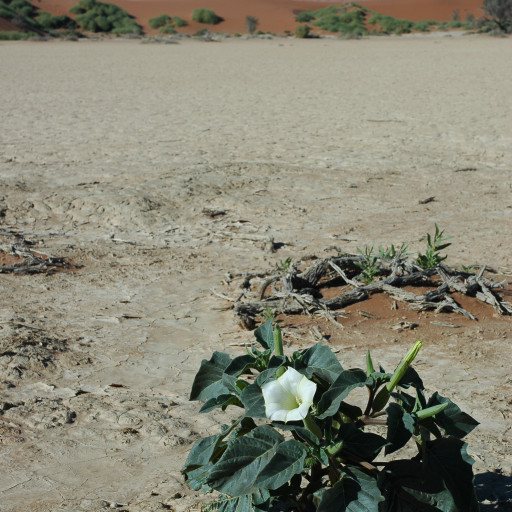
Plant Overview
Often called the "Moonflower" or "Devil’s Trumpet," Datura inoxia is a plant of striking dualities. By night, it unfurls massive, luminous white blossoms that release a heavy, intoxicating perfume to lure silken-winged moths. By day, it stands as a rugged, grayish-green shrub that has been both revered and feared throughout history for its potent, hallucinogenic, and often lethal chemical properties.
🔍 How to Identify
- 🎺 The Trumpets: Features enormous, 6-to-8-inch-long white flowers that point upward or outward. They usually bloom from late afternoon through the night, closing by the next morning’s heat.
- ☁️ Velvety Foliage: Unlike its smooth-leaved cousins, Datura inoxia is covered in a fine, grayish-white down (pubescence), giving the heart-shaped leaves a soft, felt-like texture and a muted color.
- 🦔 Prickly Fruit: After the flowers fade, they produce a "Pricklyburr"—a nodding, marble-sized seed pod covered in slender spines that eventually splits open to scatter hundreds of tan seeds.
🏡 In Your Garden
- ☀️ Sun-Drenched Survivor: This plant thrives in "neglected" spots. It loves intense heat, gravelly soil, and very little water. Because it has a deep taproot, it hates being moved once established, so choose its permanent home carefully.
- 🦋 The Night Shift: While most gardens "sleep" at night, Datura brings them to life. It is a primary food source for the massive Sphinx moth (Hawkmoth), which hovers like a hummingbird to drink nectar from the deep throat of the flower.
- 🌱 Self-Seeding Habit: Be aware that this plant is a prolific self-sower. If you don't want a forest of trumpets next year, you must remove the spiky seed pods before they turn brown and "shatter."
⚠️ Safety & Toxicity
- 🚫 EXTREMELY TOXIC: Every part of this plant—roots, stems, leaves, flowers, and especially the seeds—contains dangerous levels of tropane alkaloids (scopolamine and atropine).
- 🐾 Risk Profile: It is highly toxic to dogs, cats, horses, and humans if ingested. Even handling the plant without gloves can cause skin irritation or accidental eye irritation if you touch your face afterward. It is not recommended for gardens where small children or curious pets play unsupervised.
✨ Fun Fact
In many indigenous cultures of the American Southwest, Datura inoxia was considered a sacred "gatekeeper" plant. It was used in vision quests and rites of passage, though the dosage was so volatile that it was often overseen by a high-ranking shaman to prevent the initiate from never "returning" from the vision.

Detailed Care Instructions
To grow Datura Inoxia plant, also known as angel's trumpet or moonflower, you can follow these steps:
- Choose a suitable location: Datura Inoxia prefers full sun but can tolerate partial shade. Select a spot in your garden that gets at least 6-8 hours of direct sunlight per day.
- Prepare the soil: Datura Inoxia thrives in well-draining soil. If your soil is heavy or clayey, consider amending it with organic matter such as compost or sand to improve drainage.
- Sow seeds or transplant seedlings: You can start Datura Inoxia from seeds or purchase seedlings from a nursery. If starting from seeds, scarify them by gently rubbing them with sandpaper to expose the inner seed coat before planting. Sow seeds or transplant seedlings according to the spacing recommendations on the seed packet or nursery label.
- Watering: Keep the soil consistently moist but avoid overwatering. Datura Inoxia does not tolerate waterlogged conditions. Water deeply whenever the top inch of soil feels dry.
- Fertilization: Datura Inoxia is a heavy feeder and benefits from regular fertilization. Use a balanced, slow-release fertilizer or a diluted liquid fertilizer every two to three weeks throughout the growing season.
- Mulching and weed control: Apply a layer of organic mulch around the plants to retain soil moisture, suppress weed growth, and regulate soil temperature.
- Pruning: Prune Datura Inoxia regularly to promote bushier growth and remove any dead, damaged, or diseased parts. Pinch off the tip of young plants to encourage branching.
- Pests and diseases: Monitor your plants regularly for common pests like aphids, spider mites, or caterpillars. If necessary, apply organic insecticides or use appropriate pest control methods. Additionally, keep an eye out for signs of fungal diseases like powdery mildew or root rot, and address them promptly.
- Harvesting: Datura Inoxia produces attractive trumpet-shaped flowers that bloom from summer to fall. You can harvest the flowers for decorative purposes or to collect seeds for future planting.
Remember that Datura Inoxia is toxic if ingested, and its sap can irritate the skin and eyes. Take appropriate precautions and keep it out of reach of children and pets.
To properly water this plant, it is important to first consider the soil and weather conditions. The soil should be well-draining and not waterlogged, as this can lead to root rot. It is also important to water deeply but infrequently, rather than shallowly and frequently.
During dry spells or hot weather, the plant will require more frequent watering, but it is still important to avoid overwatering. It is best to water in the early morning or late evening, as this will help prevent evaporation and allow the plant to absorb more water.
When watering, it is recommended to avoid getting water on the leaves or flowers, as this can lead to fungal growth or damage. It is best to water at the base of the plant, either by hand or using a drip irrigation system.
Overall, it is important to pay attention to the plant's individual needs and adjust watering accordingly.
To fertilize this specific plant, you should first make sure the soil is moist. Then, mix a high-nitrogen fertilizer with water and apply it around the base of the plant, being careful not to get any on the leaves or stem. It is important to fertilize this plant sparingly, as too much can harm it. You should only fertilize once every two to three weeks during the growing season, which is typically late spring to early autumn.
The ideal soil for a certain plant in the Solanaceae family can be a well-draining soil that is rich in organic matter. It should have a pH of around 6 to 7.5, and it should not be too compacted or dense. This particular plant enjoys a slightly sandy soil that can provide good drainage. It also tolerates acidic soils above pH 5.2, but alkaline soils should be avoided. Organic amendments like compost or well-rotted manure can help to improve soil quality and fertility. The plant likes a moist soil, but it is important to avoid overwatering, as excessive moisture can lead to root rot. Adding mulch to the soil surface can also help to retain moisture and regulate temperature. Overall, a well-draining, slightly sandy soil that is amended with organic matter and kept consistently moist is the best choice for growing this plant.
Propagation of this plant can be accomplished through several methods. One common way is to take stem cuttings from the main plant. Cuttings should be taken from healthy, green stems that are free from disease or damage. Cut the stem at a slight angle using a sharp, clean pair of scissors or pruning shears. Remove any leaves or flowers from the lower third of the stem. Dip the cut end in rooting hormone and plant the cutting in a pot filled with a well-draining potting mix. Keep the soil moist but not waterlogged, and provide bright, indirect light. The cutting should root within a few weeks.
Another method of propagation is to collect and sow seeds. Mature seed pods can be collected from the plant when they turn brown and start to split open. Remove the seeds from the pod and sow them in a pot filled with a well-draining potting mix. Cover the seeds with a thin layer of soil, and keep the soil moist but not waterlogged. Place the pot in a warm, bright location, and the seeds should germinate within a week or two.
Finally, this plant can also be propagated through division. This method is best done in the spring when the plant is just starting to grow. Carefully dig up the entire plant and gently separate the root mass into two or three sections, making sure each section has both roots and stems. Plant each division in a pot filled with well-draining potting mix, and keep the soil evenly moist until new growth appears.







