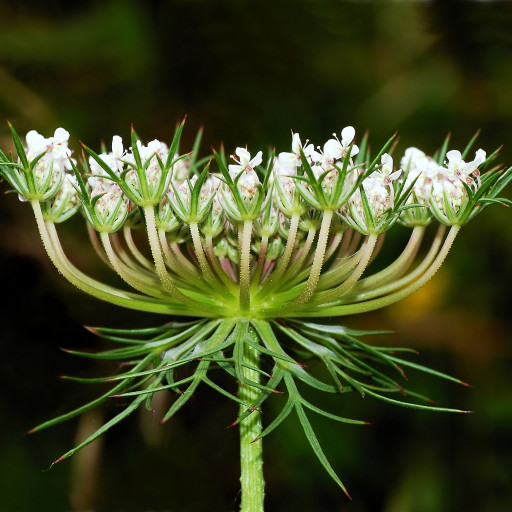
Plant Overview
Known by the elegant nickname "Queen Anne’s Lace," this wildflower is a staple of summer meadows and sun-drenched roadsides. Legend suggests the name comes from Queen Anne of England, who supposedly pricked her finger while crafting lace, leaving a single drop of blood in the center of the bloom. While it looks delicate, it is a hardy ancestor of the modern culinary carrot we know and love today.
🔍 How to Identify
- 🌸 The Umbel: Tiny white flowers are clustered in a flat-topped "umbel" that can reach up to 4 inches across. As the seeds ripen, the cluster curls inward, looking like a bird’s nest.
- 🩸 The "Dark Heart": Look closely at the center of the white lace; you will often find a single, tiny dark-purple or reddish floret that mimics a resting insect to attract pollinators.
- 🌿 Hairy Stems: Unlike its lookalikes, the stems of Daucus carota are covered in fine, stiff hairs. This is a vital identification feature: "The Queen has hairy legs."
🏡 In Your Garden
- 🦋 Butterfly Buffet: This plant is a primary host for the Black Swallowtail butterfly. If you see bright green, black, and yellow striped caterpillars munching on the leaves, leave them be—they are the next generation of pollinators!
- 🌱 The Taproot: Because it grows a deep, sturdy taproot, it is highly drought-tolerant but nearly impossible to transplant once it has started growing. If you want it in your garden, it’s best to sow seeds directly where you want them.
- 🌾 Soil Specialist: It actually prefers "lean" or poor soil. Over-fertilizing will give you lots of lush green leaves but very few of the iconic lace-like flowers.
⚠️ Safety & Toxicity
- 🚫 Deadly Lookalikes: CRITICAL WARNING. Queen Anne’s Lace looks almost identical to Poison Hemlock (Conium maculatum) and Water Hemlock, both of which are lethal if ingested. Always check for the hairy stem and the carrot-like smell to differentiate.
- 🐾 Skin Irritation: The sap of the plant can cause "phytophotodermatitis" in some individuals—a skin reaction that causes a rash or blisters when the skin is exposed to sunlight after touching the plant.
- 🐕 Pet Safety: While not typically fatal to cats or dogs in small amounts, it can cause digestive upset and skin irritation if they romp through a thick patch.
✨ Fun Fact
If you dig up a first-year Daucus carota plant, you’ll find a small, white root that smells exactly like a garden carrot. While the wild version is edible when very young, it quickly becomes woody, fibrous, and bitter as the plant matures!

Detailed Care Instructions
| Color | Orange |
| Soil Ph | 6.0–6.8 |
| Humidity | Normal |
| Invasive | Weed |
| Lighting | Full Sun |
| Toxicity | Poisonous |
| Soil Type | Loose, Well-Draining |
| Bloom Time | Spring |
| Difficulty | Easy |
| Plant Type | Biennial, Grown As An Annual |
| Hibernation | Cold Period |
| Mature Size | 6-8 Inches Tall |
| Native Area | Europe, Southwestern Asia |
| Sun Exposure | Full Sun, Partial Shade |
| Hardiness Zones | 3–10 |
To grow Daucus Carota (carrot) plants, you can follow these steps:
- Choose the right variety: Select a carrot variety that suits your climate and growing conditions. There are many different types available, including different sizes, shapes, and colors.
- Prepare the soil: Carrots prefer loose, well-draining soil. Remove any stones, debris, or large clumps from the soil. Work in compost or organic matter to improve fertility and drainage.
- Sow the seeds: Carrot seeds are tiny, so be careful when sowing them. Create furrows about half an inch deep and sprinkle the seeds along the rows. Space the seeds about 2 inches apart. Cover the seeds lightly with soil and gently water them.
- Water regularly: Carrots need consistent moisture to germinate and grow properly. Keep the soil moist but not waterlogged. Water deeply to promote root development. Avoid overwatering, as it can cause rot or splitting.
- Thin the seedlings: Once the seedlings emerge and have a few true leaves, thin them by removing weaker or overcrowded plants. Leave a spacing of about 2-3 inches between each carrot plant.
- Provide enough sunlight: Carrots require full sun to grow well. Make sure they receive at least 6 hours of direct sunlight each day.
- Mulch the soil: Apply a layer of mulch around the carrot plants to retain moisture, suppress weeds, and keep the soil cool. Avoid mulching too close to the stems to prevent rotting.
- Fertilize sparingly: Carrots are not heavy feeders, but you can apply a balanced fertilizer once or twice during their growing period to provide essential nutrients. Follow the instructions on the fertilizer package for the correct application rate.
- Monitor pests and diseases: Keep an eye out for common carrot pests such as carrot fly, aphids, and slugs. Use organic or chemical controls as needed. Also, watch for signs of diseases such as carrot rot or powdery mildew and take appropriate actions.
- Harvest: Carrots are usually ready for harvest 70-80 days after sowing. Gently pull the carrots from the soil, taking care not to damage them. Harvest the ones you need, leaving the rest to grow larger.
Remember to rotate your carrot crops each year to avoid soil-borne diseases and pests. With proper care and attention, you'll be able to grow your own healthy and delicious Daucus Carota plants.

Place in a bright room that is sun drenched almost all day. Or directly in a south-facing window.

To water this plant, ensure that the soil is moist but not waterlogged. Water the plant deeply once a week, and more frequently in hot weather or if the soil is drying out quickly. Avoid getting water on the foliage, as this can promote fungal growth. It is important to also ensure proper drainage to prevent the roots from becoming water-logged.
To ensure optimal growth for this plant, it is important to provide it with regular fertilization. Choose a high-quality, balanced fertilizer that is rich in organic matter and contains all of the necessary nutrients. Apply the fertilizer according to the instructions on the package, taking care not to over-fertilize as this can be harmful to the plant. Additionally, be sure to water the plant regularly and provide it with plenty of sunlight to support its growth. With the right care and attention, this plant can thrive and produce beautiful, healthy foliage and vibrant blooms.
The soil that is suitable for Daucus Carota should be well-draining, loose, and airy. It should also have a pH level between 6.0 and 7.5. Ideally, the soil should be rich in nutrients, organic matter, and should provide good water retention. Additionally, the soil should not be compacted or clay-like, as this can cause drainage issues and prevent water and nutrients from reaching the roots of the plant. Choosing a soil that meets these conditions will help promote healthy growth for Daucus Carota.
To propagate a particular plant species, it is first necessary to identify the most suitable parts or structures of the plant that can be used to grow new plants. In the case of Daucus Carota, the process of propagation can be done in a number of ways. One commonly used method is seed propagation, where mature flowers are allowed to dry, and the seeds harvested and planted in suitable soil.
Another method is called root division, where the plant's root system is carefully separated into smaller pieces, each of which can then be planted in suitable soil and grown into a new plant. This method is particularly useful for plants that have well-developed root systems and can tolerate root disturbance.
Another popular method of propagation is through stem cuttings. This involves cutting off a small section of a mature stem and placing it in suitable soil. With proper care and attention, the stem will begin to develop roots and eventually grow into a new plant. This method is particularly useful for plants that are difficult to grow from seed or that have a slow growth rate.
Overall, the propagation of Daucus Carota is a relatively straightforward process that can be done using a range of different methods. By choosing the most suitable method for your climate and conditions, you can successfully grow new plants and enjoy the many benefits of this useful and attractive species.








