Plant Overview
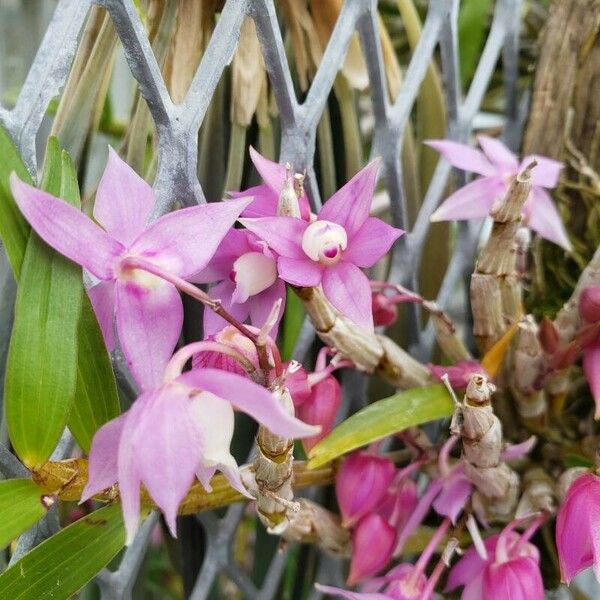
Often called the Fringed Lip Dendrobium, this orchid is a showstopper from the humid montane forests of Southeast Asia. Known for its cascading, reed-like stems that erupt in clusters of waxy, pinkish-purple blooms, it creates a "floral waterfall" effect when in full flower. It is a favorite among collectors who appreciate its dainty, bell-shaped blossoms and its graceful, weeping growth habit.
🔍 How to Identify
- 🌸 The "Bearded" Lip: The most striking feature is the lip (labellum), which is concave and features a delicate, fringed, or hairy edge, often with a white or pale throat.
- 🎋 Pendulous Canes: The stems, or pseudobulbs, are slender, many-jointed, and naturally hang downward as they mature, reaching lengths of up to 20 inches.
- 🍃 Lance-Like Foliage: The leaves are narrow, pointed, and arranged alternately along the stems. This species is deciduous or semi-deciduous, meaning it may drop its leaves before the flowering season.
🏡 In Your Garden
- 🧺 Basket Specialist: Because of its weeping habit, this orchid is rarely happy in a standard floor pot. It thrives best when mounted on cork bark or tucked into a hanging wooden slat basket, allowing the canes to drape naturally.
- 💤 The Winter "Dry Rest": To trigger a spectacular bloom, this plant requires a "tough love" period. In late autumn, gardeners should significantly reduce watering and stop fertilizing to mimic the dry season of its native habitat.
⚠️ Safety & Toxicity
- ✅ Non-Toxic Status: Like most members of the Dendrobium genus, Dendrobium hercoglossum is considered non-toxic to humans, cats, and dogs.
- 🌱 Orchid Sensitivity: While safe, it is always best to keep ornamental plants out of reach of curious pets to prevent digestive upset from ingesting fibrous plant material.
✨ Fun Fact
The species name hercoglossum is derived from the Greek words for "fence" and "tongue." This refers to the unique, transverse ridge on the flower's lip that acts like a tiny fence, directing specific pollinators toward the pollen.

Detailed Care Instructions

Place in a dark room with little light, like a dark bedroom or a spot far away from a window or directly in a north-facing window.

Water-loving plants flourish in wet or sloppy soil and near ponds. The extensive root system enables these plants to absorb plenty of water. The surface of the soil should be kept moist at all times. Place your pot in a container filled with water to guarantee that plants get enough water. If the ground becomes dry, it is recommended that you water it well. Plants in smaller pots will need to be watered more frequently. Water the soil in which the plant is standing thoroughly using a watering can.








