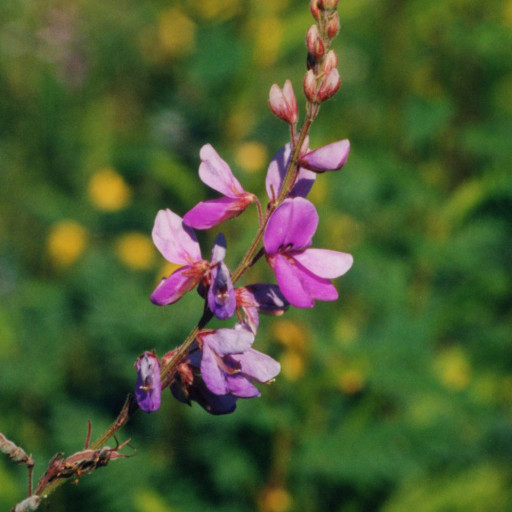
Plant Overview
Known as the Showy Tick-trefoil, this tall, elegant wildflower is a star of the North American tallgrass prairie. It gets its name from its most famous trick: the seed pods are covered in tiny, hooked hairs that act like natural Velcro, hitching a ride on any passing hiker or furry animal. While gardeners love it for its bright clusters of pinkish-purple blooms, it is also a powerhouse for soil health.
🔍 How to Identify
- 🌸 The Flowers: Large, pea-like blossoms in vibrant shades of magenta or lavender. They grow in long, branching clusters (racemes) at the top of the plant.
- 🍃 The Leaves: Classic "trifoliate" arrangement, meaning the leaves grow in sets of three. They are elongated, slightly hairy, and have a soft, velvety texture.
- 🪝 The Seed Pods: Known as "loments," these flat pods are divided into several segments. If you touch them, they will instantly stick to your clothing—a signature trait of the Desmodium family.
🏡 In Your Garden
- 🌱 Soil Improver: As a member of the legume family, this plant is a "nitrogen fixer." It works with soil bacteria to pull nitrogen from the air and store it in the ground, naturally fertilizing the area for neighboring plants.
- 🦋 Wildlife Magnet: It is a high-value plant for pollinators, especially long-tongued bees and butterflies. It is also a host plant for the Eastern Tailed-Blue butterfly caterpillars.
- ⚓ Deep Roots: It develops a robust, deep taproot early in life. This makes it incredibly drought-tolerant once established, but it also means it hates being moved—pick its "forever home" carefully!
⚠️ Safety & Toxicity
- ✅ Status: Generally non-toxic and safe.
- 🐕 Details: There are no known toxic effects for humans, cats, or dogs. The only "danger" is the persistence of the seed pods; if your dog runs through a patch, you’ll likely spend quite a bit of time brushing the "ticks" out of their fur!
✨ Fun Fact
The tiny hooked hairs on the seed pods are so effective that they served as a natural inspiration for the invention of hook-and-loop fasteners (Velcro). While Burdock often gets the credit, the Desmodium genus uses the exact same mechanical strategy to travel miles away from its parent plant.

Detailed Care Instructions
To grow Desmodium Canadense, also known as Showy Tick Trefoil, follow these steps:
- Choose the right location: Desmodium Canadense prefers full sun to partial shade. Select a location in your garden that receives at least 6 hours of direct sunlight per day.
- Prepare the soil: The plant prefers well-draining soil. Amend the soil with organic matter like compost or aged manure to improve fertility and drainage. Remove any weeds or grass from the area.
- Sow seeds: Desmodium Canadense can be started from seeds, which can be obtained from a nursery or online. Sow the seeds directly in the prepared soil in spring after the danger of frost has passed. Follow the instructions on the seed packet for depth and spacing requirements. Firmly press the seeds into the soil to ensure good contact.
- Watering: Keep the soil evenly moist but not waterlogged. Water regularly, especially during dry spells. Avoid overwatering, as it can lead to root rot.
- Mulching: Mulch around the plants with organic mulch like straw or wood chips. This helps retain soil moisture and suppress weed growth.
- Pruning and maintenance: Desmodium Canadense doesn't require much pruning but can benefit from occasional shaping to maintain a compact and tidy appearance. Remove any dead or damaged growth as needed.
- Fertilizer: Desmodium Canadense generally doesn't require much fertilizer. However, if you notice poor growth or yellowing leaves, you can apply a balanced fertilizer in early spring.
- Pests and diseases: Desmodium Canadense is generally pest and disease resistant. However, keep an eye out for common garden pests like aphids, caterpillars, or spider mites. If necessary, apply organic insecticides or use natural pest control methods.
- Propagation: If you want to propagate additional Desmodium Canadense plants, you can collect seeds from mature plants and sow them as described above. Alternatively, you can divide mature plants in early spring or fall.
By following these steps, you should be able to successfully grow Desmodium Canadense in your garden.

Place in a bright room that is sun drenched almost all day. Or directly in a south-facing window.

To water this plant, you should first check the soil to ensure it is dry to a depth of 1-2 inches. Then, thoroughly water the plant until water begins to drain from the bottom of the pot or out of the soil. It is important to avoid over-watering, as this can lead to root rot. Allow the soil to dry out slightly before watering again, and be sure to provide good drainage to prevent water from accumulating around the roots. This plant prefers consistent moisture but can tolerate periods of drought.
To fertilize this plant, use a balanced fertilizer with equal proportions of nitrogen, phosphorus, and potassium. Apply the fertilizer in spring when new growth appears and again in the early summer. Water thoroughly after fertilizing to ensure the nutrients are absorbed by the roots. Avoid over-fertilizing as it can lead to excessive foliage growth and reduce the plant's overall health.
Desmodium Canadense is a plant that belongs to the Fabaceae family. It requires well-draining and nutrient-rich soil that is slightly acidic to neutral in pH levels. The soil should be sufficiently moist but not waterlogged. The ideal soil type for this plant is loamy soil, which is a mixture of sand, silt, and clay in almost equal proportions, with plenty of organic matter. The soil should be aerated well to promote root growth, and it should be free of rocks and other debris that can hinder root development. Potting soil, enriched with compost and perlite, can also be used for indoor cultivation. Fertilizer containing high amounts of nitrogen should be avoided as Desmodium Canadense has the ability to fix atmospheric nitrogen and draw it from the air. Overall, a nutrient-rich, well-draining, and slightly acidic to neutral soil type with good aeration is ideal for the growth and development of Desmodium Canadense.
Desmodium Canadense plant can be propagated through various methods, including seed propagation and vegetative propagation. Seed propagation involves collecting fresh seeds from the plant, sowing them in moist soil, and maintaining a warm and humid environment until germination occurs.
Vegetative propagation, on the other hand, involves taking cuttings from the plant and rooting them in a suitable growing medium. The cuttings should be taken from healthy and mature plants, and the best time to do so is during spring or summer.
To root the cuttings, dip the cut end into a rooting hormone powder, then plant them in a pot with a well-draining soil mix. Ensure the soil is kept moist but not waterlogged, and provide the cutting with indirect sunlight and warm temperatures.
Alternatively, Desmodium Canadense plant can also be propagated through division of its root system. Carefully dig up the plant, and separate the roots into several sections, ensuring each section has some foliage attached. Replant the divided plants in suitable pots or garden beds, and water them thoroughly.
With proper care, Desmodium Canadense plant propagated through any of these methods should establish well and grow into healthy and robust plants.








