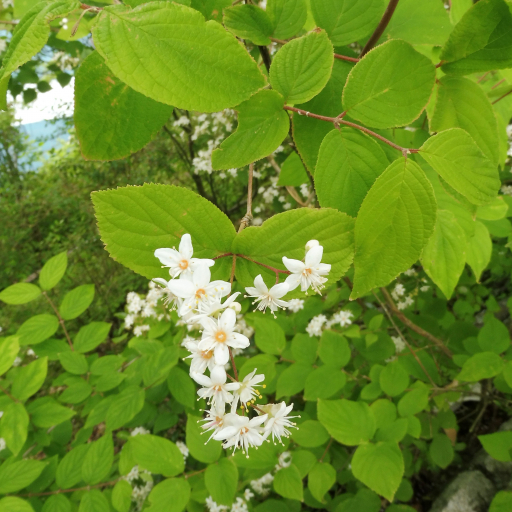
Plant Overview
Known as the "Fuzzy Deutzia," this charming deciduous shrub is a nostalgic favorite that has graced cottage gardens since the Victorian era. Native to Japan and China, it is beloved for its fountain-like habit and the snow-white blossoms that appear just as spring transitions into summer. While it may look delicate, it is a rugged survivor that earned its common name from the tiny, sandpapery hairs that cover its leaves.
🔍 How to Identify
- 🌸 The Blooms: Features dense, upright clusters (panicles) of small, bell-shaped or star-like flowers. Most varieties are pure white, though some, like 'Pride of Rochester,' boast a delicate blush of pink on the outer petals.
- 🍃 Rough Foliage: The leaves are lance-shaped and uniquely "fuzzy." If you run your finger over them, they feel surprisingly rough, similar to fine-grit sandpaper, due to specialized hairs called trichomes.
- 🪵 Peeling Bark: On older, established branches, the bark often turns a rich reddish-brown and begins to peel or exfoliate in thin strips, providing subtle visual interest during the winter months.
🏡 In Your Garden
- ✂️ Pruning Nuance: This plant blooms on "old wood," meaning the flower buds for next year are set shortly after this year's flowers fade. To avoid accidentally cutting off next season’s show, only prune it immediately after the flowers drop.
- 💧 Thirst for Stability: While it is relatively unfussy about soil type, it has a shallow root system. It prefers consistently moist soil and can look quite "tired" or wilted during intense mid-summer droughts if not given a deep drink.
- ☀️ Sun Seeker: For the best floral display, find a spot with full sun. It will grow in partial shade, but the branches may become "leggy" or stretched out, and the number of flowers will decrease significantly.
⚠️ Safety & Toxicity
- ✅ Pet & Human Friendly: Deutzia scabra is generally considered non-toxic to cats, dogs, and humans. It is a safe choice for families with curious toddlers or roaming pets.
- 🧤 Skin Irritation: While not poisonous, the "scabrous" (rough) texture of the leaves can cause mild skin irritation or a "scratchy" sensation for people with sensitive skin. Wearing gloves while pruning is a good idea.
✨ Fun Fact
The genus Deutzia was named by the famous botanist Carl Peter Thunberg in honor of Johann van der Deutz, a Dutch lawyer and financier who sponsored Thunberg’s botanical expeditions to Japan in the 1700s!

Detailed Care Instructions
| Humidity | Normal |
| Difficulty | Medium |
| Hardiness Zones | 5 - 8 |
To grow Deutzia scabra, follow these steps:
- Choose a suitable location: Deutzia scabra prefers full sunlight to light shade. Select a spot in your garden that receives at least 6-8 hours of direct sunlight a day.
- Prepare the soil: Deutzia scabra thrives in well-draining soil. Before planting, amend heavy clay soil with organic matter like compost or peat moss to improve drainage. Ensure the soil has a slightly acidic to neutral pH level.
- Planting: Dig a hole twice as wide and as deep as the plant's root ball. Gently loosen the plant's roots and place it in the hole. Backfill with soil, ensuring the top of the root ball is level with the ground.
- Watering: Water the plant thoroughly after planting to help establish its roots. Afterwards, water it regularly, keeping the soil evenly moist but not waterlogged. Water deeply, allowing the water to penetrate the root zone.
- Mulching: Apply a layer of organic mulch around the base of the plant. This will help retain soil moisture, suppress weeds, and regulate soil temperature.
- Fertilizing: Apply a balanced slow-release fertilizer in spring, following the package instructions. Avoid over-fertilizing, as it can lead to leggy growth and reduced flower production.
- Pruning: Deutzia scabra blooms on old wood, meaning it produces flowers on the previous year's growth. Prune immediately after flowering, removing any dead or damaged wood and shaping the plant as desired.
- Winter protection: Deutzia scabra is hardy, but young plants may benefit from a layer of mulch or straw around the base in winter to protect against extreme cold temperatures.
- Pests and diseases: Deutzia scabra is generally resistant to pests and diseases. However, keep an eye out for aphids, scale insects, and powdery mildew. Treat any issues promptly with appropriate organic or chemical controls.
- Propagation: Deutzia scabra can be propagated through softwood or hardwood cuttings taken in late spring or early summer. Dip the cuttings in rooting hormone, plant them in well-draining soil, and keep them moist until they root.
By following these steps, you can successfully grow Deutzia scabra and enjoy its beautiful flowers in your garden.

Place in a bright room that is sun drenched almost all day. Or directly in a south-facing window.

Deutzia Scabra is a shrub that requires regular watering to ensure optimum growth and health. To water this plant properly, begin by checking the soil moisture level around the plant. Insert your finger into the soil about one to two inches deep, and if the soil feels dry to the touch, it is time to water the plant.
Use a watering can or a hose with a gentle, steady stream to water the plants. Avoid using high pressure that can damage the plants. Water the soil around the plant, drenching it thoroughly. Make sure that the water reaches the roots of the plant.
Allow the soil to dry out slightly between watering sessions. Over-watering can lead to root rot and other fungal diseases that can damage the plant.
In addition to regular watering, Deutzia Scabra requires well-draining soil that retains some moisture to ensure healthy growth. Mulch around the plant to help retain moisture in the soil and keep the plant's roots cool. This will also help to keep weeds from growing around the plant.
In conclusion, watering Deutzia Scabra requires regularly checking soil moisture and ensuring proper amounts of water and drainage to prevent damage or disease.
Deutzia Scabra plant, a deciduous shrub, prefers fertile, moist, well-drained soil with a pH range of 5.0 to 6.5. Use a complete fertilizer, like 10-10-10, in early spring before new growth appears. Apply 1/3 to 1/2 pound of fertilizer per 100 square feet of soil. Water the plant well after applying fertilizer to ensure that it reaches the roots. In subsequent years, repeat the fertilization process annually. Avoid over-fertilizing the plant, as it can lead to weak stems and an increased risk of disease.
Deutzia Scabra plants require well-draining, moist soil with a slightly acidic to neutral pH level. The soil should be rich in organic matter and be able to retain moisture without getting waterlogged. It is recommended to use a high-quality potting mix that is specifically formulated for flowering shrubs or a blend of garden soil, compost, and sand. It is important to avoid using soil that is heavy and compacted as this can lead to poor drainage and root rot. Additionally, it is recommended to fertilize the plant with a balanced fertilizer during the growing season to ensure healthy growth and blooms.
Deutzia Scabra plant can be propagated through stem cuttings. Choose healthy stems that are not too woody and have at least two nodes. Cut the stem at an angle to allow water to drain off easily and dip the cut end in rooting hormone powder. Then, plant the cutting in a pot with well-draining soil and water it thoroughly. Cover the pot with a plastic bag to create a humid environment around the cutting. Place the pot in a warm, bright location, but away from direct sunlight. Water the cutting regularly to keep the soil moist and avoid overwatering. After a few weeks, tug the cutting gently to check if it has rooted. Once it has rooted, remove the plastic bag and gradually acclimate the new plant to the outdoor environment by moving it to a shady spot for a few hours each day.








