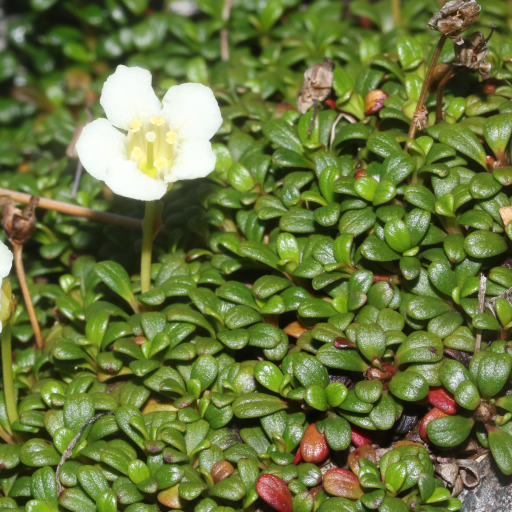
Plant Overview
Often called the Lapland Diapensia or the Pincushion Plant, this tiny mountain dweller is a true survivor of the Ice Age. It doesn't just grow in the cold; it thrives in some of the most inhospitable environments on Earth, from the windswept peaks of the White Mountains to the high Arctic tundra. It forms dense, moss-like mats that act like a fortress against the freezing wind.
🔍 How to Identify
- 🌿 The Cushion Habit: It grows in a very tight, hemispherical dome or "pincushion" shape, rarely rising more than 2-3 inches off the ground to avoid harsh winds.
- 🍃 Leathery Leaves: The tiny, paddle-shaped leaves are evergreen, thick, and crowded together. They often turn a deep reddish-burgundy during the winter months to protect themselves from intense sunlight.
- 🤍 Creamy Blossoms: In early summer, the cushion is dotted with relatively large, bell-shaped white flowers. Each flower has five rounded petals and a distinct yellow center, standing on a short, sturdy stalk.
🏡 In Your Garden & Habitat
- 🏔️ Extreme Specialists: In the wild, you will only find these on rocky, barren ridges where almost nothing else can survive. They rely on "wind-scouring," where the wind blows snow away, allowing them to photosynthesize even in early spring.
- 💧 The Drainage Rule: If you are a high-altitude gardener attempting to grow Diapensia, remember it hates "wet feet." It requires extremely gritty, acidic, and well-draining soil. It mimics the behavior of a succulent, storing what little moisture it can in its dense leaf structure.
- ☀️ Cold Sun Lovers: While it loves bright light, it is highly sensitive to heat. It cannot survive in humid, southern climates because its internal "clock" and cooling mechanisms are hardwired for the Arctic.
⚠️ Safety & Toxicity
- 🟢 Non-Toxic: There are no known toxic properties associated with Diapensia lapponica for humans or pets.
- 🛑 Conservation Warning: Because it grows so slowly (sometimes only a few millimeters a year) and lives in fragile alpine ecosystems, you should never harvest it from the wild. Stepping on a single cushion can kill a plant that took 50 years to grow.
✨ Fun Fact
- ⏳ Ancient Domes: Some of the larger cushions found on mountain peaks are estimated to be over 100 years old. Despite their ancient age, the entire plant might be smaller than a dinner plate!

Detailed Care Instructions
To grow Diapensia Lapponica, also known as Arctic diapensia, follow these steps:
- Choose the right location: Diapensia Lapponica prefers full sun to partial shade and is best grown in rock gardens or alpine gardens. It requires well-draining soil with good moisture retention.
- Prepare the soil: Ensure that the soil is well-draining and sandy or loamy in texture. Add organic matter like compost to improve the soil's fertility and moisture-retaining capacity.
- Sow seeds or plant seedlings: You can start Diapensia Lapponica from seeds or purchase young seedlings from a nursery. If sowing seeds, sow them in late winter or early spring in trays or pots filled with well-draining soil. Cover the seeds lightly with soil and water gently. Keep the trays in a cool, bright place until germination occurs.
- Transplanting: Once the seedlings have gained some strength, transplant them into your prepared, well-draining soil. Space the seedlings at least 6-8 inches apart to allow them room to spread.
- Watering and maintenance: Water the plant regularly, especially during dry spells, to ensure the soil remains moist but not waterlogged. Mulch around the plants to help retain moisture and suppress weeds. Diapensia Lapponica is a low maintenance plant, but you can fertilize it lightly in spring with a slow-release, balanced fertilizer.
- Protect from harsh conditions: Diapensia Lapponica is adapted to harsh, cold conditions, but you may need to protect it from extreme frost or excessive heat. In extremely cold climates, using a winter mulch or covering with a cloche can help protect the plant from severe freezing temperatures.
- Pruning: Prune off any dead or diseased foliage to keep the plant healthy and maintain its shape. Avoid heavy pruning, as the plant's growth is slow, and it may take time to recover.
- Division: Every 3-4 years, you can divide mature Diapensia Lapponica plants to increase their numbers. Gently lift the plant and divide the clumps, ensuring that each division has some roots attached. Replant the divisions in well-prepared soil and water them thoroughly.
Remember to research specific growing conditions for your region, as Diapensia Lapponica's cultivation may vary based on your climate and soil conditions.

Place in a window with dappled sun or a spot in the middle of a room. Or directly in a window facing west or east.

Diapensia Lapponica is a plant species that requires careful watering to thrive. To water this plant, it is important to use a watering can or a hose with a gentle spray attachment to avoid damaging the plant.
Watering should be done only when the soil around the plant feels dry to the touch. It is important not to over-water the plant, as this can lead to root rot and other related problems.
When watering the plant, it is important to avoid getting water on the leaves or flowers. Instead, water should be directed towards the base of the plant, where it can be absorbed by the roots.
In addition to careful watering, Diapensia Lapponica also benefits from regular fertilization and pruning. Fertilizer should be applied according to the manufacturer's instructions, and pruning should be done in the early spring to help shape the plant and promote new growth. So, these steps should be followed to ensure healthy growth and long life of the plant.
To fertilize Diapensia Lapponica:
- Choose a well-balanced, slow-release, granular fertilizer with an N-P-K ratio of approximately 10-10-10 or similar. This indicates equal proportions of nitrogen (N), phosphorus (P), and potassium (K).
- Before applying fertilizer, ensure that the soil around the plant is moist but not waterlogged.
- Distribute the granular fertilizer evenly around the base of the Diapensia Lapponica plant, following the recommended application rates provided on the fertilizer packaging. Avoid getting the fertilizer directly in contact with the foliage.
- Gently work the fertilizer into the top layer of soil, using a hand tool or your fingers. Be careful not to disturb the plant's shallow root system.
- Water the area thoroughly after applying the fertilizer to help it dissolve and reach the plant's roots. Ensure the soil is adequately moist, but avoid creating waterlogged conditions.
- It is recommended to fertilize Diapensia Lapponica once every growing season, preferably in early spring or early summer, before the plant enters its active growth phase.
- Monitor the plant's growth, foliage color, and overall health. If the plant shows signs of deficiency or requires additional nutrients, you can adjust the fertilizer application accordingly.
Diapensia Lapponica is a small, low-growing plant that requires nutrient-rich, well-draining soil for optimal growth. The soil should have a slightly acidic pH level between 5.0 and 6.0. It is important to avoid overwatering the plant, as it prefers dry to slightly moist soil. Adding organic matter such as peat moss or compost can help improve soil quality and provide essential nutrients for the plant. The plant also prefers a cool environment, so placing it in a shaded or partially shaded area can help keep the soil moist and cool.
Diapensia Lapponica is a perennial plant native to arctic and alpine regions. Propagating this plant can be achieved through several methods, including seed propagation and vegetative propagation.
Seed propagation:
- Collect ripe seeds from mature Diapensia Lapponica plants. The seeds are small, round, and light brown in color.
- Clean the seeds by removing any debris or excess plant material.
- Sow the seeds in a well-draining potting mix. Diapensia Lapponica prefers acidic soils, so adding peat moss or vermiculite to the mix can be beneficial.
- Gently press the seeds into the soil but avoid burying them too deeply, as they require light to germinate.
- Water the pots lightly to ensure the soil stays moist, but not waterlogged.
- Place the pots in a cool and humid environment, ideally at temperatures around 40-50°F (4-10°C).
- Germination can take several weeks to months, so be patient and continue to provide adequate moisture and light as needed.
- Once the seedlings have developed several sets of true leaves, they can be transplanted into individual pots or into a garden bed. Ensure they receive ample sunlight but protect them from extreme temperatures.
Vegetative propagation: - Identify healthy and mature Diapensia Lapponica plants from which to take cuttings.
- Using a sharp and clean knife or shears, cut a stem that is a few inches long just below a leaf node. Remove any lower leaves, leaving only a few upper leaves on the cutting.
- Optionally, dip the cut end of the stem into a rooting hormone powder to encourage root development.
- Prepare a well-draining rooting medium, such as a mix of perlite and peat moss.
- Insert the cut end of the stem into the rooting medium.
- Place the cutting in a humid environment with bright, indirect light. You can cover the cutting with a plastic bag or use a propagator to maintain high humidity.
- Keep the rooting medium consistently moist but avoid overwatering, as excess moisture can lead to rotting.
- After a few weeks, the cutting should develop roots. You can gently tug on the stem to check if there is resistance, indicating root growth.
- Once roots have formed, the cutting can be transplanted into individual pots or directly into suitable garden soil. Ensure the newly propagated plant receives adequate sunlight and water it as needed.
With proper care and attention, both seed propagation and vegetative propagation can be effective ways to propagate Diapensia Lapponica plants and expand their presence in a garden or landscape.








