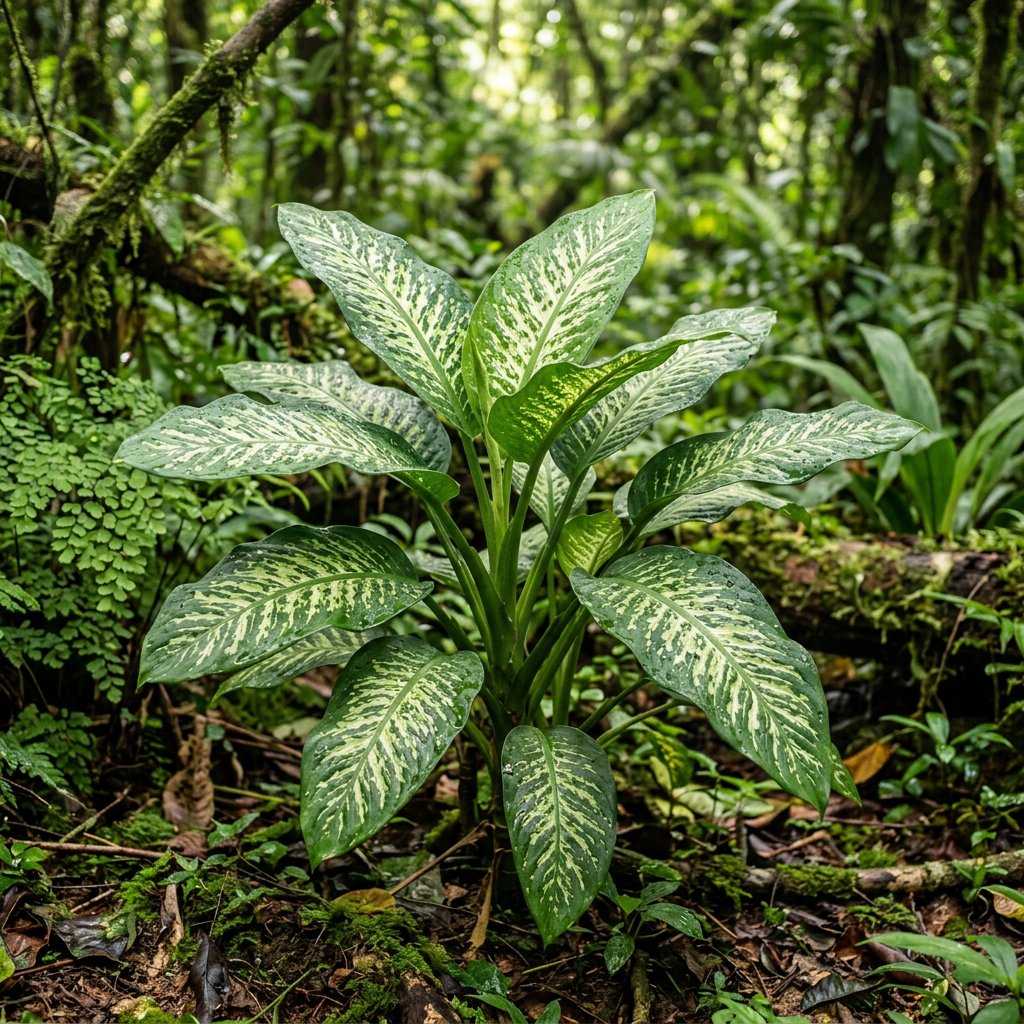
Plant Overview
Often called the "Dumb Cane" or "Leopard Lily," Dieffenbachia seguine is a tropical powerhouse that has been a favorite indoor companion since the Victorian era. Originating from the lush rainforests of Central and South America, it is prized for its broad, speckled leaves that look as if they’ve been hand-painted with splashes of cream and lime. It’s a master of filling empty corners with high-impact, jungle-like energy.
🔍 How to Identify
- 🍃 Lush Foliage: Large, oblong leaves that can grow over a foot long, featuring a distinct midrib and intricate mottled patterns of white, cream, or yellow.
- 🎋 Cane-Like Stems: As the plant matures, it sheds its lower leaves, revealing a thick, segmented green trunk that resembles bamboo or sugar cane.
- ✨ Waxy Texture: The leaves have a smooth, slightly matte finish that feels substantial to the touch, helping the plant thrive in the filtered light of a forest floor.
🏡 In Your Garden
- ☁️ Tropical Humidity: Because it hails from the humid jungle understory, it craves moisture in the air. If the leaf tips turn brittle and brown, it is often a "cry for help" for a humidifier or a nearby pebble tray.
- ☀️ The Lean: This plant is highly phototropic, meaning it will aggressively stretch toward the nearest window. To prevent your Dieffenbachia from growing sideways or becoming "leggy," give the pot a quarter-turn every time you water it.
- 🚿 Watering Nuance: It hates "wet feet." The thick stems store a surprising amount of water, so it prefers its soil to dry out halfway down the pot before getting another drink to avoid root rot.
⚠️ Safety & Toxicity
- 🚫 High Toxicity: This plant is defensive. All parts contain needle-like calcium oxalate crystals known as raphides.
- 👄 The "Dumb" Effect: If leaves are bitten or chewed, these microscopic needles embed themselves in the mouth and throat, causing immediate, intense swelling and pain.
- 🐾 Pets & Kids: It is highly toxic to cats, dogs, and small children. Ingestion can lead to a temporary loss of speech, severe drooling, and difficulty swallowing. Always wear gloves when pruning to avoid skin irritation from the sap.
✨ Fun Fact
The nickname "Dumb Cane" isn't a comment on the plant's intelligence! It refers to the historical (and often cruel) use of the plant's sap to punish or silence people, as the resulting swelling of the tongue and vocal cords rendered the victim "dumb"—an archaic term for being unable to speak—for several days.

Detailed Care Instructions
| Color | Showy Flowers, Evergreen Leaves With Blotches Of Cream Or White |
| Humidity | High |
| Lighting | Part Sun |
| Toxicity | Poisonous |
| Soil Type | Equal Parts Peat And Perlite Or Topsoil And Peat |
| Bloom Time | Call-Type Flowers Rarely Appear Indoors |
| Difficulty | Medium |
| Plant Type | Herbaceous Perennial |
| Hibernation | Cold Period |
| Mature Size | Height Can Range From 100 Cm To 300 Cm With A Spread Of 60 Cm To 100 Cm In Native Habitat, Height Up To 100 Cm Indoors |
| Native Area | Caribbean, Tropical South America |
| Temperature | 18°C - 25°C |
| Sun Exposure | Part Shade To Full Shade |
| Hardiness Zones | 10 To 12 |
To grow a Dieffenbachia seguine plant, also known as Dumb Cane, follow these steps:
- Choose the right location: Dieffenbachia prefers bright, indirect light. Avoid placing it in direct sunlight, as it can scorch the leaves. It can also tolerate lower light conditions but may grow slower.
- Provide the ideal temperature and humidity: Dieffenbachia prefers temperatures between 16-24°C (60-75°F). It requires high humidity, so mist the leaves occasionally or place a humidifier nearby.
- Select the right soil: Use well-draining and rich potting soil that retains some moisture but does not become waterlogged.
- Watering: Keep the soil moderately moist, watering when the top inch of soil feels dry. Avoid overwatering or allowing the plant to sit in standing water, as this can cause root rot.
- Fertilize regularly: Feed the plant with a balanced liquid fertilizer every month during the growing season (spring and summer).
- Pruning and grooming: Trim and remove any yellow or dying leaves to maintain a neat appearance. You can also prune the plant to encourage bushier growth.
- Propagation: Dieffenbachia can be propagated through stem cuttings. Take a 6-inch stem cutting just below a leaf node, remove the lower leaves, and place it in a pot containing a mixture of perlite and peat moss. Keep the soil moist and provide high humidity until new growth appears.
- Repotting: As the plant grows, it may need repotting every 1-2 years. Choose a pot with drainage holes that is slightly larger, and use fresh potting soil.
- Watch out for pests: Dieffenbachia can be susceptible to common houseplant pests such as spider mites, mealybugs, and aphids. Regularly inspect the plant and treat any infestations promptly.
Remember, Dieffenbachia plants contain oxalate crystals, which are toxic when ingested. Keep them out of reach of children and pets.

Place in a window with dappled sun or a spot in the middle of a room. Or directly in a window facing west or east.

To water this plant, it is important to keep the soil evenly moist but not waterlogged. Before watering, check to see if the top inch of soil is dry to the touch. If it is, water the plant thoroughly until water begins to drain out of the bottom of the pot. Allow the excess water to drain away and then empty any remaining water from the saucer underneath the pot. Avoid letting the plant sit in standing water as this can lead to root rot. Watering frequency can vary based on factors such as temperature, humidity, and light level, but in general, aim to water the plant every 1-2 weeks.
- Choose a balanced fertilizer with equal ratios of nitrogen, phosphorus, and potassium.
- Dilute the fertilizer with water according to the instructions on the package.
- Water the soil thoroughly before applying fertilizer.
- Apply the fertilizer solution to the soil around the plant, avoiding direct contact with the leaves.
- Repeat fertilization every two weeks during the growing season (spring and summer) and once a month during the dormant season (fall and winter).
- Monitor the plant for any signs of over-fertilization, such as yellowing leaves or stunted growth. If these occur, reduce the frequency of fertilization or dilute the fertilizer solution further.
The ideal soil for the plant in question should be a well-drained mixture of organic matter with balanced nutrient content. It should also have good moisture retention properties and an optimal pH range of around 6.0-6.5. It is suggested to avoid using heavy soils or those that are too compacted as they may hinder proper root growth and development. Additionally, the soil should be regularly fertilized to ensure the plant receives adequate nutrients.
Propagation of this plant can be done through stem cuttings. First, locate a healthy stem with several leaves attached. Cut off a section of the stem that is about 6 inches long, making sure it contains at least a few leaves. Remove any lower leaves from the stem cutting, leaving just a few at the top. Dip the cut end of the stem in rooting hormone, which will help it to develop roots. Plant the cutting in a pot filled with well-draining soil and keep it moist but not waterlogged. Place the pot in a warm and brightly lit area, but not in direct sunlight. After a few weeks, roots should start to appear and new growth should begin to emerge. Once the plant has established itself, it can be transplanted to a larger pot and cared for as usual.
Common pests of the dieffenbachia include Mealybugs, spider mites, thrips. Make a habit of checking your dieffenbachia frequently for pests so that any infestations can be caught and managed early.








