Plant Overview
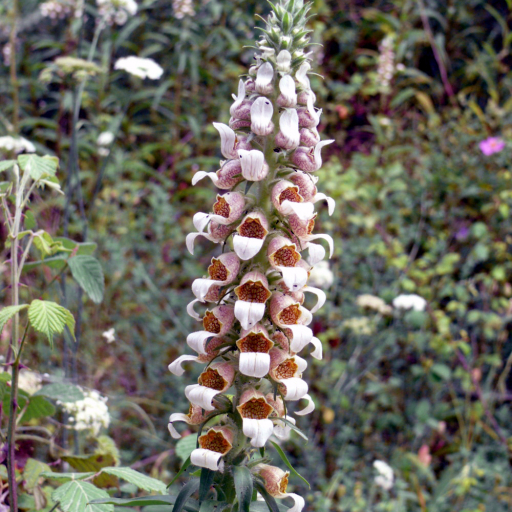
Often called the Grecian Foxglove or Woolly Foxglove, this species is the sophisticated, architectural cousin of the common garden foxglove. Originating from Eastern Europe and Turkey, it is prized by plant enthusiasts for its "steampunk" aesthetic—featuring intricate, veined flowers that look like they were crafted from antique parchment and lace.
🔍 How to Identify
- 🌸 The Bloom: It produces tall, slender spikes of bell-shaped flowers that are a creamy-white or pale tan, uniquely decorated with a complex "honey-guide" pattern of brownish-violet veins inside.
- 🐑 The "Wool": True to its name (lanata means woolly), the flower buds, stems, and calyxes are covered in a dense, silver-white fuzz that gives the plant a frosted, cobweb-like appearance.
- 🍃 The Foliage: In its first year, it forms a tidy, low-growing rosette of elongated, lance-shaped green leaves. In its second year, it sends up its famous flowering spikes which can reach up to 3 feet tall.
🏡 In Your Garden
- 🌱 The "Dry" Foxglove: While most foxgloves crave moist woodland shade, the Grecian variety is surprisingly drought-tolerant once established. It thrives in well-draining soil and can handle more sun than its purple relatives.
- 🐝 Bumblebee Buffet: The lower lip of the flower acts as a perfect landing pad for bees. You will often see bumblebees disappearing entirely into the bells to reach the nectar hidden at the back.
- ✂️ Self-Seeding Habit: It is a biennial or short-lived perennial. If you don't deadhead the spent spikes, it will happily scatter seeds to ensure a new generation appears the following year.
⚠️ Safety & Toxicity
- 🚫 Deadly Poisonous: ALL parts of this plant are extremely toxic if ingested. It contains powerful cardiac glycosides that can cause heart palpitations, nausea, and even cardiac arrest.
- 🧤 Handle with Care: Always wear gloves when pruning or handling this plant, as the toxins can sometimes be absorbed through broken skin or cause irritation.
- 🐾 Risk Level: Keep this plant strictly away from areas where curious pets or small children play. Even the water in a vase containing these cut flowers becomes toxic.
✨ Fun Fact
- While many foxgloves are medicinal, Digitalis lanata is the primary commercial source for Digoxin, a vital medication used in modern medicine to treat heart failure and irregular heartbeats. It is literally a life-saver and a life-taker!

Detailed Care Instructions
Growing Digitalis lanata (also known as Grecian foxglove or woolly foxglove) requires some specific care and attention. Here are the steps to grow this plant:
- Choose a suitable planting location: Digitalis lanata prefers well-drained soil that is slightly acidic. Select a location that receives partial shade to full sun.
- Prepare the soil: Loosen the soil in the planting area by removing any weeds, rocks, or debris. You can also improve the soil by adding organic matter like compost or peat moss.
- Plant the seeds: Sow the Digitalis lanata seeds directly into the prepared soil in early spring or early fall. Sprinkle the seeds lightly on the soil surface and cover them with a thin layer of soil, about 1/8 inch deep. Space the seeds at least 10 inches apart.
- Watering: Keep the soil consistently moist but not overly saturated. Water the plant regularly, especially during dry periods. Be careful not to let the soil dry out completely.
- Mulching: Apply a layer of organic mulch, such as straw or wood chips, around the base of the plants to help retain moisture and suppress weed growth.
- Fertilizer: Digitalis lanata generally does not require much fertilization. However, you can apply a balanced, slow-release fertilizer once or twice a year, following the package instructions.
- Support the plants: As the Digitalis lanata grows taller, it might need support to prevent the stems from bending or breaking. You can use stakes or a plant support cage to provide support.
- Pruning: Remove any dead or yellowing leaves from the plant to maintain its appearance and overall health. You can also prune the plant after flowering to encourage new growth.
- Pests and diseases: Keep an eye out for common pests like aphids or slugs, and treat them accordingly. Also, provide good airflow around the plant to prevent diseases such as powdery mildew.
- Harvesting seeds: Digitalis lanata usually produces seeds in its second year of growth. Allow the flowers to dry on the plant and then collect the seeds by gently shaking the seed capsules. Store the seeds in a cool, dry place for future planting.
Remember, Digitalis lanata contains chemicals that can be toxic if ingested, so keep it out of reach of children and pets.

Place in a window with dappled sun or a spot in the middle of a room. Or directly in a window facing west or east.

Digitalis Lanata plant should be watered regularly, ensuring that the soil is consistently moist but not waterlogged. It is important to water at the base of the plant to avoid getting the leaves wet, which can lead to mold or mildew. Check the soil moisture level by sticking your finger about an inch into the soil - if it feels dry, it's time to water. During hot or dry periods, you may need to water more frequently. It is recommended to use room temperature water to avoid shocking the plant's roots. Avoid overwatering, as this can lead to root rot. Additionally, consider using a well-draining potting mix to help prevent waterlogging.
To fertilize this plant, first ensure that the soil is moist and well-draining. Choose a balanced fertilizer with equal parts nitrogen, phosphorus, and potassium. Apply the fertilizer once every two weeks during the growing season, which is typically spring and summer. Mix the fertilizer according to the package instructions and apply it around the base of the plant. Be careful not to get any of the fertilizer on the leaves or flowers, as this can cause burning. Water the plant thoroughly after applying the fertilizer to help it absorb nutrients and to prevent fertilizer burn.
The optimal soil for the Digitalis Lanata plant is a mixture of organic and mineral-rich soil. It should be well-draining to prevent the roots from rotting and to allow air to circulate around the roots. The soil pH should be slightly acidic, around 6.0-7.0, which can be achieved by adding peat moss or sulfur. The texture of the soil should also be loose and friable to facilitate root growth and nutrient uptake. Using compost or manure can also help improve the soil structure and provide essential nutrients for the plant's growth and development.
Digitalis Lanata is a popular biennial plant that belongs to the Plantaginaceae family. This plant can be propagated through several methods such as seed propagation, division, and root cuttings.
Seed propagation is the easiest method of propagating Digitalis Lanata. The seeds should be sown in a well-draining soil mix during the spring season. The soil should be kept moist and warm, around 65 to 70 degrees Fahrenheit. The seeds will germinate within two to three weeks and will develop into seedlings.
Division is another method of propagating Digitalis Lanata. It involves separating the clumps of plants into small sections with healthy roots. This method is usually done during the early spring when the plants are still dormant. The individual sections can then be transplanted to a new location, and they will grow into mature plants.
Root cuttings can also be used to propagate Digitalis Lanata. This method requires you to cut a small section of the plant's root and plant it in a well-draining soil mix. Ensure that the cutting is taken from a healthy plant and that the soil is kept moist. The cutting will develop into a new plant in a few weeks.
Overall, Digitalis Lanata can be propagated through seed propagation, division, or root cuttings. It's a straightforward process that requires little effort, and you'll be able to grow new plants to add to your collection.








