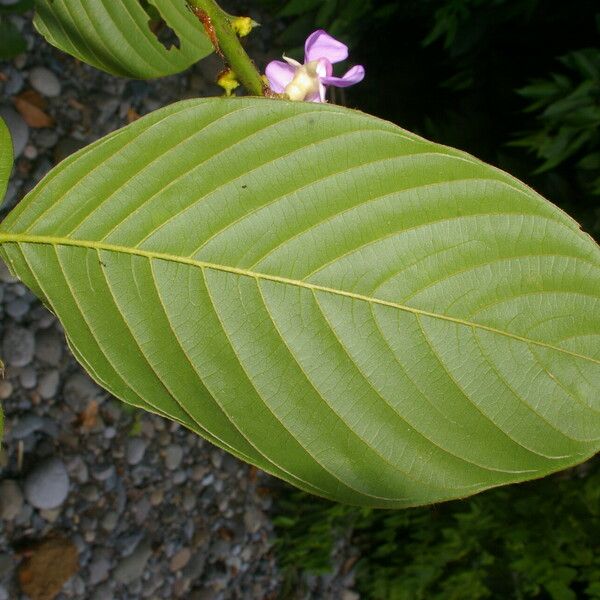
Plant Overview
Often called the Marble Vine or Sea Bean, Dioclea reflexa is a true botanical adventurer. This vigorous woody climber is famous not just for its lush tropical foliage, but for its incredibly tough seeds that can travel thousands of miles across oceans, earning it a reputation as a world-traveling "drift seed." In many cultures, these polished, marble-like seeds are tucked into pockets as good luck charms or "sea purses."
🔍 How to Identify
- 🌿 The Foliage: It features large, trifoliate leaves (sets of three) that are glossy and vibrant green, typical of tropical lianas that aim to soak up every bit of available sunlight.
- 💜 The Flowers: It produces striking, pea-like flowers that grow in upright, velvety clusters. They are usually a deep violet or reddish-purple, standing out sharply against the green canopy.
- 🫘 The Seed Pods: The pods are thick, woody, and slightly furry. Inside, you’ll find the prize: hard, rounded, brown seeds with a distinct dark band (the hilum) that covers nearly half their circumference.
🏡 In Your Garden
- 🧗 The Climbing Habit: As a woody vine (liana), it requires a very sturdy support system. It is not a plant for a small trellis; in the wild, it effortlessly scales tall forest trees to reach the sun.
- 💧 Tropical Requirements: It thrives in high humidity and constant warmth. While it loves moist soil near riverbanks, it is surprisingly resilient to salt spray, which is why it is so successful in coastal regions.
⚠️ Safety & Toxicity
- 🚫 Status: Generally considered Toxic if ingested without professional processing.
- 🐾 Details: The seeds contain bioactive compounds (including L-Dopa and certain alkaloids) that can cause severe digestive upset or neurological symptoms if eaten by pets or curious children. While used in traditional medicine in specific regions, it should never be consumed as a hobbyist plant.
✨ Fun Fact
The seeds of Dioclea reflexa are so buoyant and durable that they can float in saltwater for several years without losing their ability to grow. A seed dropped in a river in Africa could theoretically wash up on a beach in South America and still sprout into a healthy vine!

Detailed Care Instructions
To grow Dioclea reflexa, also known as butterfly pea vine or pigeon pea vine, you can follow these steps:
- Obtain seeds: Purchase seeds from a reputable supplier or collect seeds from ripe pods of existing plants.
- Prepare seeds: Soak the seeds in warm water for 24 hours to help with germination. The seeds will swell during this process.
- Choose a location: Select a location that receives full sun or partial shade. The soil should be well-drained and fertile.
- Prepare the soil: Remove any weeds or debris from the planting area. Loosen the soil with a garden fork or tiller and mix in compost or well-rotted manure to improve its fertility.
- Sow the seeds: Plant the seeds about an inch deep in the soil. Space the seeds about 8-12 inches apart to give the plants enough room to grow.
- Watering: Water the seeds thoroughly after planting and keep the soil consistently moist throughout the germination process. Once the plants are established, water them regularly, allowing the top inch of soil to dry between waterings.
- Provide support: Dioclea reflexa is a climbing vine, so it will require some kind of support structure like a trellis, fence, or pergola. Install the support structure nearby or at the time of planting.
- Fertilize: Regularly fertilize the plants during the growing season with a balanced fertilizer or organic compost to promote healthy growth and flower production.
- Pruning: As the plant grows, prune any dead or damaged branches to maintain its shape and encourage new growth.
- Watch out for pests and diseases: Keep an eye out for common garden pests like aphids or caterpillars. If necessary, use organic insecticides or handpick the pests. Also, ensure good air circulation to prevent fungal diseases.
- Harvesting: Dioclea reflexa produces attractive purple flowers. Harvest the flowers when they are fully open for decorative purposes or for making tea. You can also collect the seeds for future plantings.
Remember that Dioclea reflexa is a tropical and subtropical plant, so it thrives in warm and humid climates. If you live in a region with cold winters, it may be necessary to grow it as an annual or in containers that can be brought indoors during winter.
To properly water the Dioclea Reflexa plant, there are a few important factors to consider:
- Soil moisture: Dioclea Reflexa prefers evenly moist soil that is neither too soggy nor too dry. It is crucial to maintain a consistent level of soil moisture to ensure the plant's health.
- Watering frequency: The frequency of watering will largely depend on various factors such as the pot size, weather conditions, and humidity levels. As a general guideline, it is recommended to water the plant whenever the top inch of the soil feels dry to the touch. However, it is important not to overwater the plant as it can lead to root rot.
- Watering method: To water the Dioclea Reflexa plant, it is recommended to use a watering can or a gentle stream from a hose to avoid overwatering or causing damage to the leaves. Ensure that water reaches all parts of the pot evenly and allows excess water to drain out.
- Adequate drainage: Providing good drainage is essential for the well-being of the plant. Using a well-draining potting mix and ensuring there are drainage holes at the bottom of the pot will help prevent water from pooling and causing root-related issues.
- Environmental conditions: Consider the surrounding environmental conditions to adjust your watering routine accordingly. During hot and dry periods, the plant may need more frequent watering, while during cooler months or if the humidity is high, you may need to reduce the frequency.
Remember, these guidelines are general recommendations, and it is always best to observe the plant's specific needs and adjust watering accordingly. Regularly monitoring the soil moisture and the overall health of the Dioclea Reflexa plant will help you maintain optimal watering practices.
To fertilize Dioclea Reflexa successfully, follow these instructions:
- Begin fertilizing the plant when it is actively growing, typically during the spring and summer seasons.
- Choose a well-balanced, water-soluble fertilizer that is suitable for flowering plants. Ensure that the fertilizer contains essential nutrients such as nitrogen, phosphorus, and potassium.
- Dilute the fertilizer according to the package instructions, typically using 1/4 to 1/2 strength. It is better to use a weaker solution to prevent over-fertilization, which can harm the plant.
- Water the plant thoroughly before applying the fertilizer. This helps prevent burning the plant's roots.
- Apply the diluted fertilizer around the base of the plant, focusing on the soil area. Avoid pouring it directly onto the leaves or stems.
- Follow a regular fertilizing schedule, typically once every two to four weeks during the growing season.
- Monitor the plant's response to the fertilizer. If you notice any signs of over-fertilization, such as leaf burn or wilting, reduce the frequency or strength of the fertilizer.
- During the dormant season (usually winter), decrease or suspend fertilization, as the plant's growth slows down.
- Always read and follow the specific instructions provided by the fertilizer manufacturer for best results.
- Remember to also provide appropriate watering, sunlight, and care to ensure overall plant health and vigor.
Note: It is advisable to refer to the plant's specific care requirements and consult local gardening resources for further guidance.
When cultivating Dioclea reflexa plants, it is crucial to select the appropriate soil type to ensure optimal growth and vitality. The ideal soil composition for Dioclea reflexa consists of well-draining soil that retains some moisture while allowing excess water to pass through easily. The soil should have a slightly acidic to neutral pH range, generally around 6.0 to 7.0.
Dioclea reflexa plants thrive in rich, loamy soils that are fertile and nutrient-rich. Such soils provide a sufficient supply of essential minerals and organic matter to support healthy growth. Additionally, incorporating compost or organic matter into the soil before planting can help improve its overall structure and nutrient content.
Moreover, it is recommended to avoid heavy clay soils, as these tend to retain excessive moisture and impede proper drainage, leading to the risk of root rot. Sandy soils can also be unsuitable for Dioclea reflexa, as they drain too quickly, causing the plant to become dehydrated more easily.
To summarize, the ideal soil for cultivating Dioclea reflexa should be well-draining, slightly acidic to neutral in pH, and enriched with organic matter. By providing such a soil environment, you can support the healthy growth and development of your Dioclea reflexa plant.
Propagation of Dioclea Reflexa can be done through both seeds and cuttings. Here is a step-by-step guide on how to propagate this plant:
- Seeds:
- Collect ripe seeds from the plant. These seeds are usually enclosed in a pod or a fruit.
- Remove the seeds from the pod and separate them.
- Fill a container or seed tray with a well-draining potting mix.
- Moisten the soil slightly to prepare it for seed sowing.
- Place the seeds on the soil surface, spacing them out evenly.
- Gently press the seeds into the soil to ensure good contact.
- Cover the seeds lightly with a thin layer of soil or vermiculite.
- Place the container or tray in a warm and bright location, avoiding direct sunlight.
- Keep the soil consistently moist but not waterlogged.
- Germination typically occurs within a few weeks. Once the seedlings develop a few sets of leaves, they can be transplanted into larger pots.
- Collect ripe seeds from the plant. These seeds are usually enclosed in a pod or a fruit.
- Cuttings:
- Select a healthy and mature stem from the plant.
- Using a sharp, sterile knife or pruning shears, take a cutting that is approximately 6-8 inches long.
- Remove any leaves from the bottom half of the cutting.
- Dip the cut end of the stem into a rooting hormone powder (optional) to encourage root development.
- Fill a small pot with a well-draining potting mix.
- Create a planting hole in the soil using a pencil or your finger.
- Insert the cutting into the hole, making sure at least a couple of nodes are buried.
- Press the soil gently around the cutting to secure it in place.
- Water the cutting thoroughly, allowing excess water to drain from the bottom.
- Place the pot in a warm and bright location, but avoid direct sunlight.
- Maintain a consistently moist soil but be cautious not to overwater, as it can lead to root rot.
- After several weeks, the cutting should start to root. You can gently tug on it to check for resistance, indicating root development.
- Once the roots have established, the cutting can be transplanted into a larger pot or directly into the ground.
Remember to provide the newly propagated Dioclea Reflexa plants with appropriate care, including regular watering, sufficient sunlight, and necessary fertilization to ensure healthy growth.
- Select a healthy and mature stem from the plant.








